People, ideas, machines X: Freedom's Forge - the story of American business and industrial production in World War II
Lessons that are in the minds of those doing the DOGE/White House regime change, lessons relevant to UK productivity & security crises
What is America but beauty queens, millionaires, stupid records and Hollywood?
Hitler, 14 June 1941
My business is making things.
William Knudson, 28 May 1940
You find your key men by piling work on them. They say ‘I can’t do any more’ and you say ‘Sure you can’. So you pile it on and they’re doing more and more. Pretty soon you have men you can rely on absolutely.
Henry Kaiser
You can’t work as hard as I am getting production and pay any attention to personal relations. Henry Kaiser, 22 June 1943
Politics is the womb in which war develops… War is not a mere act of policy but a true political instrument, a continuation of political activity by other means.
Clausewitz
In no profession is the dread of innovation so great as in the army.
Colonel John Mitchell, British Army, 1839
Success depends on foreknowledge. Foreknowledge cannot be elicited from spirits, nor from gods, nor by analogy with past events, nor from calculations. It must be obtained from men who know the enemy situation… [Only commanders] able to use the most intelligent people as agents are certain to achieve great things. Secret operations are essential in war.
Sun Tzu
None of the most important devices that have transformed war — from the airplane through the tank, the jet engine, radar, the helicopter, the atom bomb, all the way to the electronic computer — owed its origin to a doctrinal requirement laid down by people in uniform.
Martin van Creveld
FINAL UPDATE, 25/3: CH15 — Kaiser gets into carriers, the story of the B29 … to the Conclusion. Hope you enjoyed it!
UPDATE, 17/3: CH13 — Ford’s B24 factory at Willow Run, field modification as Knudsen’s solution for how to update designs without scuppering mass production. B24 closes the ‘Atlantic Gap’, spring 1943.
[UPDATE, 11/3: CH10-12 — putting ship manufacturing onto an assembly-line and cutting production time from half a year to FIVE days; 1942 momentum kicks in from the 1940-1 changes, production surges; landing craft; women surging to skilled work; Kaiser reinvents steel production in California; auto industry shifts to full war production, including Sherman tanks; Ford gets into the B-24…]
In early March 2025, SW1 is going through its standard cycle: an emotional spasm in which it herds to new delusions, it polices them with denunciation of dissidents, then the delusions crash into reality and everyone memory-holes what they said. This cycle will turn out like all the others since the regime tipped into slow collapse in 2016. The NPCs will quickly forget the things they predicted as they were carried away by their war fever. But 2025 is the year SW1 delusions in many areas can no longer be maintained. ‘Reality cannot be fooled.’
If interested in how serious people go about war, read this blog instead of the regime media.
This blog is notes on Freedom’s Forge by Herman.
It tells the story of how American industry organised for World War II. And some of the extraordinary characters such as Henry Kaiser, now largely unknown but an extraordinarily able builder of anything, the Elon of the 1920s-30s who then answered FDR’s call to help the country beat the Nazis.
It’s very topical as a subset of Silicon Valley and the entrepreneurial elite are now trying to change DC radically and one of the core goals is to apply lessons from the golden age of American manufacturing and industrial capacity at speed and scale, in civilian and military spheres. Part of the project is a cross between a) the lessons from this period and b) lessons from the Valley, and Andreessen’s BUILD BUILD BUILD, for modern technology and advanced manufacturing. This book is one of those read by many involved in the White House/DOGE project. Another is Now It Can Be Told which I said in 2019 would be relevant in the next pandemic: it was but SW1 fought, almost entirely successfully, to prevent any learning from it.
This is also highly relevant in Britain where productivity, growth and real wages all slumped from 2008.
Tory MPs 2010-24 lost all interest in productivity, growth and state capacity while presiding over a state making almost everything worse.
It’s hard to exaggerate the contrast between a) smart entrepreneurial people outside SW1 who have assumed these things are of intense focus inside SW1 but b) inside SW1 attention has been almost entirely elsewhere and they were just not interested in anything other than the odd tweak. Tories and Labour, Brexit and Remain — all focused attention on a tiny number of issues and tiny amounts of money. Their election campaigns yapped about sums of money that were a rounding error of a decimal point on forecasts that are always out by more than that.
The MPs operated inside a consensus of policy/think tanky types that ‘you can only make tiny changes’, ‘the economy is so big almost nothing has an effect’, ‘the public don’t want dynamism so it’s politically impossible to be radical in the sense Cummings et al want’, ‘Brexit was stupid because those voting for it don’t want dynamism and a more US/Singapore style government’. SW1’s assumptions about what is ‘good politics’ and ‘what can be communicated’ are always empirically false but a) they are ‘a real existing factor’ in the psychology of MPs who want an excuse to ignore hard things so they can happily just scroll from one news cycle to another and b) they totally align with Whitehall’s desire, and HMT’s desire in particular, for ‘no change’. SW1’s cross-party assumptions on the politics of dynamism are absolute nonsense and almost totally believed across factional lines. It’s crucial to understand that across parties, SW1 types hate the thought of dynamism: it is their enemy. They want to believe it’s unpopular so they’ll latch on to memes and pollster snake oil ‘proving’ it.
We made this a huge focus 2019-20 and started changing most important aspects of policy. As I’ve written before even I was somewhat shocked how little the Tories cared about these things in summer 2020 even after a pandemic and practically unprecedented economic shock. When Boris stopped almost everything, the MPs were happy in 2021. They just wanted ‘to go back to normal’, i.e the Simulacrum of politics they all grew up with in the 1990s. See previous blogs for details.
But debate is changing in some ways. Tories remain uninterested in these issues. Kemi spends more time playing games on her iPad than thinking about how and why Tories failed so badly on all this. But Labour is now in government and can no longer just parrot ‘once dumb evil Tories are removed the Whitehall Rolls Royce machine will go back to normal and solve everything’. They’re now presiding over Whitehall’s vandalism and some of them are rationally panicking. (See Chris Curtis and other mostly younger Labour MPs who realise backing the status quo is a loser.) And Reform is trying to work out how to replace the Tories. So outside dead Tory world elements are grappling with how to escape the doom loop of stagnation. After Kemi is replaced, there’s some chance her replacement finally realises the Tory Party is dead unless it re-engages with core issues of productivity and state capacity. And the LFG growth campaign is growing and recruiting in the entrepreneurial world. (If you want to help the forces of dynamism, get involved with the LFG campaign, Discord here.)
These issues are also important in the context of SW1’s latest hysteria over Ukraine as Trump has pulled the plug on the doomed cross-party policy of three years.
What were the biggest disasters on Ukraine?
The entire SW1 ecosystem — left/right, leave/remain, Tory/Labour, MP/official/media — told you: Slava Ukraine, as long as it takes, whatever it takes, Putin will fail, sanctions are crippling Russia, China will abandon Russia, the world will unite for democracy, the counteroffensive is a triumph, Russia can’t sustain her losses and is on the brink of collapse etc.
America is facing the reality that the propaganda is fake and China is the big winner, as I said would happen in Q1 2022. As America recalibrates, SW1 and Europe are going crackers because three years of fairy tales are colliding with reality. Roughly 99% of SW1 was disastrously, historically epically wrong. They’ve humiliated themselves and our country globally, helped wreck a country and kill a million people, and given China a historic bonanza of money and intelligence and leverage.
An SW1 regime that cannot cope with Somali machete-wielding teens, with Albanian drug gangs, with Pakistani rape gangs, with Islamic extremists running ‘gas the Jews’ marches every week in London — a regime with cross party and NPC consensus that stopping the dumb dinghies over the Channel is ‘literally impossible’ (Sam Freedman) and it’s ‘fascist’ to try — is dreaming of phantom forces controlling East Ukraine’s borders.
Slava Ukraine is a perfect way for our Idiocracy, its intelligentsia and the regime media, to vent nationalist emotions without having to be patriotic for Britain. It’s ‘impossible’ to control our borders but we must fight over Ukraine’s borders. We must coverup the rape gangs ‘for community cohesion’ and to continue mass immigration but we will rally on TV to fight ‘the new Hitler’ thousands of miles away with forces that do not exist.
What was the context for SW1’s disaster?
I’ll contrast my view with the SW1 consensus from 2000-2016.
NB. I lived in Russia 1994-6 and met people like Putin — middle ranking KGB guys who got involved in organised crime. Like anyone who lived in Moscow in the insane 1990s, I left with a very different perspective to the SW1 conventional wisdom.
My position 2000-2016 was:
A/ The pro-EU Blairites babbling ‘Putin is a reformer’ and ‘Russia could join the EU’ are deluded. Russia is not European — read Dostoyevsky and Tolstoy! The Putin government is a mafia-KGB government that may well have blown up tower blocks to justify invading Chechnya. Its structure and ideology is misunderstood in SW1 discussions.
(I was seen as an extremist, ‘anti-Russian’, and the tower block idea back then was seen as a ‘crazy conspiracy theory’ by the same crew who cheered escalation in 2022. NB. I was never anti-Russian, only anti the regime.)
B/ We should stop the flow of mafia money corrupting the City, the bar and SW1. When I lived in Moscow in the 1990s, London was known as ‘the laundry’. This was an accurate nickname.
(Deeply unpopular. SW1 wanted the cash to flow until 2022. In 2021, a few months before the invasion, I publicly attacked the Tories for still taking cash from dodgy Russians and was attacked by Tories for my attack.)
C/ We should be much tougher about mafia /KGB operations, we should smack Putin back with operations to show he can’t behave like this. People were shot on London streets. Some had their heads chopped off (a Chechen speciality).
(Nobody interested.)
D/ We must transform the MoD and defence procurement because fake budgets and disastrous procurement are destroying our forces.
(Strong anti-interest. Nobody interested in procurement. Nobody wanted the fake budgets to end.)
E/ The combination of the above policies with ‘Ukraine should join NATO’ is very dumb. It mixes great weakness with provocation on exactly the wrong thing.
(Nobody cared. No serious discussion.)
In 2016, Jake Sullivan and others manufactured the Russiagate hoax over Brexit and Trump. Suddenly all over SW1 people who had seen me as an extremist now described me as pro-Putin. The Russiagate hoax was thoroughly entangled in the ‘disinformation’ racket. I’ve written a lot about this and won’t repeat it. But it converted much of SW1 to thinking of Putin as ‘evil’ and because Russians are white they were convenient baddies in the period when the Far Left was rampaging. Putin = Hitler = Trump + Brexit. (Notice how Congo and Sudan slaughter isn’t news in the regime media because the baddies are black. Russians and Jews are good baddies because they are white.)
This was the SW1 context for February 2022.
What were the core mistakes that contributed to SW1’s delusional fantasies?
First, delusions over goals, tradeoffs, the asymmetry of interests and nuclear deterrence. The most important thing in a war is definition of political goals and priorities. Cf. blog on Colin Gray and defence planning.
While it is vital to make sound decisions about how to fight, it is of much greater moment to decide whether or not to fight, and with whom…
E.g1 Britain’s blunder of confusing ourselves over the 19th Century Belgium guarantee, confusing Germany into thinking we would not fight for Belgium then suddenly fighting for it after Germany was committed. (If you compare 1870 and 1914 you see how little the post-Northcote-Trevelyan Foreign Office learned from Bismarck turning them over.) This disastrous ‘strategic ambiguity’ got us into a war for which we were disastrously unprepared and a century of wealth built up 1815-1914 was squandered in consequence. ‘Strategic ambiguity’ would be a very very bad approach to Taiwan. I hope Trump does a deal whereby Taiwan is peacefully reunified for the CCP centenary in 2049 and the West focuses on its own industrial production to replace the comic Taiwan bottlenecks — a deal in the spirit of Lee Kuan Yew who consistently advised the West to forget fantasies on Taiwan and accept reunification. Red lines in Asia should be elsewhere, not through a country of Chinese people visible from China.
E.g2 Hitler’s political errors over Russia and America outweighed by far the German army’s advantages at the planning and operational level: political misjudgement outweighed forces’ competence by far.
As I’ve said from Q1 2022, nowhere in the West could anybody write down a clear definition of realistic priorities in Ukraine given political assumptions in Russia and America. The supposed ‘expert’ community — academics like Professor Lawrence Freedman, O’brien, Snyder et al — chose to be emotional cheerleaders and poisoned their own thinking from the start: ‘Putin has already lost… Putin won’t admit he’s lost… 50-50 Russia collapses in weeks’ Freedman kept telling us 2022-3. I said at the time this was delusional and Putin would keep increasing effort because of how important it is to him and his regime. This expert community has never recovered from its emotional commitment in Q1 2022. It’s been even worse than public health on covid. And the failure is politics — they can write interesting things about military operations, drones and tanks etc, but they cannot write anything realistic about the politics and the politics is always more fundamental and is our regime’s spectacular failure.
Ukraine is existential for Russia. It is trivial for America and Britain. If all Ukraine vanished in a sink hole it would have almost no effect on us. In the early 1990s the expert community’s consensus was it would be totally stupid to start discussing Ukraine joining NATO. If you think my views on NATO and Ukraine are odd given the near-universal agreement among NATO regimes now, consider that in the 1990s there was strong disagreement with the first wave of NATO enlargement, never mind talk of Ukraine:
Some principles of strategy are so basic that when stated they sound like platitudes: treat former enemies magnanimously; do not take on unnecessary new ones; keep the big picture in view; balance ends and means; avoid emotion and isolation in making decisions; be willing to acknowledge error. All fairly straightforward, one might think. Who could object to them?
And yet – consider the Clinton administration’s single most important foreign-policy initiative: the decision to expand NATO to include Poland,Hungary and the Czech Republic. NATO enlargement, I believe, manages to violate every one of the strategic principles just mentioned.
Perhaps that is why historians – normally so contentious – are in uncharacteristic agreement: with remarkably few exceptions, they see NATO enlargement as ill-conceived, ill-timed, and above all ill-suited to the realities of the post-Cold War world. Indeed I can recall no other moment in my own experience as a practising historian at which there was less support, within the community of historians, for an announced policy position. (John Lewis Gaddis, History, Grand Strategy and NATO Enlargement, 1998.)
Also look at the massive lists of people like George Kennan, Paul Nitze, Richard Pipes, Kissinger, former heads of CIA and NSA et al — famous Cold Warriors who fought and won the Cold War — who explicitly said in the 1990s that even floating the idea of NATO expanding to Ukraine was extremely stupid. Then in 2007-8, the neocons who gave us Iraq, such as Victoria Nuland, got Bush to start pushing the idea. The moronic idea became official policy. And Putin warned — if you carry on like this the result will not be Ukraine in NATO but Ukraine wrecked. (Even Biden talked openly in the 1990s about how enlargement would provoke a hostile response but of course he was such a dope he laughed about it.)
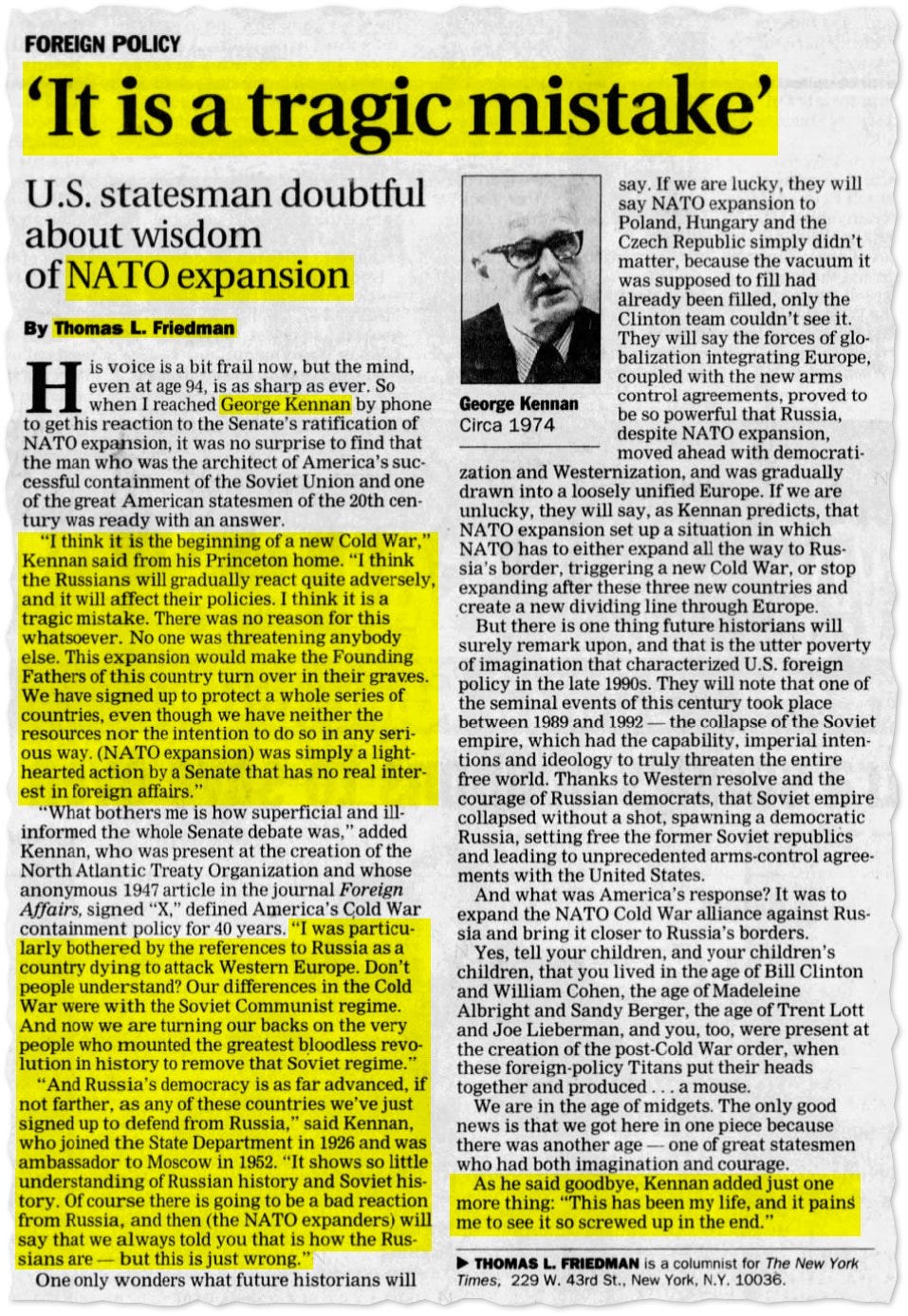
We (‘the West’) could never articulate realistic goals given a) it’s existential for Russia but not us and b) Russia is one of the two big nuclear powers. Will you really escalate this to a nuclear crisis and risk nuclear war? If no, then you’re snookered. If yes, then you’re mad and dangerous.
Professors Snyder and O’brien, warmongering pundits like Edward Lucas et al, have repeatedly condemned what they call ‘the western habit of self-imposed restraint’ because of nuclear weapons. They argue:
1/ WE should announce that WE will NOT be deterred by Russian nuclear threats.
2/ But Russia WILL be deterred by OUR threats (nuclear and non-nuclear) and actions (including attacks on Russian territory) and RUSSIA must ‘show self-restraint’ — because we say so!
3/ This is ‘rational’ and if Putin doesn’t follow our logic he is ‘irrational’!!
4/ Putin was ‘mad’ to invade Ukraine!!!
This logic is a demand that deterrence only works in one direction because it’s convenient for us this way. It is the logic of the toddler applied to nuclear deterrence.
The asymmetry of interests and consequent credibility over nuclear threats is an insoluble problem. All you can do is assess the balance of risk (global nuclear war) and reward (the West can put missiles etc in Ukraine) and make a judgement. The West’s Idiocracy can’t cope with problems like this so they just pretended they could ignore it.
As Professor Kotkin, biographer of Stalin, said (Nov 2023):
We had no public conversation about the definition of victory in Ukraine except for ceding to the Ukrainians their definition which was [summary]… Those were attainable if you took Moscow. If you don’t take Moscow you need another definition of what victory might be.
Instead of discussing realistic goals, we broadcast to the world our true Idiocracy nature. We kept saying that ‘Ukraine decides what’s victory’!! No serious Power ever hands over to a small peripheral corrupt colony the definition of goals/victory in a conflict with a peer Power, yet that is exactly what Washington, SW1 and the EU did with Ukraine.
NB. While it is true that Russia opposed Ukraine joining NATO, there is a deeper force at work. The Russian elite sees at least a chunk of Ukraine as Russian. This is true regardless of NATO. Even if NATO expansion had never happened, it would be true. They see it as Russian and they see it as an existential threat to Russia to have it occupied by America/NATO and used to base missiles etc. So it is true both that a) the NATO policy was stupid but b) the core issue is US military expansion into Ukraine, whether it’s called NATO expansion or not.
It is not in British interests, nor humanity’s, to increase the number of ways in which nuclear tripwires could spin out of control, which NATO expansion inevitably does. A core goal should be decreasing the number of ways these tripwires could spin out of control.
(NB. Stoltenberg on TV in September 2023 actually admitted that — totally contrary to the official story up until then — in 2021 Putin offered a deal of ‘no NATO enlargement [to Ukraine] … as a precondition for not invading’. This got absolutely zero regime media coverage. Cf. Stoltenberg, 9/23, on NATO website.)
Second, delusions over China. At the start there was widespread briefing that ‘China will support democracy’. I said this was delusional and China had a great opportunity to a) get paid vast amounts to blow our stuff up for free, b) weaken the West, and c) put Special Forces embeds in to watch how western systems work.
This is what happened. China is the big winner. It’s made a load of money, weakened the West and got great intelligence.
Third, delusions over sanctions. The West was deluded over the effect of sanctions generally. Sanctions do not stop countries pursuing existential interests. They just dig deeper. And you cannot isolate Russia when the world’s biggest manufacturer has a big interest in supplying it. The EU couldn’t even enforce their own crummy ideas on sanctions inside the EU, never mind elsewhere (see all the ships sold by Greece to the Russian fleet).
And we were delusional over India and non-China Asia, South America etc. We thought and briefed they’d ‘rally to support democracy’. Wrong. They see us as the vandals. They have helped Russia avoid sanctions. We’ve paid much more for energy and even bought oil from Russia via Indian middlemen at inflated prices, so it costs us more and Putin makes more. Super-stupid.
Sanctions and our economic warfare has had big blowback effects on Europe’s economies and politics without scuppering Russia’s war effort. America has also gained from LNG market effects, Ukraine blowing up Germany’s pipeline etc.
(The No10 story even switched half way through from the Trolley proudly saying ‘WE cut off Putin’s gas’ (2022) to Sunak saying ‘PUTIN cut off the gas supplies and it had a devastating impact’ on our gas prices (2024). As usual on Ukraine, the regime media did not expose the narrative whiplash, it just pivoted to the new Official Line.)
Fourth, delusions over atrocity propaganda.
Evil Putin blew up the pipeline! Then the CIA briefed the NYT that … err, it was Ukraine.
There was a constant string of stories claiming ‘Russia blew up a market today’ followed 1-3 weeks later by a quiet briefing from the CIA that … err, it was a UKR defensive missile that fell with bad luck. Zelensky kept claiming ‘a Russian missile landed in Poland’ or ‘Russia attacked the nuclear facility’ when the missile was Ukrainian and the attacks on the nuclear facilities were Ukrainian — intended by Zelensky to entangle idiot westerners in his conflict.
The UK regime media peddled UKR propaganda much more faithfully than they ever support any British policy — our media won’t even support our Special Forces who risk themselves to whack terrorists. The regime media was so extraordinary — and in my experience unprecedented in 25 years — that even after Putin gave speeches explicitly stating that because of UK actions we had opened ourselves up to the following counter-actions, our regime media literally en masse blanked the story. Zero coverage in any regime media. Not only normal voters but in my experience MPs themselves often had no idea when I told them ‘oh did you see what Putin said yesterday about reprisals against Britain?’ ‘Err no must have missed it.’
The war did not start in February 2022. It started in 2014. Look back at how the regime media covered Ukraine shelling the Donbas then and you’ll be shocked — sometimes the Ukrainians are baddies! https://x.com/Glenn_Diesen/status/1892410776905797983. You now see nothing in regime media about the murders and terrorism of Ukraine in this period, you only hear about Russian violence.
The unprecedented lies from No10 have poisoned trust for a very long time to come. Cf. when a leak happened from a US citizen on a gaming forum, the MoD reported it as ‘Russian disinformation’ — a flat out lie. The Times reported it as fact and after the truth came out never corrected it. This sort of thing has happened hundreds of times. Our media is even more unreliable on Ukraine than on domestic politics.
Nazis. Before 2022 it was widely acknowledged that Ukraine had a serious problem with real Nazis. Real Nazis are not Trump or Farage. They are Ukraine militias who wear actual Nazi badges like the infamous deaths-head and openly say ‘we’re Nazis, we support what Hitler did against Russia, we will use Nazi methods against the Russians’. Congress passed laws to stop funding of these organisations. Regime media did documentaries on them.
After the war started, we funded the Nazis and rebranded them as heroes. Professors who see themselves as ‘anti-fascist’ retweet propaganda from Ukraine accounts with Nazi links. (Obviously individual cases are tricky to be confident about — some don’t know who they are retweeting and don’t check because their standards are bad.)
Sometimes the Nazi branding morphed with ISIS iconography normalised in the regime media — here is the Washington Post printing beheading t-shirts as if it’s all just standard slava ukraine propaganda, nothing unusual.
I don’t have any good sense of how widespread the Nazi problem is in Ukraine now because the main sources of information are our regime media, Ukraine, and Russia all of which lie massively. It would take reliable independent on-the-ground reporting to figure out, which doesn’t exist. But this isn’t my main point.
My point is: our regimes and media rebranded actual Nazis as freedom fighters and systematically suppressed coverage of the fact that Ukraine troops parade around in SS symbols. Once you do this, all bets are off on ‘disinformation’ and what else the regimes are fooling themselves about.
(Yes the Nazi thing is particularly ironic given the regime media has gone all-in on ‘Hitler/fascist’ as a general description of everybody who opposes the old regime.)
Women. As the manpower problem grew, more and more ghouls pushed the meme that Ukrainian power should not be thought of as ‘manpower’ but also ‘womanpower’. One of the very worst examples of this I saw was General McMaster saying that he wanted to see Ukraine’s women conscripted and sent to the front in order to … show China America is serious about TAIWAN!
I was revolted by this and wondered if the warmongers had not gone too far. No! It quickly became an acceptable discussion in the regime media and NPCs waxed lyrical on how it was actually really inspiring to see women fighting on the front line. They would post videos of these heroic encounters which end with women hunted and blown to bits by drones.
These two trends convinced me further that the West was on course for a hideous reckoning.
Fifth, delusions over ourselves. For thirty years the parties and Whitehall have united in hollowing out capabilities:
Hollowed conventional forces. Put hundreds of billions into duff projects (e.g AJAX, aircraft carriers that have to flee at the start of every wargame to the edge of the game and hide). Failed to invest in future technologies, e.g drones. Killed military R&D.
They’ve launched lawfare against Special Forces. Cf. use of ECHR to declare operations soldiers won medals for ‘unlawful’, then prosecutions follow. This is now causing operational problems as SF soldiers ask, very reasonably, am I opening myself up to time-unlimited liabilities and their commanding officers cannot reassure them because it’s impossible in principle to predict what new madness our courts will create with the ECHR. This week they stopped the deportation of a Nigerian drug dealer because he ‘believes he is possessed by the devil’. Such courts are plainly capable of declaring any SF operation ‘unlawful’ whenever they are asked by scum activist-lawyers in years to come.
They’ve let the nuclear enterprise rot as I’ve recounted many times since 2021. It now relies on vast Pentagon subsidies of money, materials and intellectual property. Which also gives DC vast leverage over a British PM. The nukes are already in an over £50B secret black hole. Having to recreate all the infrastructure without US support would be over 100B. The odds of Starmer facing this openly and explaining how taxes will have to rise by vast amounts so we can bounce more Ukraine rubble are close to zero. MPs and regime media do not understand how constrained a UK PM now is and what a disaster one phone call from the Pentagon to the Cabinet Secretary would be.
They’ve undermined the spirit of aggression necessary for effective intelligence agencies. Both parties supported the lawyers in pursuing intelligence officers (another problem I tackled in No10 which the Cabinet Office handled appallingly). The parts of the deep state we rely on being very punchy have been largely neutralised. Many things you would assume are being done are not done because the agencies assume rightly the ministers will not support.
Catastrophically bad procurement. Massively expensive platforms that are not at the technological frontier and are unsuitable for mass production. Severe corruption of our civil service as officials go to the companies they negotiated contracts with, a system defended by the NPC class as ‘necessary to stop corruption’: they defend the old system as ‘necessary to stop corruption’ while it is the corruption. General rot of industrial production and opposition to domestic supply chains even after the covid disasters.
Promotion of mediocrities to critical roles, top people leave — the general Whitehall anti-talent ratchet has applied here too. Brilliant talent leaves to business, the mediocrities with little moral courage get promoted. SNAFU.
As I discovered in 2019, there is no place in Whitehall where thinking about all dimensions of conflict occurs. The hollow laugh in the MoD as to where this should occur was ‘the Cabinet table Dom, Trolley and Wally, hahahahaha’. Hollow laughter.
I’ve said all this repeatedly. SW1 closed their ears. For three years of war, they let the MoD and procurement and fake budgets get worse and worse. All the work we started in 2020 to fix the nightmare was stopped.
The rest of the world can see this. They laugh at the gap between our rhetoric and pretensions, the ‘Munich’ speeches and 1940 cartoon patter and the reality that we can deploy almost nothing for any length of time. But SW1 is now largely a closed system. Its inputs are largely internal and emotionally based programming. Reality is not allowed to intrude on core delusions. Both parties and Whitehall perceive a combined interest in preserving fairy tales and excluding reality.
In 2025 the Ukraine fairy tales will hit the buffers in ways that even SW1 can’t hide from itself. But the MPs will continue to ignore the reality of our forces. There will be no proper hearings. The Defence Select Committee will not call any of us who got to the bottom of the MoD’s list of failed projects and fake budgets in 2020. They will keep it all covered up and keep printing lying-delusional op-eds from Wallace, who contributed enormously to the MoD disaster 2021-5, always arguing to put more money into broken things, resist change, and lie. The new Review will mean further rounds of cross-party consensus on fake budgets and lies and spending on broken projects. Everyone will stay silent on the nuclear fiasco. And the hollowing of conventional forces, lawfare on Special Forces, and rot of nuclear forces will all continue.
I don’t think anything short of financial collapse of our Ponzi scheme or the humiliation of having a carrier sunk etc can penetrate SW1’s reality distortion forcefield. This is the lesson of covid and Ukraine so far. Look at the Idiocracy double down on delusions in the past week. Why would it change? What force is big enough to make it when self-evidently neither the worst pandemic since 1918 and the worst land war since 1945 have not been big enough?
Remember — the true test of wars isn’t how they start — normally with emotional and delusional speeches — but *how they end*. The West has a record of starting wars with faux Churchill rhetoric, failing dismally, and slinking away to change the subject. This will follow the pattern. Ukraine will NOT get a Star Wars ending. It will get picked over by vultures like Boris Johnson looking to scam millions in ‘reconstruction contracts’.
If UK forces go to Ukraine, they will get droned to a smoking ruin. Russia is itching to do it and can blame it on ‘local terrorists’. It will be a massive humiliation and Trump will not save our bacon. I suspect after a lot of huffing and puffing there’ll be no ‘coalition of the willing’ deployed in Ukraine. If it is deployed, it will be a disaster. And once Starmer has to have meetings on particular scenario planning, he’ll probably bottle it. Fundamentally everyone in Europe wants to operate under America’s nuclear guarantee and I do not think Trump will extend it. He thinks the whole thing has been an avoidable disaster and he wants it to stop. If Europe tries to continue with fantasies it will have to do so alone. Then it’s in an even worse state. I can imagine Europe seizing Russian assets and causing more chaos including for the euro.
PS. Predicting is not the same as preferring. I’ve predicted disaster for the West’s UKR ‘policy’ from the start. Our Idiocracy conflates such predictions with preference. I do not want Putin to prevail but in analysing politics I try to separate what I want from what seems likely. NPCs optimise for social approval.
(Someone who worked in No10 in 2020-21 sketched a possible way out on Ukraine. I don’t agree with some of it — in particular I think trying to get the UK’s Idiocracy to handle ‘security guarantees’ is impossible, it is a ‘regime-complete’ problem, i.e only regime change allows a UK Government that could do it. But it usefully sets out crucial issues and unlike normal SW1 babble it is being examined in DC.)
The NPC pivot to ‘Rejoin!’
One of the things that SW1 will generate in its 2025 crisis over productivity and security is a resurgence in the London Rejoin campaign.
Objectively this is laughable. But this never stops SW1 NPCs. Rejoin fits many psychological needs:
The Establishment has no economic model.
Germany has blown up. For thirty years the ‘sensible people’ of Westminster have peddled the idea that Germany is the model we should be following, Germany is ‘a serious country’ etc etc. This was wrong in 1999. It’s blown up on SW1 since 2022 as Germany hits de-industrialisation, energy crisis, rapid revival of extremist politics etc. Westminster hasn’t replaced this meme.
They fear and loathe the Vote Leave perspective and will try almost anything before doing the obvious things. They’ve absorbed the post-70s Whitehall anti-technology culture. It was an awful shock to have Vote Leave in No10 saying science and technology are central to the economy and defence and to the PM’s job. They were much relieved when we left and science and technology returned to being things ‘serious’ people do not prioritise in No10.
This anti-technology culture has merged with the ‘the Valley tech companies are outright fascist and AI is a scam’. As I’ve said, the ‘AI is a scam’ is guaranteed to make them all look very stupid (but it won’t matter — they’ll all just pretend they said the opposite and move on, like on Iraq etc).
They can’t face reality on their disastrous Ukraine war.
They hate and fear MAGA. They rightly fear that if it succeeds in various ways it will seed similar movements in Britain and Europe.
~80-90% of SW1 always hated Brexit. They are emotionally on the side of the Monnet-Delors project against America and ‘hyper capitalism’ and they also increasingly love Monnet’s inherent and explicit anti-democratic orientation.
The EU is now going to blather on yet again about ‘strategic autonomy’, ‘building up its defence to reduce reliance on America’ etc. It will bring out all sorts of (often unlawful under EU law) special purpose vehicles (SPVs), i.e financing tricks, and the ECJ will say ‘all lawful’. The EU has always grown via Leninist ‘beneficial crises’ — this is the established Monnet method. You can already see the Leninists of Brussels — on the back foot for a decade and out of ideas about how to revive the Monnet-Delors march of integration — seeing their chance. So money will flow with rhetoric. This will be intoxicating for SW1’s NPCs. I’ve watched this cycle since working on the euro campaign in 1999. I vividly remember the entire SW1 media swallowing No10’s spin about the Lisbon summit of 2000 which promised to close the gap with America on technology. I predicted failure. I’ve predicted failure in every cycle since. I’ve always been right. I’ll be right again. The EU cannot do what it wants to do because of how it is structured and it cannot accept this lesson because it’s existential: it’s like Whitehall accepting the permanent civil service was a historic error. This new ‘leap forward’ for integration will be an economic and strategic failure, a massive waste of money that adds to their already enormous debt burden and accelerates the EU’s multiple crises including even more pressure on the structurally flawed euro and even more support for extremist politics.
Rejoin is a simple thing they can emotionally attach to that obviates a need for thought. NPCs don’t want to think about hard things. NPC graduates crave an identity and Rejoin is an identity. (This is of course what Lenin and Hitler understood well about modern graduates and exploited.) Their identity can’t be ‘independent Britain doing our best for ourselves and the world’ — that is ‘fascism’. But ‘Europe is our natural home in a world of Xi, Putin and Hitler-Trump, we must play our part in building a new Europe for this new world’ — this is a very natural identity for the NPCs. Ukraine has shown that NPCs have very strong nationalist emotions but they just cannot attach them to their own nation, they care about borders but not OUR borders. Nationalism for Ukraine and ‘the European project’ allow them to indulge in nationalist emotions without seeing themselves as nationalist. It’s perfect.
Rejoin brings together anti-America, anti-entrepreneur, anti-tech/AI, anti-democracy, with the quasi-religious Net Zero. Net Zero also legitimises central planning over Anglo-American capitalism. And Net Zero legitimises protectionism in defence of the quasi-religious. And Rejoin allows them to ignore the collapse of Whitehall’s performance and UK institutions generally. ‘Brexit broke them, Rejoin will fix them!’
I don’t think this emotional spasm will grow into an actual serious chance of a government policy shift to Rejoin (mainly because McSweeney probably has a good sense of what a disaster it would be for the 2029 election). But it doesn’t need to. It just needs to provide NPCs with an emotional identity and something they can wave when asked ‘what’s your plan for our productivity and defence crisis?’ The Customs Union and Single Market and European defence and SPVs, Slava Ukraine, down with Hitler! It gives them something to talk about and emote over until the next election takes over their emotions.
Also note that the same NPC-complex that praised Trolley and Sunak when in 2021 they ditched our 2019 guarantee not to put up individual taxes are lobbying for Labour to ditch their promise to pay for their Ukraine fantasies. In 2021 I pointed out that this would be a strategic disaster for the Tories for many reasons. It was. It would be a disaster for Labour too. I suspect they will at least introduce new ‘taxes on the rich’ because they can’t change how Whitehall works and save money, per my previous long blog on the parties…
Finally, you can see the NPCs excitedly claiming that Starmer’s polls will be transformed by his ‘leadership’ on Ukraine. This leadership will soon be a bust. But that isn’t the main point. Foreign policy ‘success’ always has a very short half-life.
Churchill 1945.
Bush and the first Iraq War — briefly ~90 approval. Lost to Clinton.
Obama after killing bin Laden. Briefly 80-90 approval. Soon back to what it was.
No, this SW1 emotional spasm will NOT change the core issues around Starmer. Voters know he’s a dud. His polls will reflect this. The unknown issue is what others do. Does Farage get Reform onto a trajectory of ‘alternative government’? When do the Tories ditch Kemi? See previous blog.
As I’ve said many times, it would be good for our NPCs to watch JFK’s Peace speech after the Cuban crisis. It is good that the new White House is much closer to this outlook than the last White House.
Previous in this series:
IX: Notes on Britain's 'Organization of Victory' 1793-1815 and B) Siemann’s biography of Metternich. How the British deep state organised to defeat Napoleon.
Intelligence.
Procurement.
Manufacturing capacity.
Technology.
Civil service reform.
Balance of Power.
Metternich and European community, international law.
This blog is particularly interesting as we are watching, as I said would happen in 2022, the meltdown of the post-1945 international system in parallel to the crisis of domestic regimes across the West. Pitt and Metternich had to struggle with the implosion of the old Europe in revolution and war and create something new. SW1 is trying to pretend to itself that it can maintain the old regime, the dead ‘rules-based international order’ which has been a wonderful alternative to a serious strategy for SW1 for 30 years. It can’t. Soon everyone will have to face the need for something new. I’ve said this repeatedly. SW1 has refused to listen. 2025 is the year they are forced to face it.
NB. Pitt did not have endless written ‘strategy’ papers nor did he have NPC scripted meetings like Cabinet now. He had unscripted meetings and talked directly to real experts, like Groves doing Manhattan who also avoided written reports where possible.
I tried this in No10. It is a superpower in politics to ignore hierarchy and find the person who actually understands X and talk to them, because the whole system is organised to stop this happening (or even let the expert into the room with the senior politicians). Many people I called to No10 for meetings — like tiny agencies responsible for niche technologies in the intelligence world — said ruefully that the last time anybody from their organisation had been invited to No10 by the PM’s office was in the 1980s.
VIII: CIA counterintelligence chief James Angleton, 'a wilderness of mirrors', covert operations, assassinations, moles & double agents, disinformation. A blog on Angleton and the broader history of the CIA and US elites’ attempts to understand the political world. The long-term failures of the CIA on critical geopolitical issues, their security failures and penetration by the KGB, the fundamental problems of building effective intelligence agencies and integrating their work in an overall institutional structure — these deep problems are all extremely relevant to today as Washington increasingly can align on just one thing, hostility to China. Given this history we should not bet on the Washington deep state outperforming the PRC on intelligence and in many areas it seems the PRC has learned lessons from America’s victory over the Soviet Union better than Washington learned them. (This is 99% finished, a little tidying up to do.)
VII: On RV Jones, Scientific Intelligence in World War II, how Whitehall vandalised the successful system immediately after the war. Many issues explored in the RVJ blog are relevant to those subscribers interested in the future of AI, ‘safety’, and security.
VI: Alanbrooke diaries, incredibly relevant to today’s problems and what military ‘strategy’ really is.
V: Colin Gray and defence planning
IV: Notes on The Kill Chain — US procurement horror, new technology, planning for war with PRC.
III: More on fallacies of nuclear thinking / strategy / deterrence. If you read this and the earlier one you’ll see that almost everything the media says about Putin and nuclear threats is wrong / misguided and, worse, so is much of what is said by international relations/historians/military academics.
II: Thinking about nuclear weapons
I: On innovation in militaries, when does it succeed/fail — e.g why US got ahead on aircraft carriers, RAF defence in 1930s.
Prediction: 1) lessons from UKR will overwhelmingly support the arguments of those who in 2020 argued for radical MoD changes (including taking money from old tank projects that everybody privately admitted were a multi-billion pound disaster) and 2) the correct criticism of the review and connected documents will be seen as a) they did not go nearly far enough, b) the collapse of No10 follow through on defence reform in 2021 was — like the collapse of 2020 plans for planning reform, tax cuts, deregulation, Project Speed, intense focus on R&D and skills etc — a disaster for the country (and a political disaster for the Tory Party). (Me, 3/2022)
And some other related stuff pre-No10…
On high performance government, ‘cognitive technologies’, ‘Seeing Rooms’, UK crisis management (2019)
On AI, nuclear issues, Project Maven (2019
On the ARPA/PARC ‘Dream Machine’, science funding, high performance, and UK national strategy (2018)
On China vs US, the ‘Thucydides trap’ book (2017)
If you’re thinking through AI and geopolitics you should study, or at least skim for a weekend, my chronology of Bismarck. A month of study and you’ll be in the top 0.01% of people who really understand high performance politics, an incredible shortcut, and one that ~100% of those in politics are too lazy or deluded to grasp! If you take this path, you will have a great advantage over your competitors.
Prologue
As France collapsed in May 1940 Churchill sent FDR a telegram warning of the danger of ‘a completely subjugated, Nazified Europe’, France and Britain beaten, and America facing a hostile continent.
FDR had been focused on recovery from the Depression. The Democrats had been burned by Wilson’s entanglement of America in World War I and its aftermath and were determined to steer clear of a repeat. Coolidge and Hoover had maintained engagement in European diplomacy.
But FDR withdrew from international engagement.
A Democrat Congress passed the Neutrality Acts banning companies from selling any war equipment to belligerents.
FDR encouraged investigations into businesses that supplied WWI such as DuPont and General Electric which got branded ‘merchants of death’.
Companies withdrew from the war/defence business.
Defence budgets were slashed.
FDR encouraged Chamberlain to appease Hitler.
But by 1938 he was worrying about German expansion and increasing the airforce budget. The Army and Navy Munitions Board became an executive office of the President. After the war started FDR changed the Neutrality Acts so UK and France could buy munitions from America.
But American forces were still so run down over years that Patton had to buy nuts and bolts himself to keep his tanks running. America had 6 working arsenals. 85% of machinery in those 6 was over 10 years old, much was 19th Century. Wargames showed the Army was a shambles.
After the war started, FDR appointed a War Resources Board of industrial leaders to consider what was needed. But it provoked a backlash and he disbanded it after 6 weeks.
Until May 1940 FDR wouldn’t challenge Congress and public opinion which remained hostile to discussion of US involvement.
After France’s collapse and Churchill’s telegram, he summoned Morgenthau and George Marshall. Morgenthau wanted defence cuts. Marshall wanted a bigger budget. Marshall said that Britain and France might soon be defeated and America would be facing Germany. If Germany landed five divisions on the coast, they could go ‘anywhere they wished’. FDR should summon industrialists to the White House and get a plan for rapid defence manufacturing. Marshall won. FDR asked Congress for much more money and said they should plan to build 50,000 planes a year.
There was huge opposition and confused debate.
Morgenthau summoned airplane executives from Lockheed, Douglas et al. They had a nightmare 1930s with tiny government budgets and constant government attacks. In 1938 they’d struggled to supply 90 planes a month. Morgenthau couldn’t answer their questions.
News from Europe got worse and worse. On 20 May Germany got to the Channel. Britain evacuated from Dunkirk. Many feared Britain would be invaded and defeated.
Churchill warned that if Britain were beaten, he might be replaced by someone who would hand over the British Navy.
FDR turned to Bernard Baruch, a wealthy financier and Democrat fund raiser. He’d been head of the War Industries Board in WWI. FDR had watched him improve US war production from chaos in summer 1917. Baruch turned down the vast job of building American war production. Baruch told FDR to summon Bill Knudsen.
After FDR’s ‘50,000 planes’ announcement, Hitler said:
What is America but beauty queens, millionaires, stupid records and Hollywood?
CH1: The Gentle Giant
William Knudsen came to NYC from Norway in 1900 aged 20. He was a proverbial immigrant — he arrived with $30, through hard work he became rich, famous and powerful. He’d worked on various jobs at home all through school.
He started in NYC where he learned about various new machines including steam engines. He moved to a company making the new horseless carriages. He learned about machine tools and steelmaking. In a decade he was managing 1,500 people. He worked with Ford on the Model T. Ford bought the company. Knudsen started making the Ford factories more efficient. (Knudsen also learned from mentors that a factory was about creating value from the dignity of work.)
This was partly about making as many parts as possible interchangeable so they were simpler and the price would fall. It was partly about optimising assembly line production. Most important was creating a continuous linear sequence that allowed every part to be fitted where and when it was needed, to make things simpler and faster, while lowering costs via growing volume rather than skimping on materials.
The less complex parts were, the easier they were to make; the easier to make, the less the cost; the less the cost, the greater the demand… First determine what machinery should be used. Next decide where every machine tool is going to be placed… Be sure the flow of materials coincides with the sequence of operations.
Knudsen developed the concept of first figuring out the layout of all the machinery and flow of materials then building the factory around it, rather than the normal way around.
Everything got simplified and more efficient. Knudsen was soon touring all Ford’s plants to improve them. In 1910 ~90k cars were made, within a few years it was 10X and two-thirds were Ford.
But Ford did not believe in customer choice. This created tension with Knudsen who suggested letting customers choose colours etc. After the war he decided to leave.
Alfred Sloan was executive VP of General Motors. Billy Durant had set about buying every company connected with making cars that he could for GM including Chevrolet, Buick and Cadillac. Sloan’s company was one of those bought.
Durant could create but not manage. In the post war crunch, GM lost >80% of its stock value. In a rescue package, Durant left as President and Du Pont took his place. He brought in Sloan.
The two decided to give each separate division — Buick, Chevrolet etc — maximum freedom to aim at their share of the market.
Sloan later wrote:
Decentralization is analogous to free enterprise. Centralization to regimentation.
Sloan called Knudsen to make it happen.
Knudsen set about it. He was famous for always wearing his hat because he never slowed down long enough to take it off. He was always on the move. He had also learned to control his temper and the difference between leading and driving.
I learned when you shout at someone you make him afraid. And when he’s afraid he won’t tell you his troubles.
He broke the production of the Chevrolet into three stages.
Castings, forgings, stampings etc.
Machining and assembly. He converted as much as possible to multipurpose tools to speed up and simplify.
Finishing, painting etc. He removed files and hammers. Workers had to trust the machining process!
The goal of manufacturing was not to make things faster or look alike but to make them work alike. Every engine should work like every other. This meant great accuracy of machines, not craftsmen.
Accuracy is the only straight line to great production.
Accuracy means speed and savings.
Sales jumped. He told everybody he wanted to sell one Chevrolet for every Model T. ‘Vun for vun’ became the battlecry of the factories.
The next big revolution Knudsen brought, after the continuous assembly line at Ford, was flexible mass production. He developed annual models:
Customer feedback via dealers became crucial.
Customers could choose colour and other things.
Everything became more flexible.
Everybody opposed at first. It seemed unnecessarily complex and expensive. But it was a huge success. The 1927 Chevrolet forced Ford to move on from the Model T. The 1929 model was the last before the Depression and changed the entire industry. In 1931 Chevrolet overtook Ford. GM became the largest industrial corporation in the world.
CH2: The Master Builder
Henry Kaiser was born in NY state 1882, youngest child of a German immigrant shoemaker. He dropped out of school at 13. Aged 24 he headed west to Spokane to make his fortune and get enough cash to marry the girl he loved. He started with a lowly hardware shop job. He got into road building with his own company (with help from a far-sighted banker). There was growing demand for roads. In 1916 Congress passed a highway bill for a national system. The first one ran from Maine to Florida.
He was intense and demanded huge efforts from staff. Some of them quit but would often return because they missed the environment. (You read very similar stories about Steve Jobs.) He was obsessive and immersed himself in the details of projects and thereby became brilliant at assessing the costs involved. Staff referred to him as a ‘suction pump’ because he would suck information out of them. He was tolerant of mistakes but intolerant of lies from staff. He developed an ‘indirect’ management style: don’t say ‘do this do that’ but ask questions that lead people to the desired response. [Great teachers do this.]
He made many technological advances. E.g he fitted Caterpillar trucks with ploughs and (after failing to persuade Caterpillar to make diesel engines) he started ripping out their petrol engines and replacing them with diesel (much cheaper).
He learned to get on with politicians. Politicians need things to get elected so we should try to help them get those things, he would tell his staff.
His big breakthrough was the Hoover dam on the Colorado river. There’d been decades of wrangling about a possible route. By the 1930s it was agreed to do it 30 miles south of a small town, Las Vegas. The federal government wanted a $5M bond up front. This forced Kaiser to look for partners. He teamed up with some similar tough characters, who’d gone west as young men to make their fortunes, running different firms with different specialities. He also made a deal with Warren Bechtel. Kaiser was their point man to deal with the politicians.
They won the bid in March 1931. Conditions were very tough. It became the first ‘steel hat’ job it was so dangerous. ~100 died. Paycheques were spent in Vegas.
A major issue was tension over unions. Unions tried to organise. Kaiser rejected them. Ickes, Secretary of the Interior, pressured Kaiser but Kaiser won the argument. Ickes also pushed on safety regulation. Kaiser pushed back. At one point Ickes threatened 300k in fines. At the end Ickes admitted Kaiser had been right.
In September 1935 — four years after the deal was agreed — the opening ceremony with FDR was ahead of schedule and 4M under budget. Part of the reason was the innovation of putting two competing teams on parts of the job.
Kaiser moved on to another dam on the Columbia in Oregon. He added another innovation: healthcare insurance which became known as the Kaiser Health Plan, the biggest private health insurance system in America.
CH3: The World of Tomorrow
April 1939 the World Fair opened in NYC. 44m visited. The GM pavilion housed the most talked about exhibit, Futurama, a striking display of a future city based on the car. It had a novel audio-visual display (the Polyrhetor) that apparently couldn’t be matched until the 1990s!? [True?] As visitors left they were given badges saying ‘I have seen the future’.
Knudsen visited Europe in 1938 and came home worried about the prospects of war and for GM plants in Europe to be commandeered into the war efforts.
In 1940 per capita income was still only two-thirds pre-Depression levels and unemployment was still ~15%.
In April Denmark was invaded and Knudsen did not hear from relatives for 5 years.
CH4: Getting Started
On 28 May 1940 Knudsen was at work when he was called by FDR and asked to come to the White House. On 30/5 he was there. That day troops were evacuating from Dunkirk.
One of his daughters asked him why he was going.
This country has been good to me and I want to pay it back.
Sloan was unhappy and predicted getting involved would be a disaster. Businessmen who had tried to help had been vilified. Ickes had attacked the idea of business having a major role in organising for war as an affront to democracy.
Harry Hopkins, FDR’s closest adviser, was living in the White House. He was now engaged on war preparations. He met Knudsen.
There was a meeting with FDR then FDR introduced Knudsen to others he’d invited from the business world. They would be the Council of National Defense Advisory Commission. It would be part of the Office of Emergency Management set up to deal with the war.
The situation was bad:
There was no real boss, nobody was in charge. There wasn’t even a chairman.
The Army, Navy etc could ignore them.
Ickes did not favour Knudsen. He wrote in his diary he seemed too cold and domineering. And ‘I have heard that Knudsen even makes his own notes in handwriting’! [Nothing the bureaucracy fears more than someone who keeps track of what’s agreed and what happens!] Many of the New Dealers feared big business being integrated into the administration at the expense of labour.
America would need to massively increase production of materials like steel and aluminium. They were producing 4 ships per month and would need hundreds. There was no actual plan to do this.
An ally was Jesse Jones, chair of the Reconstruction Finance Corporation. Their partnership proved crucial. A tenth of all dollars spent on the war from 1940 went through Jones’s agencies.
In WW1 production had been a disaster until Wilson appointed Baruch but it was too late. America produced vast amounts but the war was over before it was used. (After 1918 the government even forced many valuable big machines to be scrapped and refused accepting them even as free gifts from companies.) It was the same story again.
Knudsen was given a copy of the Industrialization Mobilization Plan — an 18 page document. It was hopeless. It assumed an M-Day — mobilisation day — after which orders were issued and everybody acted and stuff appeared. The critical concept of lead time did not appear.
He kept asking the army, navy etc ‘how many pieces of what do you want?’ They could not answer. He had lunch with George Marshal who also did not have an answer. And the armed forces had no concept of economies of scale! They thought about costs in single units — one X cost Y so 100 X costs 100 times Y. And the numbers they used — an army of 280k — Knudsen was sure would prove rubbish. Knudsen realised that business would have to take the lead in determining what production they aimed for.
The day after his lunch with Marshal, he jotted a plan.
Start now on things with a long lead time like ships, tanks, planes.
Plan for the shorter-cycle things like trucks, clothing.
Get a team who understood mass production. He made John Biggers his deputy.
The NDAC had its first meeting on 12 June.
One of his first steps was to remove restrictions that stopped business working on armaments.
He also made a crucial alliance with Henry Stimson, a crucial DC figure and Secretary of War, who agreed that business would have to be able to make profits if government wanted full cooperation.
CH5: Call to Arms
In 1938-9 orders from Britain and France were multiples of domestic war orders. In 1938 a RAF team flew to Burbank. They ordered long range bombers, modified from a civilian model. France ordered 6k engines from Pratt & Whitney. France and Britain ordered machine tools. Their orders boosted steel production. US manufacturing started growing with these orders.
FDR modified neutrality rules to let them keep ordering. Monnet (architect of the EU) suggested pooling orders for scale. In the first half of 1940 they ordered three times the planes they had in 1939, including the P-51 Mustang, one of the most important fighters of the war.
Then Dunkirk meant massive abandonment of heavy machinery, artillery etc. Because FDR supported it, DC pulled some clever bureaucratic/legal jiu-jitsu to unlock old US supplies of rifles etc and send them to Britain.
The Army quickly ditched its plan and instead planned for an army of a million by 1941 and two million by 1942, 9m then 18m planes, thousands of ships. Marshall estimated the bill at 11B. FDR said it was too much — but would spend much more.
During WWI cost-plus contracts were common: i.e government paid a fixed % on top of the costs. After 1918 sharp limits were imposed on profits for war production. Amortisation rules meant 16 years to write off costs.
WK had to get someone to explain to FDR and the cabinet what amortisation was and advised the limit be reduced to 5-6 years (Germany was 7) so companies could write off their costs quicker for defence work. He also told FDR to introduce a system of ‘letters of intent’ from the government so a company could get advanced funds from a bank and protect expenses in case the contract didn’t go through. FDR resisted. Stimson supported WK. He got his way.
Britain now told WK that we needed 4k bombers per month while America was producing ~500, and a thousand tanks per month. And in 1941 a third of all warplanes and half all tanks produced were sent to Britain. Hanging over this until Lend-Lease was how we’d pay.
Apart from the Army factory only one private company made tanks (American Car and Foundry) which was making ~13 per month.
WK flew to Detroit and asked Chrysler to ask them to design a new process for making tanks then execute it. The people there had never seen a tank. The War Department gave them $20M to start work. The engines would come from Continental Motors.
By March 1941, Chrysler’s new facility was finished. They built the factory around them for the new M3 design. Then they discovered the Army design had many problems like tank treads not working in mud and they were using springs made for old railway carriages decades earlier. So Chrysler redesigned the vehicle.
E.g the Army was sure you had to rivet armour plates together and welding couldn’t work. WK went to the top welding experts. Yes they could do it with welding, the Army was wrong. Welding proved faster and safer. Welding became standard in the M4 Sherman.
The situation was desperate. Companies did not want to get involved and feared spending money then left to eat the expenses as the government pulled out of deals. WK said the government would have to pay advance payments and do cost-plus contracts to get them moving. Congress opposed. But it happened.
Henry Ford refused to help make engines for the RAF and blew up in rage with WK. WK went to the owner of Packard who agreed to make the Merlin engines for the RAF. A battleship transported a container of secret drawings etc. Packard built a factory for mass production. They started churning them out 3X faster than the handmade UK process.
Also in summer 1941 from Britain came proximity fuses, the cavity magnetron, radar, and jet propulsion. Increasingly British scientific discoveries flowed to America where engineering processes started mass production.
CH6: Arsenal of Democracy
By October 1940 WK had overseen 920 contracts with 500 companies worth ~$3B for the Army and $6B for the Navy.
Unfortunately Kaiser had annoyed Jesse Jones and WK. Jones was suspicious of his persuasiveness and wouldn’t let his staff meet him alone! Kaiser and Knudsen were so similar they clashed.
WK did a tour with General Hap Arnold of aircraft companies. Their planned numbers were small and their plants primitive.
In October 1940 WK told an event of car manufacturers that America and Britain needed big bombers and the car companies would have to build them. The companies agreed. They also agreed to cancel the annual change in car models to free up capacity.
The car industry was the biggest employer with 5% of all adult Americans working in it and had the biggest pool of engineering talent. GM would make 10% of everything America produced in WWII including thousands of aircraft engines and different parts for the aircraft companies. The aircraft companies made the planes, the car companies built whatever they could to save time for final assembly. WK coined the phrase ‘arsenal of democracy’.
There was union grumbling but it faded as the unions’ own plans couldn’t actually deliver what was needed. The average car had ~15k separate parts but a twin-engined plane had ~150k, a 10X increase. The unions did not know how to make this jump. WK did.
Out of $100B contracts in the war, 70% went to the 100 biggest companies. This caused some political tensions but WK insisted that the effort required the companies with the best engineering resources to do most of the work. Smaller subcontractors also made money and half a million new businesses were created in the war. There were 1,400 for the B-29 alone.
Many went to FDR with a demand to stop civilian car production. WK said NO: if the plants were shut down then the engineering talent would disperse at great cost. Instead, he said: increase defence orders to the car companies then when they are swamped in the future and America has to switch to all-out war, then will be the time to switch off cars and the engineers will just flip projects inside the companies.
They also needed to produce emergency boats for Britain because of U-boat losses. But shipyards were full with US orders. Kaiser saw his chance. He brought the British to the mudflats at Redmond, San Francisco. There was nothing there. But Kaiser told them — we’ll build new shipyards in months. He was looking to build ships in 3 months instead of 11 months. When they put the first bulldozer down to build a road, it sank in the mud and disappeared. Soon it would be a famous shipyard producing the most famous merchant ship, the Liberty ship.
In December there was another panic at the state of Britain with the U-boat attacks and Hitler pushing towards Egypt. Out of panic looking at the numbers for what needed to be built and how it could be financed, the idea of Lend Lease emerged. FDR explained it publicly as — when you lend your neighbour a hose to put a fire out, it’s still your hose but the person who needs it first gets it. Who would have legal title, asked a hack? ‘I don’t know and don’t care’ replied FDR.
They created the Office of Production Management to replace the NDAC. FDR insisted on two bosses, WK and Sidney Hillman to represent labour. Stimson and WK were worried but had to swallow it. FDR was often under pressure to create a single ‘war production tsar’ but he never did.
By the end of 1940, America was making:
50k planes
130k engines
380 Navy ships
9,200 tanks
17k heavy guns
rifles, helmets, clothes etc.
CH7: Ships, strikes, and the bib book
Experts predicted it would take Kaiser 6 months to build solid ground for the shipyard. It took him 3 weeks, an eighth of the time. Amid continuous rain round the clock trucks brought rock and gravel. They sank 24k iron piles for the piers. It was so fast one remembered that it was ‘a race between the Kaiser draftsmen and the field people as to whether we could build it first or the engineers and architects could draw it first’.
In 1941 there were no hydraulic rigs. The biggest bulldozers had 132 horsepower. Water and gas mains needed cast iron or welded steel pipe.
The yard had 7 shipways. A massive building stored pre-assembled parts until they were needed. The shipyards would revolutionise shipbuilding worldwide.
Kaiser was a hard taskmaster:
You find your key men by piling work on them. They say ‘I can’t do any more’ and you say ‘Sure you can’. So you pile it on and they’re doing more and more. Pretty soon you have men you can rely on absolutely.
Kaiser also built a shipyards in Portland and encouraged competition between them and their managers.
Gibbs and Cox was the leading naval architecture firm in America. They would design ~3/4 of US naval vessels in WWII. Their most famous was the Liberty ship. Gibbs was already talking to Kaiser when WK approached him. The Liberty would have as many straight lines as possible so it could be welded rather than rivets. They assumed it would be expendable, that they would be sunk in large numbers, and had to be built super-fast and in large numbers.
There was no electricity or running water.
Rooms and bunks were tiny.
No mechanical ventilation.
No fire detection system!
In March 1941 FDR signed the first lend lease agreement.
The first Liberty keel was laid in April 1941.
In summer 1941 WK organised a study led by Stacy May of what America could really do, called the Big Book. After a trip to Britain, May brought it to Stimson’s desk. The total bill was $150 billion. Congress’s defence authorisation for 1942 was $11B. And the 150B ended up half the $300B actually needed.
Union membership surged from 6% in 1933 to 16% in 1940. Communists used their influence in unions to push strikes to undermine help for Britain. Many were not over pay or conditions but over which union should have jurisdiction over workers. WK was furious and denounced them as ‘criminal’. FDR announced a national defence mediation board. But FDR would not back those calling for decisive presidential action to stop the strikes — he prevaricated. In spring-summer 1941 FDR was ‘cautious to the point of immobilization’ (Kershaw).
CH8: Countdown
Almost everywhere he looked WK saw 18 months as the number to get America building — 12 months for new plants and retooling, 6 months for conversion. He hept telling FDR, it takes time to get started but once mass production is running the momentum is very powerful.
Machine tools are the heart of the industrial process. They drill, bore, turn steel, slice slabs of iron. They mill, grind, shear, and press steel, iron, aluminium into parts. Some machine tools are the size of a house. In 1940, 87 were needed to make a propeller shaft. In 1940 almost every machine tool came from 200 firms, most with barely 100 employees. The Depression had hit them hard. Japan and the Soviet Union became important customers.
In spring 1942 WK told Geier, the leading American machine tool maker, to double, redouble and redouble production. Geier started round-the-clock production. He had managed to smuggle a giant machine for boring naval guns out of Germany and reassemble it.
In spring 1941 there was a lot of criticism of WK. But the cause of the delays was FDR. In May, an American freighter was sunk by a U-boat inside the security zone. FDR decided to act and on 27/5 declared a state of national emergency.
He sent troops in to squash a strike but strikes continued even after Hitler invaded Russia in June. Polls showed two-thirds opposed to getting involved but fatalism that they would get involved. FDR created another agency, SPAB, to try to coordinate raw materials between civilian and military needs: it was another failure.
But in the second half of 1941 defence spending jumped elevenfold and machine tool production doubled.
In June FDR imposed an oil embargo on Japan.
In July he froze their assets.
In October 2,000 Japanese were ordered evacuated from the West coast.
In December the Japanese struck at Pearl Harbor.
CH9: Going All Out
On 7/12/41 Japan struck. 8 battleships, 2 cruisers, and 4 destroyers were wrecked. Docks and facilities were wrecked. The next day Hitler declared war on America.
On the Tuesday after Pearl Harbor FDR summoned WK. He’d seen WK’s report on production in 1941 including 51k aircraft engines, 97k machine guns, 4k tanks.
But FDR said he wanted 30k planes in 1942 instead of projected 18k, 45k tanks, 8m tons of merchant shipping instead of 1.1M etc.
FDR: Can we do it?
WK: Yes sir.
FDR set out massive building plans the next day in his State of the Union: 60 planes in 1942 then 125k in 1943.
WK’s airplane man, Babe Meigs, warned him that the New Dealers would attack him and try to take over. (Meigs did heroic work in standardising parts across the US and UK air forces which greatly helped mass production.) There was a wave of press attacks on WK and other businessmen led by the unions who claimed corruption and greed. And even after Pearl Harbor communist-infiltrated unions were calling strikes.
In January WK called a meeting of the car companies and ran down a checklist of things he needed and asked who would build what. He ticked off his items. He returned to DC pleased. And ran into a storm of abuse. Bureaucrats were shocked and unions stoked up the media. He was accused of putting America ‘up for auction’. The people who had criticised a lack of progress in 1941 now attacked his progress. WK knew that America had not been at war and had not created a legal framework that could direct and compel — and proper legal authority still did not exist because of FDR’s prevarication. But the media did not care. Then Leon Henderson suddenly seized half a million civilian vehicles for the war effort instead of them being sold leading to a collapse of civilian car supply chains and layoffs — as WK had predicted, then he got the blame! He was even attacked inside the White House by Eleanor Roosevelt!
After growing media clamour, WK was suddenly given a scrap of paper announcing that FDR had created a new agency and abolish the OPM and SPAB, with a new boss. FDR never called him, he just announced it. Hopkins admitted it was ‘done in a brutal way’. Stimson, Jones and others were extremely unhappy with what FDR had done. WK was made a three star general via Stimson to work on procurement in the War Office — the only civilian in history to be made a three star general. FDR went along with it because WK had not made a stink in the media.
WK was gone, the New Dealers thought they’d won. But America was on a new trajectory. There were 25k prime contractors and 120k subcontractors. A ‘rule of three’ took root — in the first year after a production order, output would triple, in the second year, it would jump by a factor of seven, at the end of the third year, the only limits on output were material and labour.
By D-Day total employment in the Detroit area more than doubled. Their big problem was worker shortage because of competition from the likes of Kaiser’s shipyards. There was a huge migration of workers from rural South and Appalachia.
In February 1942 Hitler put Speer in charge of war production. They shifted to modern American methods of mass production. He had huge powers including over wages and prices plus cooperation of Goebbels’s propaganda machine. But Germany was late to the mass production revolution that had grown up in America from before WWI. Many German industries resisted the transition partly because they remained loyal to traditions of quality craftsmanship. The German car industry sat half-idle through the war! Barely a fifth of the massive VW plant at Wolfsburg was ever used. Then it got bombed. And constant changes of mind over priorities led to huge bureaucratic chaos. Speer did mobilise huge resources — by 1944 production was up nearly half. But it could not compete with America.
Tiny Wake Island (2,300 acres), halfway between Hawaii and Philippines, was attacked. After truly heroic defence, it was captured. This sealed the fate of the Philippines and Japan was master of the central Pacific. (When the Japanese realised they were doomed, they shot all prisoners on Wake Island.)
Pearl Harbor was rebuilt fast using Henry Kaiser’s concrete.
The Army planned to expand to 7 million by the end of 1943.
CH10: Ships for Liberty
U-boats sank 6.4M tons of merchant shipping in the first half of 1942.
Replacing it was crucial. With Churchill visiting America after Pearl Harbor, FDR announced 8M tons would be built in 1942 and 10M in 1943 — up from 5M in 1942. They immediately started wiring the main companies asking for ideas on expansion. Contracts were signed in DAYS.
Kaiser went all out. By the end of 1942 there were 80k men and women in the Richmond yards. People were sucked in from all over the country, some destitute labourers from dustbelt states like characters from The Grapes of Wrath. Kaiser ended up turning the mudflats into the town of Richmond — shops, restaurants, theatres, schools, hospitals etc. And Kaiser raced to go faster and faster, which was also cheaper and cheaper.
In 1942 Kaiser got the time to build a Liberty ship down to 70 days.
In February 1942, thanks to the U-boats success, FDR raised targets again to 9M tons in 1942 and 15M in 1943. Most thought this impossible.
In 1942 the CIO and AFL extended their battle for control of shipyards.
In Richmond, Kaiser now changed how ships were made.
The traditional method: when a ship’s hull was nearing completion and the deckhouses were being added, swarms of welders, electricians, cutters, pipe fitters etc would do their jobs but also get in each other’s way. This slowed production. Ships required doing a lot of things at the same time rather than in sequence.
They experimented with building the deckhouses off-site then install them complete onto the hull, like snapping the lid onto a box. They built a massive shed with workspaces for the different crafts for outfitting the deckhouses. When finished, the deckhouse would be hoisted, transported and slid into place. Then they expanded this approach to include the engine room. It was assembly-line production for shipyards. Cf. p185ff for details.
Production time plummeted. Kaiser had already reduced the time from 220 days for a ship to 100. This pushed it under 50. The technique spread and the record kept falling. 43 days in July. TEN DAYS from keel laying to launching in September! They’d cut production time by ~90%.
Then they kept stripping and simplifying. In November, it was 5 days — this record stood, they’d found the frontier, and the ship performed great until 1963.
CH11: The Production Express
The New Dealers were happy WK was replaced by Donald Nelson as head of the War Production Board. They thought he would do what they wanted and reduce the power of business. The media lauded him, Lippmann sang his praises. The unions thought he would be friendly. Hopkins and others assumed he’d be easy to lean on.
FDR gave Nelson much greater powers including the authority to:
force a company to accept a contract,
requisition private property,
order production of civilian goods halted.
Nelson disappointed the New Deal establishment. He continued WK’s approach. In a year was ‘the most hated man in Washington’ (Herman), with both the New Dealers and the defence bureaucracies hostile.
Truman’s committee found various fraud and waste but Knudsen had not been given the authority to examine how the money was spent.
Nelson had worked for years in Sears and understood American business. He was determined like WK not to shift to centralised government control but to let American competitive business continue. Like WK, Nelson wanted to keep the drive for war production as voluntary as possible as long as possible so the right incentives got the right people to the right jobs. He was determined not to tell industry how to do its job. He pushed back when the forces complained of resources still being spent on the civilian economy and pointed out that the defence companies needed other companies to keep core things going like civilian transport. But inevitable-in-war spot shortages were always blamed on incompetence from the planners.
Nelson opposed joint labour-management committees the unions were desperate for. He said such things always ended up with business and unions getting together ‘to see how they can screw the public’.
There was also a big problem over anti-trust. Thurman Arnold was responsible and he was a crusader. He thought there were many violations in the war production economy. WK’s system largely stopped competitive bids in favour of cost-plus contracts to save time. Arnold hated it. He also hated seeing businessmen in DC giving contracts to their old companies and he started filing cases. Nelson defended them saying the government needed to prioritise their expertise — 70% of the ‘dollar a year’ men were engineers, managers, heads of research etc. In 1942 FDR passed an executive order suspending anti-trust prosecutions against companies vital for war production.
Tanks went from 4k in 1941 to 25k in 1942.
In 1941 there were hundreds of bombers, in 1942 there were 2.6k B-17 and B-24.
136k aircraft engines in 1942.
Total airplane production 48k in 1942.
Aluminium: in 1939 the US had ONE producer making 327M pounds per year. By 10/43, output reached 2.25 billion pounds, almost a 1,000X increase, and US companies held 42% of global manufacturing capacity.
By the end of 1942 US was producing more than all three Axis powers combined.
The aircraft manufacturers shared information in unprecedented ways — engineering data, test data, tools and equipment. They developed a shared stockpile of parts. They helped each other out with shortages.
Women started playing a big part in skilled production— and Life made them famous with a story on women working at Lockheed, and a girl named Vera Lowe with her hair tied up and a riveting gun: Rosie the Riveter. By the end of 1942 there were 3M women working in defence. By autumn 1943, 37% of the workforce in aviation were women and almost half in electrical equipment.
Andrew Higgins made a crucial contribution to landing craft. He developed specialist boats for transporting things like lumber in shallow water. The Navy had ignored him. After Pearl Harbor there was huge demand. He ended up designing 90% of vessels used by the Navy in the war, all kinds of landing craft.
Steel became the biggest bottleneck in 1942.
Production was barely 30M tons in the 1930s.
By 1942 there were multiple projects backlogged on steel.
The lead time to improve seemed long.
Then Kaiser came up with a miracle.
CH12: Steel Men and Cast-iron Charlie
Nelson developed the Controlled Materials Plan to improve coordination on critical raw materials like steel and copper.
The steel giants were on the East Coast or Midwest.
Kaiser was determined to build a new steel factory in the West. In 1941 he got agreement for a $150M steel production complex to be fed by the hydroelectric dams he’s been building. Bureaucrats thought it crazy and slowed everything. He kept pushing. Nelson, desperate for steel, approved it and ~$110M loan in March 1942.
He’d never built a steel factory but he assembled a team and got cracking. They picked the San Bernardino Valley.
Land was cheap, loads of space.
At the junction of three major railroads.
Labour was cheap, a lot of farmers looking for better jobs.
He built the factory much faster and cheaper than the established steel companies. He installed a smokestack-scrubbing device making it the most advanced anti-pollution technology in the country.
The value of California’s manufactured goods tripled 1941-5, personal income doubled even though millions moved there. In 1945 DC was spending 8.5B in California, almost all on defence. For every two dollars of government money there was a dollar from private banks and business.
In early 1942 car companies started shifting production lines totally to war production. Machine tools were ripped out and new ones installed. Kanzler was a critical figure and used the Automotive Council for War Production and other associations which pooled information and coordinated on problems and shortages. Knudsen had put most of the orders with the big companies. Now, once they shifted then the subcontractor ecosystem also shifted.
The auto industry ended up producing 20% of all US munitions in the war.
Carmakers produced 50% of aircraft engines.
Carmakers produced half all machine guns.
Carmakers produced 90% of aerial bombs.
Carmakers produced 80% of tanks and tank parts. From March 1942 the Chrysler tank arsenal was producing 1k Shermans (M4s) per month. And Ford produced engines for the Shermans.
Carmakers produced 100% of Army trucks and other vehicles. By 1945 the Army bought 3.2M vehicles, one for every 2.75 Americans in uniform.
Ford produced more war material than all Italy.
Charles Sorensen was another immigrant who became key to Ford. He was a great rival of WK. Sorensen wanted Ford to make the entire plane. WK thought Sorensen didn’t appreciate the problems — a car had 15k parts, a B-24 ~500k (>30 times more). Sorensen insisted. Nothing happened.
Then came the problem of building the B-24. Hap Arnold wanted a bomber with longer range, higher ceiling, bigger payload. The British loved it and their orders forced WK’s team to look for help. When Sorensen watched the first planes being together it reminded him of the Ford N days before assembly-line production — it was ‘a custom-made plane put together as a tailor would cut and fit a suit of clothes’.
After their meetings Sorensen stayed up all night sketching the problems and how to build the B-24 with modern methods. He proposed $200M for plant and equipment and Ford would build bombers on a production line, churning out far more than Germany could dream of. In February 1941 the deal was signed. The factory would be the biggest in the world, a mile long. Albert Kahn was brought in to build it. The plan was: 1) make parts and dies, 2) make all parts for assembly by others, 3) make the entire plane, from spring 1942. Old Henry Ford thought by the time they got going the war would be over, but he didn’t block the plan.
CH13: Agony At Willow Run
Willow Run was a sleepy creek west of Detroit surrounded by woods and farms. In 1939 Henry Ford established a summer camp there for inner city youth. In 1941 he decided to use the area for the new B24 manufacturing factory. In March 1941 bulldozers moved in to start building the site for the biggest factory on Earth.
Technicians flew from Detroit to San Diego to learn about the tools and dies and sequence of operations and engineering skills needed to produce a fleet of bombers. Others chased down the aluminium, glass, steel and bricks for the factory and the materials for making the planes.
Sorenson asked Consolidated for the blueprints for the B24. Consolidated replied that there were there was no complete set of blueprints and engineers partly made them up as they went along, modifying here and there with new suggestions and in response to tests and new specifications. A new Ford team took two freight car loads of drawings from San Diego and creatied new blueprints for everything.
In August 1941 machine tools started arriving. By November limited production of plane parts began.
Workforce issues had never been properly thought through by Ford or government. They needed at least 45,000 workers for full production. By April 1942 they’re only 9,000. They needed workers from Detroit but the roads were lousy and dirt paved. So they had to build a new highway.
As problems mounted, there were furious disagreements. Sorenson fell out with people, lost his temper, drove people away. There were arguments over things like molds. The car people hated that the aircraft industry made molds and dies from rubber or soft metal alloys. This made exact measurements extremely difficult. Ford wanted to use steel. Then they discovered that steel dies damaged delicate aluminium surfaces. Now Consolidated could gloat: maybe you know about mass production but we know about quality production.
The B24 design was still evolving. The Air Force command changed demands. In 1942 the Air Force ordered 575 master changes. Feedback from flights arrived. Ford installed expensive steel dies which then had to be junked.
Journalists and Truman‘s committee started sniffing around asking about delays and problems. The newspapers changed the name from Willow Run to ‘will it run’.
In July 1942 Charles Lindberg drove to Willow Run to meet Henry Ford to discuss the problems. There they met a tall man wearing an Air Force uniform. It was Lieutenant General William Knudsen. His job for Stimson was simply to seek important bottleneck in production and fix them. He visited 350 plants in his first six months fixing all manner of bottlenecks.
Looking at Ford‘s and others’ problems with planes, Knudsen concluded that the way to way forward was field modification:
freeze designs
let the factories produce planes
then add whatever improvements are necessary at a different place specially equipped to do that.
Commercial airlines were brought in to help run modification centres. The idea was demonstrated before Knudsen went to Willow Run.
Knudsen also noticed that Willow Run was both building finished planes and building sub-assemblies such as wings and tail sections which were shipped somewhere else. These operations were running at cross purposes. So Knudsen said: everything must be working for one purpose, flyable B24s from nose to tail, Ford should subcontract some of the sub-assemblies for delivery to Willow Run instead of the other way around.
By autumn 1942 Willow Run was working better. Everything flowed through the massive structure of 2.3M square feet. A 2 mile long monorail conveyor carried pieces of aluminium sheet metal to the separate assembly departments. A huge mechanised chain dragged each bomber through the four 60 foot bays of the assembly process.
In September 1942, the first completed Ford B24 emerged. A week later FDR visited. But there remained serious labour and union problems. Strikes interrupted production.
By October 1943, they were producing 300 a month.
At the beginning of 1944 they were producing 500 a month.
In March 1944 American bombers launched their first daylight raids on Berlin.
Willow Run built half of all the Liberators made during the war.
Ford had turned a plane that used to cost 200,000 man hours to make into one that cost only 18,000 hours — a roughly ten-fold compression in time.
After the planes left Willow Run, they headed south to a modification centre run by Bechtel-McCone, a company formed by Steve Bechtel and John McCone. In January 1943 they won the contract from the Air Force to build its biggest modification centre. They changed aeroplane modification from a series of temporary fixes into a systematic manufacturing process.
86% of those hired by Bechtel-McCone to do the modifications had never worked with aeroplanes before.
More than half were women.
The most important of the B24s going through the modification centres were the Very Long Range Liberators which changed the course of the war.
The ‘Atlantic Gap’ was a long stretch of sea southeast of Iceland that convoys had to pass through but no plane could reach. This zone was the U-boats hunting ground. The British suggested experiments with extra fuel tanks. The effective range doubled. The Atlantic Gap shrank. By spring 1943 the VLR eliminated it as the extended range meant they could destroy the U-boats. In May Admiral Donitz called off his U-boats because they were now too vulnerable and could not sustain the damage.
CH14: Victory Is Our Business
In 1943 the battle with the unions came to a head.
In April the minders union threatened strikes and some broke out. A furious FDR said the army would take over mines and denounced it on the radio. The union backed down. In June miners went on strike again.
The media and public were hostile.
FDR threatened to strip draft deferments from every miner.
The union backed off but the damage was done.
Congress passed the War Labor Disputes Act setting a 30 day notice period for all strikes and ending the secret ballot for union membership.
FDR vetoed it.
The Senate overruled him in 11 minutes.
Work stoppages in 1943 cost 13.5M man days, triple the number in 1942.
In a rail strike in December the Army ran the railways for 3 weeks.
Problems eased in 1944. Unions backed off. somewhat. Only 8.7M man days lost — enough to build six 35,000 ton battleships or 14k B24s. Even a week before D-Day 70k workers were on strike in Detroit.
Nelson stepped down in summer 1943 but the system Knudsen and he had built for defence production in the hands of business continued. Production was now stunning:
160 Liberty ships per month.
18k was ships and subs plus 16k landing craft.
30k tanks.
86k aircraft of all kinds.
By 1943 US production was double that of Germany and Japan combined.
Most of this was achieved by a few big companies with vast ecosystems of subcontractors.
GE made vast amounts of different products from electric lights to flying suits. General Motors under Sloan had predicted the war wrong (above) but then it came it switched fast to converting almost 90% of its 41 operating divisions to munitions production as war sales reached $3.5B in 1943.
GM made 10% of everything America produced in WW2. And GM got into planes and learned from Willow Creek’s problems. GM also figured out huge savings to be made by transporting trucks and other things dis-assembled on Liberty ships then re-assembling them on arrival. Liberty ships took supplies for Russia to Iran then a factory site at Andimeshk, initially with staff having to chase off roving jackals as they built the factory, assembled them, handed them over to Russian drivers who drove them 800 miles — wartime cooperation between one of the world’s biggest companies and the Red Army.
By 1943 the government limited civilian consumption via rationing and prioritisation of materials etc.
The War Production Board could order companies not to build new things like cars or fridges.
The Army and Navy from 1943 could force companies to renegotiate contracts if they thought profits or costs excessive.
But the War Production Board did NOT order companies what to make. The government ordered things and companies chose what to make.
The system was much more rewarding for entrepreneurs like Kaiser than Germany or Japan which protected favoured companies and industries more.
The war produced half a million new businesses. There were businesses making office huts and businesses that figured out how to make welding guns much better.
It ‘drove the New Dealers crazy’ (Herman) but it was how Knudsen had thought it should work from the start.
When war came the government produced an amazing book called Your Business Goes to War which explained how businesses could get in touch with government, how to get materials, how priorities worked, how to deal with unions etc. A shoe company could make helmet linings. A razor manufacturer could make percussion primers.
Labour markets transformed:
20M Americans left home to find work in the war.
7M left farms especially in the south. But farm payrolls fell by only 1M. They turned to mechanisation and fertilisers.
~1M blacks left the old states of the Confederacy, 500k went into uniform. In June 1941 FDR issued an executive order banning racial discrimination in defence industries. Knudsen supported desegregation. The forces remained segregated. Unions mostly fought to keep blacks out. The mix of blacks moving north and whites moving north then having to mix in the north without Jim Crow laws led to tensions and some riots (e.g Detroit 1943).
Women also transformed production. By July 1944 36% of all workers in prime defence contractors were women.
Wages rose an average of 70% in the war.
CH15: The Man from Frisco
You can’t work as hard as I am getting production and pay any attention to personal relations. Henry Kaiser, 22 June 1943
By 1943 Kaiser was all over the media.
Midway and other battles in 1942 had shown the potential of the aircraft carrier. And Britain’s and America’s navies saw their potential for convoy protection.
They decided to build the Independence class of carrier — less than 15,000 tons which could carry 9 torpedo planes and 24 Hellcat fighters, about a quarter of the biggest carriers. But they wanted something ready to go faster, therefore it had to be smaller. They went to Kaiser who in 1942 the Navy could see building Liberty ships at an extraordinary rate.
When he presented his first idea, the Navy committee turned him down 16-0. Walking down the street dejected Kaiser saw a friend, a lawyer and a friend of FDR. Kaiser rolled the plans out on the ground by the road. The lawyer said — the President should see this, stand by for a call. They waited in their hotel and that evening the lawyer called: be at the White House tomorrow morning. FDR brought in senior Admirals and Kaiser and told them to build it. The contracts were signed! [Great example of how often progress requires tunnelling around or through the bureaucracy in informal ways.]
By April 1943 the first of Kaiser’s carriers was launched.
Hollywood made a movie of him, The Man from Frisco.
Then there was a series of problems with boats cracking. They were not all his. But his profile meant it became his problem. The mystery wasn’t solved until 1927 — the steel used could crack with a combination of temperature change in the North Atlantic plus heavy loads. It was not Kaiser’s fault. 26 deaths and 8 ships lost of 2,744 made was relatively trivial. But he had a bad PR problem in 1943 and questions dogged him.
Total airplane production hit 48k in 1942. In September 1942,
Kaiser met Howard Hughes, then a well known private aviator and head of Hughes Tool Company. Hughes envisioned a plane with 8 engines and a wingspan of 320 feet, taking off from water and carrying 100 tons of cargo or 750 men or a Sherman tank. Aviation executives like Donald Douglas and Jack Northrop told him it was mad. But people had said the same about the Liberty ship. He managed to get an $18M contract to build it. Prototypes had to be built with wood to save aluminium so the media invented the use of spruce so they could call it ‘the spruce goose’. It quickly went bad. Hughes was a perfectionist who did not care about hitting deadlines and he also started vanishing. Kaiser was enraged. By early 1944 it was binned. After the war Kaiser blamed Jesse Jones for telling him to do the project with Hughes. Hughes continued to sink millions into the project for years. It flew one flight in 1947, returned to its hangar and Hughes kept a 50 man team employed for thirty years in case the government ever called to say 'they’d changed their minds.
In late 1943 James Forrestal asked Kaiser to take over the Brewster plane company which had important functions but bad union problems. He solved them and got it going again.
By early 1944 70% of US manufacturing was wartime production:
Building a plane every 5 minutes.
Producing 150 tons of steel per minute.
Launching 50 merchant ships a day.
Launching 8 carriers a month.
But over half America’s businesses were still cranking out civilian goods and services.
CH16: Superbomber
In August 1943 Knudsen flew to New Guinea to talk to MacArthur and George Kenney.
They discussed the B24 and the P38 long range fighter. Some wanted to shift to a newer version. Kenney pleaded — no, the P38 is great, just make more of them. Knudsen said Ok. (Knudsen once said to Kenney after a bad meeting, ‘Do you know what a conference is? A conference is a gathering of guys that singly can do nothing and together decide nothing can be done.’)
When he got back he was presented with plans for the B-29. In 1939 Lindbergh had warned Hap Arnold that Goring was building a long range bomber force that America must counter. Arnold commissioned a new long range bomber from Boeing. the engineers were told it had to be bigger and better in every way: fly higher, longer range, better armaments. One of the innovations was a GE device — the first onboard airplane computer for fire control. It had a range of 5,330 miles.
It was such a complex production job at a time of such great pressure that five companies including Boeing agreed to do it together. There were four main plants in four cities. They had to replace the classic assembly line with six — and cranes putting together the major pieces at the end. It was the most complex machine ever built until then and ended up being more expensive than the Manhattan Project.
The first prototype was ready in August 1942. The first test flight was in September.
But there was a disastrous test flight in January 1943 that killed the crew and crashed into a building killing others. The Truman committee wanted to cancel it. Others in DC agreed.
Knudsen came to the rescue.
CH17: The Battle of Kansas
Hap Arnold was determined not to let the B29 get closed down. He lobbied hard. He promised it would be ready by Jan 1944. They closed the program off from all outside interference. All normal bureaucracy was removed. Secrecy was relaxed. And Arnold called Knudsen and asked him to iron out the bugs.
He immediately uncovered problems like dodgy metrics. The engine project was a nightmare. Everywhere he looked were problems.
Knudsen focused on it relentlessly. After months he got the various parts working.
By spring 1944 production was growing fast.
Arnold had a visit from General Groves, running the Manhattan Project. Groves told him he was working on a superweapon and needed a plane that could carry it. The two most complex technological operations in history had converged. Arnold assured Groves that the B29 could be modifed to carry whatever the mysterious weapon was. (NB. Arnold, the head of the Air Force, did not know about the M.P.)
CH18: Fire This Time
As the B29s headed to India and China, they hit very hot climates and a lot of problems emerged. Planes crashed. Bombing missions missed their targets.
Curtis LeMay arrived to take charge of bombing Tokyo. He focused on training. Still a failure. Then he had an idea: fire bombing.
Kaiser had turned to making magnesium to break Dow’s virtual monopoly. It was a disaster but he persevered. By a lucky twist of fate, workers realised that magnesium, highly flammable, could be combined with other chemicals to make a new kind of incendiary bomb that would be very hard to put out. The Chemical Warfare division did a trial in the Utah desert. It was so successful they immediately ordered production of weapons at scale.
LeMay dropped the first new bombs on Japan in December 1944. Didn’t work. Then he realised they were dropping them too high. He made a series of changes. The planes would fly much lower. No fighter escorts. Strip out almost all guns to carry more bombs. Only fire bombs, nothing else.
In March 1945, the new plan hit Tokyo.
It was as though Tokyo had dropped through the floor of the world and into the mouth of hell. (LeMay)
83k were killed, the most destructive air raid in history. Next LeMay’s 600 B29s dropped Kaiser’s magnesium bombs on:
Nagoya
Kobe
Osaka
Yokohama
Toyama
In 1944 the US produced 93k planes. The logistical support needed was immense. In September 1944 Knudsen was asked to run the new system. By now DC was trying to DE-mobilise the war effort and figure out an orderly transition back to a civilian economy. Reconversion was the new slogan.
LeMay was only told about the atom bomb in May. Then the squadron of modified B29s, trained by Groves, turned up. LeMay didn’t like being in the dark. He argued against the use of the atom bomb and for the continuation of his strategy and he persuaded Arnold, the only senior person to formally oppose the use of the atom bomb.
CONCLUSION
In Tehran, Stalin raised his glass to toast ‘American production without which this war would have been lost’.
America had built:
141 carriers
807 cruisers, destroyers etc
203 submarines
52M tons of merchant shipping
88k tanks and self-propelled guns
2.4M trucks
41 billion rounds of ammunition
325k aircraft
America was also the least mobilised country:
It had the lowest fraction of men in the armed forces.
More women stayed at home rather than going to work.
America converted the least of its output to war production — about 47% compared to almost 60% in Britain and more for Germany and the Soviet Union.
It had poured resources into Britain and Russia.
And its civilian economy was much bigger in 1945 than 1939. Total economic production doubled.
Wages were up 70%.
American workers were twice as productive as German and four times Japanese.
DC was besieged by economists like the young Paul Samuelson predicting de-mobilisation causing another Great Depression.
But the adjustment was smooth. Private capital investment, flat during the war, tripled 1945-46. In 1946 there was a tax cut imposed on Truman by Congress.
Most women went home.
Factories converted back to civilian production.
For twenty years after the war the economy grew at about 4%.
Knudsen’s health was knackered. He died April 1948.
Economists started arguing that the war showed that in the 1930s FDR hadn’t spent enough — $350B in deficit spending did the job $50B of New Deal spending couldn’t. Unions and other propagandists argued that war production was a triumph for the federal government, not big business. Now, they argued, we just have to apply deficit spending to improve living standards. Keynes’s disciples occupied crucial posts.
Kaiser had predicted the opposite of Samuelson — the explosion of pent up demand. He expanded in every direction including prefabricated homes. But he made a fatal mistake trying to expand into car production. He had to sell everything in 1958. He died in 1968 at 85.
By then much of American business was suffering from competition with German and Japanese companies.
Thoughts
There’s something very powerful about the entrepreneurial culture of America between the Civil War and WW2. Characters like Knudsen embody the American dream. Immigrants could succeed via hard work and integrate into American life. They were proud of America and wanted to be American. They answered the call of wartime service out of a sense of duty and to ‘pay back’ as Knudsen put it.
The same lesson as all these blogs: there is no substitute for finding the extreme outliers in talent. They figure out the best system.
Knudsen: continuous production line then flexible mass production. Lower costs via growing volume rather than skimping on materials.
Sloan: decentralisation is analogous to free enterprise.
Kaiser: accuracy is the only straight line to great production.
Knudsen and Kaiser developed an indirect management style of asking questions, not orders.
US pre-1941 wartime planning and production was diabolical. Production had been a shambles in WWI but lessons were not learned. It remained a shambles in 1940. Even in 1940 there was no actual plan for mobilisation and production. Knudsen was given a copy of the Industrialization Mobilization Plan — an 18 page document. It was hopeless. It assumed an M-Day — mobilisation day — after which orders were issued and everybody acted and stuff appeared. The critical concept of lead time did not appear. [This the big meta-lesson I keep repeating. The very dispiriting lesson of history is that in the huge crises that are foreseeable — like a war or a pandemic — the core agencies supposed to plan for them do not even think about the basics in any serious way and everything has to be hacked together at speed by new people coming in. This is what happened in spring 2020. when the UK ‘pandemic plan’ turned out to be a) based on totally false assumptions and b) be based on flu and c) amounted to ‘give up and just let it rip’. A set of people had to hack together a new plan in chaos. Then the NPCs shouted ‘chaos’ and blamed the people sorting it out and promoted those who had failed to prepare — even putting the person in charge of the pandemic plan in charge of the entire civil service.]
FDR’s initial set up with Knudsen had usual problems of government: nobody actually in charge, just another voice to add to the noise that everyone could ignore. FDR prevaricated on many key legal issues until Pearl Harbor.
Key aspects of business were not understood in the White House, like amortisation. They had to figure out how business could make money, how to change amortisation rules etc so incentives supported mass production.
Running competing teams on projects works.
Putting car companies on engines was a triumph. Mass production quickly got engines produced three times faster than the British handmade process. The auto industry ended up producing 20% of all US munitions in the war.
The Army often had hard principles that were wrong and true experts exposed: e.g ‘welding can’t work, you must use rivets’.
Cost-plus contracts have many drawbacks and are abused now but WK made them work. [Hopefully this issue is explored further.]
Kaiser explained a crucial simple thing: ‘You find your key men by piling work on them. They say ‘I can’t do any more’ and you say ‘Sure you can’. So you pile it on and they’re doing more and more. Pretty soon you have men you can rely on absolutely.’
Design for the Liberty ship assumed it would be sunk in large numbers. This is the opposite of today where we assume a war in which we do not get sunk.
Budgets remained ludicrously unrealistic for a long time. In 1941 Congress authorised $11B for 1942. The best estimate of what would be needed for the war in 1941 was $150B but $300B was the eventual expenditure.
The unions were a bigger problem than the Axis. Communists used their influence in unions (e.g CIO) to push strikes to undermine help for Britain. This continued even after Pearl Harbor. Work stoppages in 1943 cost 13.5M man days, triple the number in 1942. In 1943 Congress passed the War Labor Disputes Act setting a 30 day notice period for all strikes and ending the secret ballot for union membership.
FDR’s attempts to create agencies to coordinate raw materials between civilian and military needs failed until Pearl Harbor.
An effect of increased production was worker shortages and competition between war efforts and this created an incentive for a huge migration of workers from rural South and Appalachia.
By 1942 a ‘rule of three’ took root — in the first year after a production order, output would triple, in the second year, it would jump by a factor of seven, at the end of the third year, the only limits on output were material and labour.
Germany was late to the mass production revolution that had grown up in America from before WWI. Many German industries resisted the transition. The German car industry sat half-idle through the war. Barely a fifth of the massive VW plant at Wolfsburg was ever used. And constant changes of mind over priorities led to huge bureaucratic chaos [like the MoD today].
Kaiser had never built ships or steel factories before but he was so good at manufacturing he could figure out how to do it better than others on the job. His innovation of assembly-line production for ships cut production time by ~90%. His steel factory in California made steel production simpler, cheaper and faster.
After Pearl Harbor FDR gave WK’s successor, Nelson, more powers to direct business. In 1942 FDR passed an executive order suspending anti-trust prosecutions against companies vital for war production.
Women played a crucial role in production. By the end of 1942 there were 3M women working in defence, by the end of the war ~5M. By autumn 1943, 37% of the workforce in aviation were women and almost half in electrical equipment. By July 1944 36% of all workers in prime defence contractors were women. In Kaiser’s Richmond shipyards they were 70%. Life made Rosie the Riveter famous. Norman Rockwell painted her in 1943 with a foot mashing Mein Kampf.
Knudsen and Nelson were determined to keep the drive for war production as voluntary as possible as long as possible so the right incentives got the right people to the right jobs. The civilian economy was needed to maintain workers in the defence companies — e.g civilian transport, clothing, food etc. There were inevitable shortages but by maintaining the free market system as much as possible, the civilian economy minimised problems. There was rationing and influence on the civilian economy but war production did not come from government telling companies what to do — they placed orders and negotiated contracts that were profitable. They could force renegotiation if prices/costs seemed unreasonable but the heart of the system remained the free enterprise economy with entrepreneurs competing with big companies and innovating — not the German-Japan system of government direction and favoured industries/companies.
Ford’s Willow Run factory to build B24s using the lessons of car mass production turned a plane that used to cost 200,000 man hours to make into one that cost only 18,000 hours — a roughly ten-fold compression in time.
Willow Run showed a basic problem and a solution. Problem: how to update designs in response to new information? Knudsen’s solution — field modification: instead of modifying the mass production run, freeze the basic design in place for a good period, get loads made, and create separate modification centres to do tweaks.
By 1943 US production was double that of Germany and Japan combined. Most came from a few big companies like GE and GM. GM made 10% of everything America produced in WW2.
America produced by far the most with the least militarised economy and society. After the war, unions, academics argued that war production was a triumph for the federal government and deficit finance — not private enterprise.
What are some big obvious things a serious British regime would do based on this?
Respect, treasure, empower builders and their ecosystem. As is happening in America we need a plan for a world in which supply chains are de-globalising and countries must make decisions about what manufacturing they should bring home. Britain de-industrialised. This must partially reverse for security reasons — you can’t have a drone army based on DJI and its supply chains, we saw what happens to global supply chains in 2020 etc. The health of future British armed forces depends on the health of civilian manufacturing, engineering, logistics, R&D etc. The conventional wisdom on economic policy that emerged in the 1990s is hopeless, both parties remain locked into it, and a serious regime will have to replace it. (You can see MAGA starting this in America though the coverage of it here is a joke because everything must fit the regime media story: Putin = Trump = Hitler.)
The MoD and Pentagon for decades have shifted towards platforms that take decades to design and build and are extremely expensive. They are bought in fewer and fewer numbers. By the time they are ready for action a lot of the technology is out of date (cf. the software in the F35 and F22). We need to go in the opposite direction — the direction we can see in wartime America and in today’s Ukraine war: mass production of cheap platforms you can afford to lose, not custom-made platforms too expensive to lose.
Do what we started in Jan 2020 and prioritise bringing extremely high skilled people to Britain. (NOT the fake ‘high skilled immigration’ that Boris and Sunak cheated us with in the 2021-4 Boris-Carrie wave.)
Whitehall as it is obviously cannot sense, think or act in the ways needed to shift industrial production, procurement, R&D etc into a new regime. Starmer will tinker but mostly fail. It can only happen with a full re-orientation of how the PM’s office and the centre of power work including the end of the Treasury’s malign vandalising epically wasteful grip. Westminster has resisted this for decades and will continue.
The armed forces planning processes are horrific and delusional. And as I keep stressing there is no institution to bring together thinking on all aspects of war — conventional forces, special forces, nuclear, space, electronic war, intelligence, trade, diplomacy, propaganda etc. (Media stories about supposed expertise on propaganda in ‘secret units’ is 99% nonsense. As those responsible said to me in 2020, ‘we’re far behind good political campaigns’. And you can see this in Ukraine where Whitehall’s propaganda has been laughable.) Such an institution should exist and the current idea that ‘the Cabinet is the place it all comes together’ will be as successful as it was in 2020, i.e total disaster and Cabinet will be sidelined in a true crisis.
The incredible value of super-compressed but super-unstudied tokens
I can’t explain this well but here goes.
After 25 years watching politics I think that there is a fundamental principle I’ll try to find a good name for: the most valuable tokens* in politics a) recur continuously in history, b) they are extremely simple and can be super-compressed but c) are always ignored by almost everybody. History is a process in which ~100% of players (individuals and institutions) cannot absorb these tokens, or if they can absorb them they cannot find a way to act on them, and a tiny fraction of 1% see/intuit them and find a way to act on them. The same process recurs over and over.
* I use the word tokens because as AI models develop we will increasingly refer to intelligence and ideas in terms of ‘tokens’, the units on which the models operate: models input tokens, process tokens, and output tokens.
Some examples of a handful of tokens that, if you internalise them, will help you understand politics better than almost 100% of the political elites who have been programmed with tokens that are opposite to these:
MPs focus very little on public opinion and elections in X years time and are hopeless at communication (even though it’s supposedly a core skill given their job), instead they focus overwhelmingly on the media and very short-term career snakes-and-ladders (days and weeks, not years).
It will become obvious after the outbreak of crises like wars, pandemics, financial crises that much could have been done to avert or alleviate the crisis but close to zero people in power even asked the relevant super-high leverage questions, never mind directed the focus of the most able people onto them. (There was one — ONE —meeting with the PM and the military concerning the implications of our Belgium guarantee before 1914 (in 1911). It did not resolve key issues and nobody bothered trying to resolve them for the next three years. Then the issues blew up in July 1914. ‘Strategic ambiguity’ fooled ourselves and caused disaster. This is totally normal. Similarly as I explain above about priorities and tradeoffs over Ukraine: never anywhere even ONE competent expression of the problem by a senior responsible politician in three years. If you disagree, please post the link!)
Bureaucracies will prioritise defending their powers and budgets, and fighting against obvious moves to improve performance, even when this is pathological for the country on the scale of killing thousands and wasting many billions. If you’re not prepared to remove people fast from bureaucracies then you have no leverage over them and they’ll carry on being pathological to a degree people outside the system cannot conceive.
‘You find your key men by piling work on them’ (Kaiser).
FDR and regime uncertainty
From the Cowen/Tabarok blog I saw this the other day by chance, relevant to this blog:
Robert Higgs coined the term regime uncertainty to illustrate the challenge faced by business under Franklin Roosevelt’s New Deal, when a flurry of unpredictable legislation such as the expansive and often unclear mandates of the National Industrial Recovery Act (NIRA), attempts at court packing, abrupt tax increases, and shifting labor policies, meant businesses couldn’t reliably forecast returns or risks. Uncertainty magnified bad policy causing investment to collapse and remain unprecedently low.
For the eleven-year period of 1930 to 1940, net private investment totaled minus $3.1 billion. Only in 1941 did net private investment ($9.7 billion) exceed the 1929 amount.
The data leave little doubt. During the 1930s, private investment remained at depths never plumbed in any other decade for which data exist.
Real options theory explains why uncertainty can reduce investment even more than predictable but unfavorable policies. Suppose you’re deciding whether to build a factory in North Carolina or South Carolina. Both locations are viable, but one of the Carolina’s might offer a tax concession — though the decision won’t be announced for six months. Even if investing immediately would still be profitable without the concession, you might choose to delay building the factory. The potential benefit of waiting (the real option) only needs to offset the costs associated with waiting. Thus, even modest uncertainty can incentivize investors to delay big investments. Recent studies confirm Higgs’ insights: spikes in uncertainty strongly correlate with declines in private investment.
Thanks for subscribing.
Please share.


I think it's very interesting that you think Chris Curtis (Bluesky fanatic - [0] and Netflix show aficionado [1]) and Looking for Growth (founded by "Russia is bad" typecast metropole [2]) are good examples to follow.
There is a serious dearth in political talent because people have not built anything for a generation. "Those who can't, teach. Those who can, will leave for Trump's new $5m gold visa".
I'm increasingly of the belief that the only way to change this is to start exceptionally small. If we want to return to US levels of productivity (e.g. ~£65k GDP per capita) it's going to be far easier to start with a home, then a road block, then a town and build and build.
Trying to turn around the ship is a fools errand. Best hope is to grow exponentially, to be so small the system doesn't know you, to be so big it's already too late.
0. https://x.com/chriscurtis94/status/1824789876048335170
1. https://bsky.app/profile/chriscurtis94.bsky.social/post/3ljgcq53wwk2k
2. https://x.com/isnit0/status/1896832983690264971
I have followed your work since 2014 (Babble in the Bubble!) and learnt a huge amount from it, but I read what you write about Ukraine with bafflement. I suspect we see the issue so differently that there is not much point in arguing over it, but I would make a few points.
1) The pro-Ukraine policy has not 'collapsed' - it has been reversed by Trump. He can do that - he is the president of the world's only superpower - but it is an active decision to cut off the flow of arms/intelligence/aid and that has consequences. I would agree with you that the pro-Ukraine side have failed to articulate a coherent theory of victory, but the anti-Ukraine side have equally failed to explain how they will handle a resurgent Russia allied with Iran, China, and North Korea and in a position to menace its neighbours. How Trump and Musk blowing up US alliances with Canada and Europe is going to help here is not clear to me. There is a lot of lack of strategic vision to go around! Look at what Singaporean ministers have been saying after Trump's pivot to Russia. There are ramifications to abandoning Ukraine that are hard to foresee.
2) You write a lot about how wrong all the pundits etc. have been, but your own record here is not unimpeachable - in Feb 22 you were retweeting pieces by Samo Burja about how the reformed Russian army would stun the world. A bit of epistemic humility is good for all of us. I think you are letting your substantive disagreements with L. Freedman (and perhaps with his son) colour your perception of their analysis. Freedman senior has been very clear and quite self-critical in his analysis. It is hard to reconcile the Cummings from whom I learnt about 'superforecasting' and 'prediction under uncertainty' with the way you write about how X predicted Y, Y didn't happen, and so X is a fool.
3) You have been very focused on the risk of nuclear war, but your assessment of this seems unbalanced to me. It is true that confronting Russia raises the risk of a nuclear confrontation (we might argue about how much it raises it), but letting Russia destroy Ukraine will teach small countries that they need nuclear weapons to survive. Nuclear proliferation will significantly worsen nuclear risk. There is a trade-off here!
4) In your analysis, you almost never feature the Ukrainians - except to make the point about how many of them are Nazis (Russia also has a bit of a Nazi problem, it might be noted). The Ukrainians are in a bad position after Trump's actions this week, but they retain a large and professional army, a developing strategic strike capability, and a significant defence industrial complex. They also - overwhelmingly as far as anyone can tell - do not want to be part of Russia and they seem pretty committed to ongoing resistance. They are going to play a role in whatever happens next and that makes the situation very hard to predict.