‘People, ideas, machines — in that order!’ What Colonel Boyd shouted in the Pentagon for years…
Introduction
Below are notes on The Kill Chain (TKC) and some comments on similar issues re Whitehall. This book was read by me and others involved in the Integrated Review in 2020.
Previous in this series:
Two charts illustrate very deep long-term problems in military organisations, thinking and procurement — and an inability of the political parties nominally in charge of these bureaucracies to change direction — in America, UK and the EU.
Building has got incredibly slow
Building has got incredibly expensive
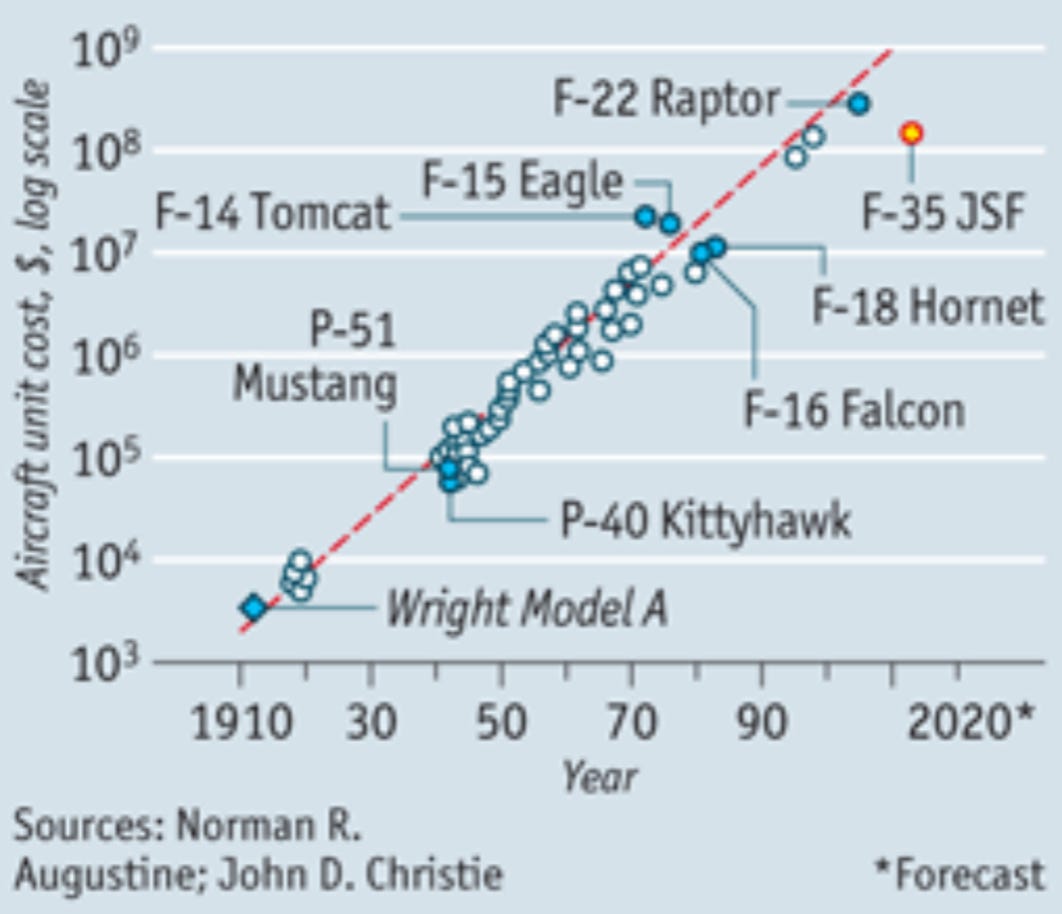
Bombers were similar but have started coming off this curve
Obviously we cannot stay on these exponential curves. Ludicrous as Pentagon and MoD procurement have been for decades, they can’t aim for a single trillion dollar plane taking 50 years to build...
How will we jump off?
What will we do instead?
These questions, central to TKC, are also central to wider issues:
How we reform military thinking and military procurement.
How we reform procurement generally, including a legal framework and operational system for emergency procurement so we don’t have a repeat of covid 2020 when we were faced with the choice of a) ignore/bend/break the law or b) watch thousands (including NHS staff) die unnecessarily — a legal situation that is particularly bad for Britain given the interaction of a) the rightful respect for the rule of law by officials and b) the way the common law works, which is different to the legal situation in other EU countries, pre and post-Brexit.
How we encourage change in NATO and Europe in response to Russia’s invasion of UKR. What sort of conventional forces do we build and how? How should different states’ plans coordinate? How do we change nuclear thinking, procurement and strategy (the UK procurement of nuclear is highly classified black humour)? In response to Putin’s invasion and the growth of China, do politicians across the West just throw more money at broken institutions and procurement systems?
Broader questions of how governments should promote economic growth and the ecosystem around scientific research, technology development, universities, startups, VCs, intellectual property law and do on. E.g planning law reform, like procurement, could deliver hundreds of billions in value over the next 20 years if a government actually got serious about being a government. Cf. Patrick Collison’s list of people doing things really fast.
What the UK decides to focus on given Brexit blew up the old ‘national strategy’, into which it chaotically staggered in the 1960s-70s. Will we prioritise science and technology generally, seek strategic advantage in specific niches, shift the economy away from reliance on housing and the City, change how core deep state institutions work — per the Vote Leave view of the world — or will we continue with the Tory/Labour approach of 25 years, leaving us with low growth, low security, poor services, rotten politics defined by intensifying scramble for a share of a stagnant economy, and only the choice of buying American or Chinese technology with all that implies for political and strategic choices, prosperity, security, and individual freedom?
Left to themselves, the only reasonable forecast is our political parties and bureacracies will try to do more of what they’ve been doing given that’s what’s incentivised and embedded in their culture.
While the Pentagon and MoD can’t stay on these cost curves, they will not by default switch from high-friction-high-latency-low-performance to low-friction-low-latency-high-performance. They will not by default switch from bad to great at procurement and being startup customers. They will not by default bring in much better people, face the failures of the last 25 years and use the budget process to jump into the future. They will not by default fix the abortion of ‘coordination’ between No10, the Cabinet Office, FO, MoD, services, intelligence agencies et al that makes ‘strategy’ a joke in Whitehall (and which the NSC process has not fixed).
Their default mode will be stagnation — business-as-usual means the DoD and MoD drifting off these curves into spending the next 20 years repeating the last 20 years, building stuff that’s (maybe) a little better for the same ludicrous prices at the same ludicrous (or even longer) pace. E.g The B21 bomber does leave the curve above but is planned to cost >$200B for ~100 planes — i.e it has come off the curve but it’s another manned-aircraft program for a few very expensive platforms taking decades to conceive, build and deploy (already out of date when they do fly).
In the absence of a powerful external force operating, SW1 will no more try to change radically than the Pentagon did after 1986 when Bernie Schriever, the legend who built the ICBM program, described for Reagan the rot in the Pentagon and how to improve it. His recommendations were ignored/blocked, it all got worse.
That was, obviously, the logic of Brexit — to provide such a powerful force that the system would have to change and to some extent this logic has been vindicated (e.g large increase in R&D spending, new focus on technology in Integrated Review). We’ve seen normal bureaucratic inertia wobble in 2020 in response to the powerful force of covid plus Vote Leave in No10 (e.g Vaccine Taskforce) then reassert itself in 2021 (e.g failure to build on the VT and properly fund new vaccine ideas that do not target the spike). A crucial question: to what extent will normal bureaucratic inertia resist the powerful force of the UKR war?
In 2020 I walked up Downing Street holding a copy of Schriever’s letter for the cameras to see, a simple way of sending a message to relevant people given I had started, unknown in Westminster (and largely unknown even in No10), a secret semi-formal process (parallel to the formal Integrated Review) with the Cabinet Secretary, the excellent finance director of HMT, the Permanent Secretary of the MoD, John Bew, Keith Dear and a handful of others to come up with the first honest figures for the MoD budget in living memory and to figure out which MoD projects were duds. Hahaha said the media looking at Schriever’s memo — missiles, procurement, nukes, defence reform, war … what a dick he is to be thinking about all this hahaha… Now they’re mostly cheering for war…
This project worked. Nothing leaked, almost unique in 2020 and partly a function of the fact that no ministers and only ~4 spads were involved. We got the first budget figures agreed to be honest by HMT, Cabinet Office and MOD in living memory, including on nuclear where MPs do not appreciate the scale of financial disaster inevitable. (E.g the ‘Heywood wedge’, created to hide Osborne’s disastrous decisions from 2010, and itself a disaster that pushed dishonest budgets through the system like a bow wave year after year, was finally acknowledged and fixed.) We went through honest assessments of MoD disasters that should be stopped. We agreed to shift money to more promising ideas and to fundamental rethinks in some areas (e.g FCAS/drones). We agreed on some principles for MoD procurement and budgeting reform — the existing process for how MoD/No10/HMT agree budgets is disastrous, partly because it’s always so short-term. Of course those true figures remained secret and the ones used publicly are not the same! NB. a) It took Vote Leave to make this happen, b) it only worked because no elected people were involved and only 3 even vaguely knew it was happening, c) the impetus from No10 for MoD to change and to make these issues public largely died in 2021 (despite Bew’s heroics).
As I’ve stressed before, one of the interesting things about 2020 was that many great officials, in the environment of a) Brexit having been settled and b) the core state’s collapse in spring 2020, were very keen on radical change viz economic policy, science and technology, procurement and civil service reform — much more keen than MPs, ministers, the PM or the media. While parts of Whitehall are undoubtedly extremely resistant to change, it’s also true that parts of Whitehall are much more in favour of it and understand how to do it, and the true blocks to change are in Parliament where almost nobody, literally almost nobody, is interested in how true power works.
It’s fascinating how few ministers show any interest in the processes whereby they are themselves managed — agendas, minutes, pre-meetings, processes such as the one I’ve just described, ‘chairman’s notes’ so ministerial meetings are literally scripted and ministers are reduced to ‘non-player character’ status rather than ‘live players’. Almost like … they aren’t really interested in actually governing, just the public displays of governing — like walking up Downing Street for the cameras to Cabinet meetings described by the media as ‘deciding furious rows’ about covid policy when the issues have already been settled by officials and spads in the covid taskforce and the Cabinet is pure Potemkin. (Exactly the same happens on UKR.) The MPs don’t notice or mind this charade provided the media don’t report the reality, which of course almost never happens. Provided nobody breaks kayfabe, high status continues to flow from the presence in the Potemkin theatre hence vicious battles to get to walk up the street in front of the cameras but no interest in who drafts the Chairman’s notes! (NB. On Brexit guess what happened? We took over writing the Chairman’s notes so that we scripted the meetings, and the real battles were not in the XS meetings but between us and officials over the wording of the script. This struggle for real power was entirely invisible to the media or Parliament.)
2020 showed that there are sufficient officials who want change to make this possible if No10 is occupied by people who want to work with them, but such officials cannot force change in the absence of such a No10 — indeed it is very dangerous to careers to try. Parliament is >99% NPC, approximately all live players are unelected, which you may think is good or bad (I’m ambivalent) but it’s definitely not the official story of ‘democracy’.
I recommend this piece by Keith Dear, one of the very few in the room for that secret semi-formal process. He saw how those discussions morphed into the MoD’s 2021 Command Paper.
K. Dear’s piece is, as far as I know, the only thing public by someone who knows the full picture and the honest numbers. It is a lot more reliable than FT pundits such as Philip Stephens who have foolishly argued that UKR shows we should have continued with the (disastrous) tank-buying approach of the last decade and we should now ‘ditch the IR’. (Most saying ‘ditch the IR’ have clearly not read the IR.)
As I’ve said before, the true lessons of UKR will support those of us arguing for radical change in 2020. E.g look at the asymmetrical value of drones. In 2020, one of the things special forces pleaded for help with was a loosening of the MoD’s dumb rules around SF procurement of, and experimentation with, drones. Look at the sinking of the Moskva and ponder the vulnerability of traditional platforms to precision strike, ponder ‘carriers / Taiwan’ — a central point in TKC.
Immediately after my departure (within 5 days) the PM, who had been almost entirely uninterested in the whole subject and struggled to stay awake in NSC meetings, started backtracking on the whole approach and started dragging the system back to — fake numbers, steal from tomorrow to avoid tough decisions today, raid the R&D budget to fund bullshit the backbenches want but everyone in-the-know knows is screwed, business as usual. Same old Tories… Tory MPs like to think of themselves as the party that defends the armed forces but their record since Thatcher has been one of extreme neglect, incompetence, lies, and putting immediate media nonsense ahead of preparing for the future.
The Kill Chain (TKC)
Brose worked in McCain’s office when he was chairman of the Senate armed services committee. He led a team authorising and overseeing the Pentagon and the stuff it bought and developed. He had access to a lot of highly classified information including he says classified wargames and most classified US programs (so we can reasonably infer that there are not a load of classified programs that negate his main points, such as the vulnerability of carriers). Brose now works at one of the most interesting defence technology startups, Anduril. I tried to get them involved in MoD procurement in 2020.
I think a lot of what he says is accurate and important to understand. Much more importantly so do many people in the MoD, armed forces, and intelligence services.
As he says, the heart of the matter is the budget process and procurement system and they affect each other in complex feedback effects. The budget defines true priorities — not what politicians say are priorities (‘we must innovate, we must build new technologies’) but what the system defines as the true priorities that will actually happen regardless of politicians’ babble. This is what creates incentives for military careers which, as we saw in the Rosen blog, is critical to whether new ideas are possible or are blocked.
NB. The budget process was fundamental to the Manhattan Project, Schriever’s ICBM program, and Apollo. They could not have worked as they did with what is now normal budget process, as the participants such as Schriever and Mueller stressed. In the 1960s, McNamara and his ‘whizz kids’ from Ford, in charge of the Pentagon, deliberately replaced these processes on the basis they would bring lower costs, less waste, less corruption, more ‘transparency’, more ‘accountability’.
The result: more costs, more waste, more corruption, less ‘transparency’, less ‘accountability’! And the story since has been Congress pushing further with the McNamara approach for almost everything. The main exception has been the growing use of classified ‘black budgets’ to escape the normal rules, including for JSOC (classified special forces). As George Mueller said before his death, US bureaucracy means that Apollo would now be totally impossible as a public civilian project, it could only happen as a black project. But this has also meant a trend towards classifying things to hide failure, in Washington and London.
While much of TKC is relevant to the UK — and all the main bits about procurement and budgets — it’s important to note that, as serving officers who have read this have put it to me, the situation is worse here. Bad as TKC’s depiction of Washington is, many serving officers stressed to me that America has done a better job at facing failures in Iraq and Afghanistan and changing. (Cf. a US paper I circulated in 2020, There Is No Spoon.) Many of those who presided over failure in UK operations in Iraq and Afghanistan were promoted and continued to avoid facing failure and simply shoved more money into the same broken systems. (When asked for new ideas, some of these senior characters cut and pasted passages from Time magazine and submitted them to the PM as MoD work.) As the joke goes, we should help Ukraine by sending Russia our Ajax vehicles (one of the procurement disasters we tried to stop, with considerable support from inside the MoD and forces, in 2020).
TKC is a bit repetitive and returns to some themes in different chapters — e.g effects of advanced manufacturing, drones, military version of ‘internet of things’. I have stripped repetition out of the notes.
Not criticism but important to note, TKC does NOT discuss two crucial things — nuclear weapons or special forces.
Underlying it all though are crucial political issues. He takes it largely for granted that America and China are fated to be antagonists in a classic great power struggle like Athens v Sparta or UK v Germany. And he believes that the goal of US military reform should be to prevent China dominating East Asia.
It may be that such a classic dynamic is unavoidable. Perhaps that goal is right. Many experts think so.
But I think that these things should be questioned hard at the political level. I do not think ‘preventing China’s dominance of East Asia’ — whatever that means exactly, and it is not defined clearly enough in the book — is necessarily the right goal. Defined in some ways, it could be a disastrous goal. I think there are things America can and should do to try to maximise the chances of escaping otherwise normal dynamics viz China. For example, I think it is crazy for America to commit to fighting to stop the unification of China/Taiwan — as if it is up to America/Europe to determine what happens to an island on the other side of the world, visible with the naked eye from mainland China (an ancient civilisation that the west kicked and bullied horrifically in the 19th Century) of which it has historically been part.
As Clausewitz said, and as Bismarck insisted on, political judgements should always provide the framework for military judgements. Whether to define the goal as ‘prevent China dominating East Asia’ is first and fundamentally a political question, not a military one. Those and many other political questions are for another day.
TKC is interesting and right about a lot even if you think it’s politically mistaken in important ways. Even if you want to take a very different political approach to China, the issues of how militaries think, buy and budget are critical and must change if we are to avoid huge waste and military disasters. We could and should do much of what Brose suggests even if we do not share his definition of the political goal viz China.
Ps. When we see pitches now for another war it’s worth remembering how, when various commercial interests tried to get Bismarck to support them in starting a war in China, he very firmly slapped them down:
These blackguard Hamburg and Lubeck merchants have no other idea of policy in China but to, what they call ‘shoot down those damned niggers of Chinese’ for six months and then dictate peace to them etc. Now, I believe those Chinese are better Christians than our vile mercantile snobs and wish for peace with us and are not thinking of war, and I’ll see the merchants and their Yankee and French allies damned before I consent to go to war with China to fill their pockets with money. (To the English Ambassador)
Brose’s Intro
In 2017 the chairman of the Joint Chiefs of Staff had testified that without major changes ‘in just a few years’ America would lose its advantage over China.
In war-games China now almost always beats America. Most members of congress do not know this.
US would have to transport long-range bombers, subs, missiles across the Pacific but they’d be attacked as they cross.
China will use cyber to slow everything down.
China will knock out satellites.
China will smash command-and-control (C2) networks.
China will attack US forward bases including with hypersonic missiles.
Advanced planes such as F22 and F35 are quite short range and would depend on aerial refuelling tankers which would be destroyed.
Carriers would have to turn and flee battle to avoid getting sunk. 10M per missile v ~10B+ per carrier, a factor of ~1,000.
US Marine Corps would be redundant.
How can nearly a trillion dollars a year create this situation? Because it’s spent really badly and the political system can’t fix it! There is ‘systemic failure’.
Even though technology has transformed, procurement and planning has stuck with focus on platforms.
It should focus on the kill chain: understanding, deciding and communicating, acting. The military speaks of ‘closing the kill chain’ and ‘breaking the kill chain’. Focusing on the kill chain, not platforms, helps us think about what we really care about and the future.
In many areas tech is advancing fast:
Sensors
Computing
Robotics/drones
Biotech
Quantum
Hypersonics
But the military is WAY BEHIND in getting new ideas/machines to service.
US system:
Extremely complex laws and regulations.
Much shrouded in secrecy that stops honest discussion.
A small number of huge players.
Extremely hard for innovative startups to compete.
Huge incentives against new ideas throughout the military and political system.
[NB. All this applies to the UK/MoD.]
US goal should be to prevent the CCP establishing military dominance in the Asia-Pacific.
[NB. Properly done, defining such a high level goal is a POLITICAL question in which military considerations are important but not decisive. Depending how ‘dominance’ is defined I’m not sure this is realistic or necessarily a good goal. But lots of things he says may be true and/or useful even if this goal is wrong.]
It needs a shift from large, expensive, manned, hard-to-replace platforms to smaller, cheaper, unmanned, easy-to-replace and autonomous machines.
CH1 What happened to Yoda’s revolution
In 2019 I wrote about Andy Marshall (nickname Yoda), the Office for Net Assessment (ONA), and the debate over the ‘revolution in military affairs’ (RMA) starting in the 1970s — what Soviet Marshal Ogarkov called the ‘military-technical revolution’. In 1973 DARPA and the Defense Nuclear Agency jointly sponsored a study called the Long Range Research and Development Planning Program (LRRDPP) to look at new options to deal with the Soviet Union. Out of this came a connected set of new ideas including stealth, GPS, precision strike, drones. The Soviets could not cope with the changes and had no equivalent of Silicon Valley. Most of this work was unknown publicly until the first Gulf War gave a TV preview of some capabilities. But, despite the end of the Cold War and the success of these ideas, there was no widespread modernisation of the Pentagon.
The ONA encouraged the DoD to reform and warned of opponents searching for countermeasures to US capabilities, e.g what became known as ‘anti-access / area denial’ (A2/AD).
Washington was awash in powerpoints and slogans — transformation, army after next, joint vision 2010, network centric warfare… DoD budgets talked about the RMA.
1990s — Somalia, Haiti, Yugoslavia, Serbia, Kosovo… ‘military operations other than war’ (MOOTWA).
Admiral William Owens, vice chairman of JCS in 1990s — warned DoD had not learned and US risked disaster.
Marshall commissioned the ‘Future Warfare 20XX War-game Series’, assumed to be ~2025-30 against ‘a large peer competitor’, i.e China. Martinage and Vickers (a famous former SF operator), 2001 report: foresaw China having roughly US level capabilities and preventing US fighting as it had in Iraq and Balkans. The first signals were that Rumsfeld would act but… 9/11…
JSOC (classified US SF) made huge progress with operations and developing specialist tech.
China and A2/AD were downgraded as priority.
Huge waste and disastrous procurement after 9/11 and Iraq. For example:
Future Combat System, ~20B and cancelled.
F22 and F35, the US new generation planes, cannot directly share basic airborne positioning and targeting data even though they’re both USAF programs built by the same company! Defence companies usually profit from closed proprietary technologies, not from effective data sharing.
The X47, first drone to launch and recover from carrier, was a SUCCESS… so… CANCELLED despite many objections, BECAUSE it was successful and challenged business as usual! Many in the airforce do not want drones challenging the idea that manned planes will be the future for decades. (NB. I had similar discussions in summer/autumn 2020. Most key people in the system agreed that the UK has not been properly pursuing new ideas re unmanned systems and (when talking privately) supported a radical rethink, including re the proposed spending of billions on the Future Combat Air System, another procurement project that will be disastrous if done in the old way (i.e the wrong thing, massively overbudget, taking far too long). I and others proposed a new way of funding R&D for drones / combat air. I’m told that these discussions with No10 stopped after I left. It was immediately clear the PM had no interest in the subject and no desire to argue about the budgets or disruption that a serious step into the future would need. What we’re seeing in UKR ought to reboot such discussions.)
The series of procurement disasters, largely focused on more of the same not real change, undermined the idea of modernisation…
2008 Robert Gates attacked ‘next war-itis — the propensity of much of the defence establishment to be in favour of what might be needed in a future conflict’. This argument was backwards — the real problem was last war-itis!
Under Obama, ‘AirSea Battle’. 2011 cuts led to scramble in which as usual the budget winners were more of the same and losers was future ideas.
CH2 Little green men and assassin’s mace
2008 Russia attacked Georgia. Showed Russian weaknesses. Prompted reforms.
2014 Russia takes Crimea. US intel failed again to warn.
Russian forces very capable, clearly modernised. Electronic warfare capabilities fused with intel: e.g identify Ukrainian VIP, call mother with fake news, monitor her phone, find son, drop bomb down signal… Looked in some ways like Andy Marshall’s 20XX war-games.
2013 Gerasimov article on war.
2016, RAND: Russia could get to outskirts of Baltic capitals in 60 hours and NATO would struggle to respond effectively.
2016 Russia intervened in US election.
China took lessons of Gulf 1 seriously and started investing in stealth, precision weapons etc and full A2/AD, e.g ‘Assassin’s Mace’: weapons to stop US systems operating. Hit bases. Sink carriers with DF-21, DF-26. Anti-satellite. New navy.
2014 China started manmade islands in South China Sea to support claim it was China’s.
Huge theft of US IP.
Washington repeatedly discussed China as if it can be manipulated to become ‘more western’ via incentives like trade. WRONG.
Bob Work tried to shift DoD with a ‘new offset strategy’, mimicking the 1970s Long Range Research and Development Planning Program (LRRDPP) study with JASON/DARPA. Cf. Martinage 2014 paper for CBDA.
CH3 A tale of two cities
Brose tells the story of the US ICBM program which I wrote about HERE and won’t go into in detail again. (If interested in it my paper goes into far more detail than Brose and links to more sources.)
Basics:
A mix of farsighted and extremely capable military (Schriever) and scientists (particularly von Neumann) persuaded Eisenhower to let them create a special project based in California to pursue ICBMs. (Von Neumann realised it would become possible to put a hydrogen bomb on a missile.)
Von Neumann explicitly said it must be modelled on the Manhattan Project and be outside normal Pentagon bureaucracy.
This project developed extremely effective methods — systems management — for managing highly complex technology.
Many of these lessons were then applied to the failing NASA of the early 1960s and produced the Apollo triumph.
Eisenhower supported such projects, partly because his own WW2 experience meant he valued speed and he was happy to appoint people and have them drive things.
There were similar success stories with Kelly Johnson’s famous SkunkWorks, which produced the SR-71 and stealth planes, and nuclear submarines.
These huge efforts also saw the development of Silicon Valley. One of the crucial drivers was the Pentagon telling entrepreneurs — we will buy chips with the following performance and price. The DoD created the chip market. Companies like Fairchild and Intel sprang up. Bell Labs also played a crucial role (and Bell is also much under-studied in the UK as a model for R&D).
But the Pentagon under McNamara and his ‘Whizz Kids’ fought back amid Vietnam and bit by bit the highly effective methods of ICBM/Apollo were systematically replaced with antithetical principles and standard corporate budget controls designed to bring more transparency, lower costs etc but which in defence actually did the opposite.
Supposedly greater concern for ‘transparency’, ‘due process’, ‘cost control’ and so on produced a system which…
Hugely benefits a small number of extremely big and rich companies.
Systematically suppresses startups.
Systematically suppresses new ideas in favour of incremental changes to existing ideas.
Routinely suffers both missed deadlines, with everything getting slower, and over budget.
The small number of players spend more and more time and money on lobbyists, lawyers, accountants and consultants — NOT invention/innovation.
The whole system gradually gets slower and more expensive and more corrupted by a few big players — and the response is to slow things further and add more process making the problems worse.
Companies that engage with such a system have to evolve in unhealthy directions and do things that are damaging long-term. If they don’t they die.
Politicians who try to change direction come under fire from everybody even when everybody knows they’re right.
No single player can fix it. Chairman of the Joint Chiefs? No. Powerful Senator like McCain? No. Not even the President can change it alone. It’s now at a point where only a President plus a powerful network could seriously shift it.
Another result is that a) lots of failures get classified to avoid scrutiny, b) some crucial projects, particularly involving intelligence and special forces, get classified so they can be pursued outside the normal procurement system. Many of the famous technologies such as stealth and precision-strike were very highly classified so they could be developed by the likes of SkunkWorks outside the normal system.
In the 1980s Schriever was asked by David Packard to look at it.
As Brose says, Schriever’s letter changed little, almost everything got worse in the next 30 years, and it remains an excellent description of the current failure and reasons for it.
There are ‘more rules, requirements, documents, people, reviewers and checkers than ever before involved non-productively in the decision-making process.’
In 1993 William Perry organised what became known as The Last Supper, a dinner with defence companies. He told them to look at their neighbours because most of them would soon be gone. Within a decade the number of major defence firms fell from 107 to 5.
Aircraft manufacture is a good case study. Instead of the world of Kelly Johnson’s SkunkWorks in which ideas were conceived, built, tested and scaled incredibly fast, we now have planes like the F35 and F22 which take 20 years or so and have all sorts of obsolete features by the time they fly. The incredible slowness has a feedback loop on people’s career choices — young engineers realise they may only work on ONE new plane in a career! So many go into other fields.
A connected problem, working with the government is so slow and requires so many lawyers that it’s often disastrous for small entrepreneurial companies so many of them now refuse to work with DoD. (Very similar problems happen here. There is a reason companies like McKinsey get so many contracts — they have the scale to cope with the procurement horror show and are optimised for it (e.g loads of lawyers to handle the vast pointless bullshit). Why would a technology startup want to deploy a precious team (that could be building things) to spend maybe over a year on bad meetings with a government department or agency (which often doesn’t have the people to know what it should want) then changes its mind constantly, and may waste a year then go ‘we better give it to McKinsey again so if it goes wrong nobody shouts at us’, always of course using a bogus ‘scorecard’ with spurious specificity as evidence in case of a judicial review? This is why one of my projects was ‘make government a great customer for UK startups’ but this runs so counter to decades of Whitehall evolution that even though lots of good officials want to do this it is extremely hard to actually do.)
Effects of this:
Talent goes to the Valley, not defence/security.
SV companies don’t want to work with DoD/Washington, it’s so slow and the whole culture is antithetical to the SV culture of build fast, learn, iterate.
Investors are more interested in SV than defence because the returns are much better.
CH4 Information revolution 2.0
NVIDIA GPUs — 320T OPS ≈ 1000X the F35’s chips — 400B ops per second. F35 is most advanced in US military.
Most platforms and networks do not connect to others easily, quickly, reliably.
DoD very slow to procure cloud computing.
Civilian progress in AI huge, shocking lack of thinking and learning in DoD.
SpaceX et al have cut cost of launch per KG into space. Starlink will mean thousands of LEO satellites, some for military use.
[In 2020 I pushed through UK acquisition of OneWeb which is the other global operator of such LEO satellites with the internationally recognised license. My reasons were primarily to do with military/intelligence/strategic advantage for the UK, though the commercial case was judged sound too. China very much hoped we would not to do this and intended to snap it up itself, hence partly US support for us doing it.]
Additive manufacturing will allow satellites to be made in space… CRISPR… Brain-computer-interfaces (BCI). Amputees can control robotic prostheses using thoughts… Quantum computers/sensors…
SpaceX and Palantir haave had huge problems in Washington which has resisted working with them, sending powerful messages to SV — we’re not interested in working with you.
Snowden revelations in 2013 hardened SV beliefs that government is not trustworthy. Tech companies have played hardball, e.g on encryption. Google withdrew from Project Maven, an attempt by DoD to work better with SV on AI (I wrote about it here).
Amazon, Apple, Google, Facebook, Microsoft spent 70B on R&D in 2018. The top five US defence companies — Lockheed Martin, Boeing, Raytheon, General Dynamics, Northrop Grumman — spent 6B, 10X less on R&D. Apple’s cash float is big enough to buy all five of them.
(Amazon spent $43B on R&D in 2020, up 20%, significantly more than total UK government R&D spending, ~£20B.)
‘It is as if America defeated the Soviet Union and then went about adopting the Soviet military procurement system.’
CH5 Something worse than change
Problem not:
Evil people.
Lack of money.
Lack of tech.
Lack of vision.
Bose looks at the example of the shift to building carriers and figuring out the shift to carrier groups between the wars — an example I looked at a couple of weeks ago in the Rosen review HERE.
He looks at Assault Breaker, which I looked at HERE.
Bose says a lesson of success is there must be ‘definition of real threats … as much specificity as possible what operational problems they must solve through the development of new capabilities and new ways of fighting … which specific threats, in which specific geographic locations, and at which specific scales and speeds they must act.’
[BUT while this can be true it is not always true. E.g It is not true of the carrier innovation, per previous Rosen piece. They were developed when the US Navy was thinking they may be used against UK, not necessarily Japan. Rosen says carriers were driven more by a general change in the security environment with the US becoming a Pacific power, not by specific operational problems nor even specific enemies. Assault Breaker was different but that came out of the LRRDPP… See my separate blog on this. Bose says it ‘succeeded’ but my study of it suggested this was mixed — some aspects of the LDPR were a stunning success (e.g Skunk Works stealth) but other parts including early drone work got closed down.
ICBMs. Yes there was clarity - deliver a nuke by missile accurately enough.
FCS. No clarity, sprawling.
If you look at carriers, Manhattan, ICBMs, stealth you do see — a) established military people getting b) political protection/space c) to work for years, d) able to strip back friction, e) flexibility to create attractive careers in a bureaucracy and work with technical people outside military, f) changes to operational concepts and organisations. TLDR: I think this is much more complex than Bose says but will return to it in a summary blog…]
DoD abolished Joint Forces Command, a four star command devoted to experimentation, for cost cutting.
Putin is a menace but long term the PRC is a bigger menace. Ancient civilisation. Economy is bigger and stronger. Technically they are advancing on important fronts and close to US or surpassing. They see western culture as a disaster. Huge espionage and IP acquisition (legal) and theft program. All companies have to share data with military/intel.
China is deadly serious re AI arms race. US government writes documents but lacks focus, drive.
Re AI: ‘By 2020 they will have caught up. By 2025 they will be better than us. By 2030 they will dominate the industries of AI.’ Eric Schmidt, ex-CEO Google.
(The UK recently produced an AI strategy that, very unusually for such documents, was a product of deep state + spads + world-leading outsiders and mostly managed to survive the editing process. Will there be focus and money behind it or will it end up like most SW1 documents?)
If US cannot deter China in a conventional war, likely result is China dominance over much of Asia-Pacific, home to US allies and crucial to US economy.
CH6 A different kind of arms race
China hackers got into Office of Personnel Management 2015 and stole personal data including security clearance data on 20m!
Things like F35 vulnerable to cyber weapons (particularly since its software was hacked).
We already give soldiers things like modafinil. Further enhancements will come. China has far fewer scruples than West.
LEO satellites and solar power systems building themselves in space: i.e manufacturing using solar power to make more solar power to power more manufacturing.
(Some of this chapter is repetitive and a bit vague.)
CH7 Human command, machine control
Bose debates issues around human control of intelligent and/or autonomous machines.
Boils down to: China is going to push on both AI and autonomy, US will have to do same or be left far behind.
AI will affect load of things beyond direct killing — logistics, command and control, surveillance, cyber etc.
Missile defence systems already can operate completely automatically, closing the kill chain without any human involvement.
We should apply the same train-test-trust framework we do for humans and hold leaders accountable for how they deploy autonomous weapons.
US has handled these debates very badly partly by being so secretive and allowing opponents to lie about what it’s doing.
More transparency on autonomy…
CH8 A military internet of things
DoD has been ‘shockingly bad’ at helping Congress understand its most interesting ideas about the future.
XQ-58A. Cheap target drones used for training. Idea — turn them into actual capability. Can be launched by missile and recovered by parachute, so still work after air bases knocked out. Cheap and attritable: i.e a few million each, so could fly 10-25 for the cost of a F35.
Navy’s XLUUV — extra-large unmanned underwater vehicle. Cost 50-100m vs the $3B per normal top sub.
Huge potential for low cost intelligent drones. But DoD trying to limit them to support functions, not to replace things like F22.
While corporate world has created internet of things and enabled fast easy info sharing, military systems are balkanised and info sharing is a nightmare.
Situation so bad that often google maps is used to integrate information with pins dropped manually to identify targets.
Historically it has taken multiple people to operate one complex machine. Now one person will be able to control many machines — and machines controlling other machines.
USAF has ~320k active duty people and fewer than 6k machines (aircraft, satellites, nuclear forces).
USN has ~330k active duty people and ~300 ships/subs and 3700 aircraft.
F35 has >300k separate parts. Drones will be simpler and able to do things that planes now cannot do because of the human — e.g tolerance for gravitational forces.
CH9 Move, shoot, communicate
US plans assume:
We’ll have time and freedom to move massive amounts of stuff thousands of miles to bases near the action, like 1990/2003.
We can rely on relatively small numbers of advanced platforms to hide from the enemy then strike effectively, like 1990/2003.
We can feed this machine with food, fuel, equipment, ammunition etc as needed, like 1990/2003.
Ubiquitous sensors, including civilian smartphones, will make hiding harder. E.g German company Hensoldt claims it tracked F35s in 2018. Many new sensors are being deployed under the sea.
As hiding becomes harder, perhaps future forces will focus on mass overwhelming the enemy networks rather than hiding? E.g Sep 2019 a rudimentary drone swarm penetrated US defences and struck Saudi refineries.
Hypersonics change all calculations for bases.
Manufacturing plus robotics will transform logistics and allow more to move faster and be built closer to conflict.
Everything advanced will be more vulnerable to cyber so cyber defence more important.
Range / accuracy / effect of fire — all growing. New types of fire e.g directed energy.
There will be attempts to build new radically decentralised communication networks that are less vulnerable and quicker to self-heal. Software will hop comms across frequencies to escape enemy measures.
Much will depend on space therefore we must assume there will be operations in space to disrupt/destroy satellites etc, which will also have big potential knock on effects for civilian infrastructure.
DARPA demonstrated 2018 an operator controlling drones via surgical implants.
Over time the whole command-and-control architecture now used will be replaced.
There will be more spoofing and counter-spoofing and more of it automated.
CH10 Defence without dominance
After much effort the DoD published the National Defense Strategy of 2018.
Not perfect but progress. Defined top priority as ‘long-term strategic competitions with China and Russia’. Provided adequate detail in classified form to guide policy and program choices.
We operated post-91 with few constraints. Now returning to a world in which other Powers impose more constraints.
Our goal should be: ‘preventing China from achieving a position of military dominance in Asia’. This means accepting less influence elsewhere. It means avoiding wars with Iran and NK. Means thinking much more about defence. E.g A2/AD v China. Will need to pre-position large amounts of forces, including autonomous forces and manufacturing, in Europe and Asia.
Core of future force:
Shift from fewer more expensive things to cheaper attritable things, e.g fewer large warships and planes, more low cost drones and missiles.
Shift to more AI, more cyber.
Shift to people controlling many more machines.
Shift of communication to more decentralised/resilient networks.
Shift to more focus on software that is quickly improved and can communicate across systems.
[What does ‘stop China dominance’ mean? China already is dominant in the sense of having greater military power than any other local Power. But it is not necessarily stronger than a potential alliance of Asian powers with US support. Does ‘stop dominance’ mean ‘be able to prevent China coercing/invading India and Japan’ or ‘stop China retaking Taiwan’? As I referred to at the top these crucial political questions are not asked enough and we should not let the military dictate political goals.]
CH11 Bureaucracy does its thing
2019 Mattis and the Sec of Navy tried to cut back on carriers. They couldn’t stop the plan to buy two new carriers because the hit to the industrial base was deemed too big in the absence of other work.
So they tried to retire USS Harry Truman early saving >30B. There was no comms plan. Congress was caught off guard. Lobbying operations went to work. Pentagon was not prepared to make its private argument publicly — i.e tech developments make carriers so vulnerable that resources should shift to new ideas. Navy sources briefed they wanted to keep it. Soon White House killed it. The money was taken from future ideas and capabilities.
The budget process is at the heart of the madness. Annual budget. Careers go up/down because of decisions about the present not the future. Incentives do not reward rapid tech development or new thinking.
The requirements process. How DoD determines what’s a validated military capability to build/buy. Very slow. Very consensus. Biased towards more of the same, against new ideas.
The acquisition process. Horrific. E.g army procured a new pistol — farce/nightmare but despite top brass agreeing it was a nightmare the nightmare proceeded. The request for proposals was >350 pages. The problem now is not authority. Those who have the authority rarely use it. They often don’t even realise where in the system the decisions have been made. The top Army people were baffled at the pistol debacle asking ‘who is doing [dumb thing]’ when THEY were running it.
Defence industry has become increasingly consolidated and closed to new entrants. Relations between the military and tech companies have deteriorated.
DoD builds budgets in 5 year plans. Most money spent is set by previous decisions. Congress sets many controls. If DoD wants to shift cash (‘reprogram’) it often needs OK from four congressional committees. DoD can reprogram <1 in 10,000 dollars in its budget! The budget process works bottom-up from the services so they establish huge budgets before the top of DoD sees them. It is not top down. There’s only a handful in DoD capable of bending the budget process including the Secretary and the deputy secretary. But all day every day they’re pushed to focus on the present not the future.
The top level people in DoD change every few years and aren’t around long enough to matter much. No incentive to raise problems or scupper existing programs. People are promoted for shepherding programs through the system with minimal problems.
The services fixate on counting people and things: carriers, ships, planes, soldiers.
USAF and Navy are planning further manned fighter jets. Drones are confined to support duties. [Ditto here probably.]
The big problem is not lobbyists but that a) ‘so few defense companies are left in America’ after decades of consolidation, and b) so few of the remaining companies are leaders in emerging technologies, c) those that are ‘have little to no voice in the budget process’.
Congress.
Those with military service are half the level 30 years ago.
It leads both to hostility and unthinking deference.
Few understand tech.
Polarisation has made it hard to cooperate over the military.
Passing budgets has got harder. The repeated budget impasses mean DoD can only keep spending money on what it has already been spending on, another impediment to innovation.
CH12 How the future can win
2018 Mattis and Sec of USAF tried to abandon a plan to buy a new version of JSTARS, a 30 year-old business jet with sophisticated radar to find ground targets. It had played an important role in Iraq1, Balkans, Iraq2. No good for war with Russia or China (not stealthy, cannot defend itself). USAF had plan for a new capability including drones.
Usual problems. Congressional districts and companies were anticipating the cash for JSTARS. They mobilised to kill the plan.
Unlike with the USS Truman, USAF had a plan: engaged Congress early, explained military logic, offered new money to the districts so they wouldn’t be losing out, got companies who would benefit from the new plan to lobby. Even with this huge effort it was the biggest budget battle of the year and only just went through.
CB: ‘If the future is going to win, it will have to win inside our current system. It will have to win in a system comprising parochial military services, self-interested companies, and largely distracted political leaders – all of whom will continue to be consumed more by present concerns than future ones. Those are the people, interests and political realities that matter, and none of them can be hand-waved away.’
There are more reformers in senior positions. JSTARS was a sign, there are others. E.g General Berger took over Marines in 2019 and immediately published a radical note: ditched previous goals for large ships, shifted to smaller, cheaper, more expendable and autonomous ships.
Incentives now favour:
Legacy over new
Familiar ideas over new
Offense over defence
Present over future
Hardware over software
Acquisition compliance over rapid development
Old companies over new companies
Consolidation of companies over diversification
Neither congress or DoD alone can change how we spend money and reward/punish people. Especially because some DoD people change fast but many in Congress stay for decades. There must be an alliance of politicians and military/officials.
Vague concepts like great power competition, multi-domain operations, joint all-domain command and control, transformation — are no good.
Problems should not be framed around specific services (army, navy), nor platforms (jets, tanks), nor domains (land, air, sea, space).
‘They should be framed around the kill chain — how to gain better understanding, make better decisions, and take better actions faster and more often than specific military competitors.’
The speed of getting from *idea to experimental weapons into tough testing* is critical so we need incentives for companies to compete to do this.
E.g mission-focused competitions. DoD could provide money every year for proved best solutions for core problems. The competitions should be real-world events featuring operationally relevant problems, like Work’s scenario involving the real-time targeting of 350 ships’. They should be open competitions so existing services, labs, companies and startups can try. Then we must reward winners by fast scale-up. Winners may be concepts (like Blitzkrieg) not capabilities.
If just 5% of DoD budget spent differently that’s ~30B p/a.
Ban on earmarks had unintended consequences. Done because shady, way to reward campaign contributors etc. But also meant Congress limited to funding what DoD suggests. E.g Predator was created with an earmark after USAF refused to invest in unmanned. Transparent earmarking could help.
(He’s obviously right re mission-focused competitions which have often been successful in history. Sure ‘transparent’ earmarking could help but why would Congress not do non-transparent earmarking instead if they can get away with any earmarking?! Re an alliance for reform — the HOW is the tricky part! Behind all attempts at reform lies a fundamental reality in the US/UK/EU: political incentives do not push the old parties towards thinking that ‘solving these problems is a political priority’. Provided everyone sticks to this stable equilibrium there is no political incentive for a party to change and strong incentives not to change. Those who try to change will be attacked as ‘naive’ and quickly find themselves the focus of many powerful interests. The old bureaucracies are very, very powerful and work closely with the media. Look at how elements of the deep state screwed Trump and how he could not even get his appointments vetted by the FBI.)
I’ll return to some other comments on this book, this is long enough for now…


I've only read the first section, I like to read these articles in blocks and reflect on each block of content.
I think Kelly Johnson is the man who really nailed how to supply advanced military hardware, not only was he the best aerospace engineer of perhaps all time, his project management skills and engineering culture are just unsurpassed.
The first SR-71 was designed and assembled by a team of less than 20 people. He once said there were only 6 engineers on the project including Kelly himself (separate from Pratt & Whitney who produced the engines). 60 years later it's still the fastest aircraft ever flown.
At the heart of military procurement you have to get right down into engineering process.
All over the world the discipline of engineering has been commodified, with each engineer treated as a mere manhours engine. Large and complex projects are broken down in a way that represents Fred Taylor's discredited theory of Scientific Management.
The vast majority of engineering jobs are incredibly atomised and process led. Basically the complete opposite of Kelly Johnson's preferred way of working. I can break this down a little further.
There are really two very different ways to do a technical project:
1). You commodify the engineers, atomise the tasks and follow the process. This is probably the best way to do quality at scale, economically.
2). You treat engineers as talent (yes there really are 50x engineers out there), you give them autonomy (get out of their way) and they follow engineering judgement. This is the only way to do non-incremental R&D.
Large companies use commodified engineers to do R&D, it doesn't work.
They only ever realise 5% gains. Everything is too atomised and too process restricted to ever make any major breakthrough.
This is why startups change the world and not big business. Big business should only exist to get eaten. One huge strategic reason why the East has closed the gap on the West is because we in the West keep bailing out big business and denying innovation its rightful prize.
The big military contractors in 2022, are not startups. They don't hire engineers as talent, they hire commodified manhours engines to churn through project plan and deliver slow and predictable marginal gains.
Real military innovation can come from only two sources;
1). Very high IQ soldiers (unicorns)
2). Talented and obsessive engineers working in the domain with autonomy (startup founders).
Nobody else can move the needle on military innovation, and it doesn't matter how much money you spend. There is no capital restriction on ideas.
I would also examine how military procurement is thought of, we basically have the military produce a design specification for a system that they would like to operate and then we go and tender it to pre-approved defence companies to see how much it costs and when it could be delivered. This is "closed procurement" where is the scope for innovation? It's all on the cost side, hitting the scope as cheaply and quickly as possible.
It might be much more effective if we inverted this and asked what system can I buy for £XXX that could make a difference in a war in 20XX against an enemy that looks like XYZ? That's "open procurement" and would lead to material diversity of tenders. It's a blank canvas for innovation.
Or why not do both? There should be a material budget for the latter. It's exactly the sort of thing that fits the UK's Hofstede dimensions. We should be leaning into our strengths, it's just good strategy.
To me it seems obvious that cheap autonomous platforms are the future of warfare. Whether they fly, drive, walk or swim, some kind of autonomous swarm provides all the decentralised advantages of the internet architecture design. A swarm has variable density of value and variable density of firepower and this makes it extremely difficult to target and defeat in low density state, and extremely lethal in attack when in a high density state.
e.g. spread out when advancing or retreating or idling, only come together at moments of attack to concentrate lethality.
The root problem is the gradual shift into a low-trust society. The necessary autonomy that is necessary for ARIA to blossom is something that can only exist in a high-trust society. Cultures that embrace nepotism and kleptocracy as the norm (the overwhelming majority of the global population) could never sustain such an organisation, as the funds would be funnelled into the pockets of the family, friends and underlings of the responsible person as surely as the sun rises in the east.
The processes that attempt to stymie such behaviour kill the processes that drive innovation. Without a base assumption of honesty, nothing works. As UK demographics change, along with attendant cultural norms and declining church attendance, the foundation crumbles.