

[UPDATED 8 July]
Thanks for all comments on Reading List.
Snippets below on:
No10 farce summary
Finkelstein re Tory strategy
Ukraine
AGI ruin
Evidence on daycare
Evidence on Direct Instruction
Meta-lesson from New Schools Network: Tories close things that work & don’t care about changing government
Shares only go up… at night?!
Abortion politics
I said from the start that I’d keep covid things public, not gated…
Back in 2020 we set up a system to monitor sewage for covid. Pretty much everybody uses the sewage system. It has a lot of advantages for adding to early warning systems and predictive models on covid outbreaks. It worked very well. The idea has been copied all over the world. It can obviously be used not just for covid but as part of an early warning system for other potential diseases including bioterror, the sort of thing I wrote about in my Jan 2020 recruitment blog. It was cheap given its value and doubtless could have been made cheaper. (An amusing/typical meeting was when some of the new data science team we built in 2020 suggested extending it to prisons so we could monitor true levels of drug use. ARGHHHH NOOOOOO! The last thing we want to do is know what we’re doing is bullshit and expose the rampant corruption in prisons!)
Some officials last week told me that it’s being shut down!!!
Vallance and other officials objected but were overruled.
‘For savings’.
This is an excellent and tragic example of how across the western world there is a demented refusal to learn from covid, a determination to repeat the same mistakes, a determination to keep the same broken bureaucracies, and the appalling political parties are at the heart of enabling this.
If democracy worked per the theory, then opposition parties would scream about such things. But instead you can see Starmer does nothing on such things. If anything he’s even more pro propping up the failing system than Boris hence, for example, him supporting Boris on keeping the failed MET leadership after the disasters last year. His instincts are always to side with the bureaucracy not the public. (The MET should be broken up with intelligence, counter-terrorism, VIP protection etc stripped out and the rest made fully accountable to the Mayor as in other big cities in the world.)
If democracy worked per the theory, then politicians would think: just had the covid disaster, biggest challenge 1945, I don’t want to be responsible for closing crucial assets for the next pandemic, I want it on-the-record that I said ‘keep open’.
In the real world politicians across the west either a) just aren’t thinking in any intelligent way about important issues or b) have thought and decided they won’t suffer if another pandemic hits and everyone goes ‘WTF were you thinking’. Or if a new covid variant pops up this winter that, say, is really bad for kids. (I think it’s more A than B, they’re basically just locked on tomorrow’s media, not thinking.)
As I keep saying, the real issue in government is not ‘how to do X much better’. In most areas we know. The real issue is big players in the system tend to be either uninterested in improving X or actively opposed. Almost everyone in Westminster is much happier with the existing system failing dismally than facing what it means to change seriously. It’s even true after such a disaster as covid. It’s the same viz MoD procurement, drones etc despite there being a war on.
This is also why you see constant tension between Insiders saying ‘lack of trust in institutions is a real problem’ and the public who keep voting for change and desperately want government to be very different. The key institution blocking what the public wants is the broken old parties who are locked into mindsets that aren’t even rational for them, but from which they can’t escape, partly because the vicious circle means they keep recruiting really duff people.
Brexit was always ‘necessary not sufficient’ and intended to force the parties to change or force their replacement…
(The sewage decision is also an example of Whitehall’s insane centralisation. Reversing such a stupid decision is now probably beyond anybody other than ~3-5 people one of whom would have to play personal chips with the PM, CHX or Cabinet Secretary. A huge amount of my time was spent receiving and acting on signals like this with people coming to me saying ‘X is about to happen, it’s insane, please stop it’.)
No10 farce summary
Fundamental to the shift in Boris’s attitude in 2020, reinforced and urged by Carrie, was that No10 should be reshaped to remove constraints on his whims, appetites, ideas. She encouraged this because she thought (partly rightly) that without the VL team she could position her friends in the outer office and herself influence things downstairs (which she couldn’t much with us there) as well as upstairs (which she had, is, and will).
Her plan sort of worked initially but the abysmal quality of the people she brought in proved self-destructive for the plan. Ironically she’s now got Lynton’s team there, the people who actually invented ‘nut-nut’. (No, contrary to the media, I’d never even heard about this until the media reported it was my invention and when I asked ‘where’s this come from?’ I was told ‘leadership campaign’. I never heard it used in No10.)
He said to me in November 2020 just before I left, in one of our borderline insane discussions regarding Carrie cancelling the civil service process for recruiting a new No10 spokesman so she could appoint her friend, and him telling officials ‘I have to she’s going crackers’:
Why can’t I be my own chief of staff? Why can’t I be be my own director of comms? Yes I’ll fuck up all sorts but so what, if I can’t do what I want, what’s the point of being Prime Minister?!
Since then this is essentially what’s happened. People have had those titles but he’s really been ‘doing’ the jobs, in the sense of blurting detailed commands and stopping anybody else doing what those jobs should be, and No10 became largely an extension of his appetites and fears, shifting many times per day in response to whims and pressure.
Staff no longer stop stupid things.
Staff no longer do as I and others did in 2020 viz, for example, illegal donations: ‘No, it’s illegal, it’s stupid, I won’t do it, rethink it.’
Staff no longer try to control his lies. E.g in summer 2020 we deployed an official to the Commons to try to physically stop Hancock going into his office at the last minute and feeding him nonsense that he repeated in PMQs, then No10 had to try to undo without implying the PM was an idiot or liar.
Staff who are ‘difficult’, i.e ask tricky questions re the latest PM idea won’t work, have been excluded from meetings since Q1 2021.
All sorts of formal systems to improve the chances of good decisions, catch mistakes, and prevent ethical abuses do not exist or are joke versions of what should exist.
And senior Cabinet Office officials have gone along with the collapse of proper decision-making and covered up his lies. They are compromised. The central defence of the permanent civil service is that its officials have high ethical standards and will resign rather than do some things. Like much of the old school world, this has gone too. If abuses are brought to light by spads and the Cabinet Office works to cover them up, the official rationale for the system has gone. (The previous Cabinet Secretary and his deputy did stop some abuses.)
For a long time after November 2020, this shift was cheered by the media and MPs because they hated me and wanted me gone. Though they didn’t understand what we were trying to do, they did sense that we were trying to force profound change in how politics and government are done and on crucial institutions. This seemed somewhere between deranged and dangerous.
LET BORIS BE BORIS was the demand in 2020.
Now there is the opposite demand: who can grip the trolley and stop the smashing?
Nobody.
The only set of people who could insist on certain changes are the Cabinet, if willing to threaten resignation, and he’s had their balls in his pocket. By the time this changes, he’ll already be a gonner. (The media constantly says that I picked his Cabinet in 2019. Wrong. I had nothing to do with it. It was picked before I arrived on 24/7/19. I didn’t even sit in any of the meetings on his first day in No10 with appointments because I had no idea what was happening, who’d been hired or why etc. My most significant contribution to the Cabinet was exploiting chaos in 2020 to replace Saj with Sunak (without which there’d have been no furlough because it was Sunak’s spads who developed this idea and pushed it through, including threatening officials with getting Stripe to implement it if they didn’t move). A few days before the 2019 election, Lee Cain, Cleo Watson and I strongly advised him to have a big reshuffle and bin a load of the duds. He didn’t want to. And after the result he wanted to avoid anything that sounded like tough decisions.)
The MPs have been trying to avoid a hard truth since November 2020.
Boris never had a plan for what to do or the skills for the job. The only point of him was as VL spokesman. Without our plan and team he’s … what you see.
Over the course of 2020 as he absorbed what my focus was, he decided the VL plan a) sounded far too much like hard work, b) was a guarantee of tough battles with media and powerful interests when he thought he could keep in with everybody and enjoy an easy life, and c) it wasn’t his plan. To the extent he wanted to do things, it was bridges, tunnels, bikes, trains, buildings. That’s all he was ever interested in — ‘Augustan monuments’ for ‘the hungry sheep who look up to be fed’. (It’s how we got the purchase of the LEO satellites through — a permanent monument to you … in space, orbiting for centuries! The eyes glittered … ‘the People’s Government MUST have its own satellites!’ And OneWeb was ours. Cf. Starlink/UKR.)
He isn’t going to change. He isn’t going to develop an interest in the real job. He isn’t going to build the team No10 needs — the whole point is he doesn’t want the team No10 needs. He isn’t going to grip the Cabinet Office. He isn’t going to develop a political strategy. He isn’t going to fix the rot of the Party.
In November 2020 he decided that he didn’t want to be ‘chairman’ while we ran things. He didn’t want to do the normal PM job. He wanted to follow his own appetites: play with the media and have fun. He doesn’t believe in plans or priorities — above all, no priorities, priorities are a trap to control me!, as he said Jan 2020. He’s got anti-interest in institutions.
So he’ll keep doing what he’s been doing — staggering around with Lynton’s mob and Guto Hari in chaos trying to feed the media crocodile so it doesn’t eat him, until it eats him.
Over the past few days he’s tried to claim that the whole Pincher story is ‘news to me, not my fault, I’ve been let down again’ etc (he’s always the real victim). As usual he’s sent out officials to lie. But nobody believes No10 claims any more. Not even the Mail is swallowing the latest claims. Everybody knows he was warned repeatedly. In 2020 he listened to the warnings. Now he thinks ‘what’s the point of being PM if I can’t do what I want’.
He’s already lost the Telegraph. Over the past 72 hours even the Pravda-Mail, buttressed with a peerage, has been wobbly. Murdoch doesn’t stick by losers. So the one force propping him up over recent months is crumbling.
I think the MPs will shortly put in a new ‘22 executive that’s prepared to change the rules, they’ll all come back in September, watch the chaos restart, stagger along for a few weeks then in Oct-Nov, there’ll be a spasm and he’ll be gone.
By the time a new PM is in situ, it may be 2023. And the period between Boris losing the next confidence vote and leaving No10 will be hideous. Enraged and embittered he will do crazy things. He’ll try to get hold of documents and destroy them. He’ll give many mad orders. He’ll generate further scandals. People in key jobs, like ‘C’, will have some very tricky moments.
The only way out of that would be for the ‘22 and Cabinet to insist he leaves immediately with an interim PM. Unlikely. They’ll close their eyes and hope for the best.
And the new PM will have half a year to do some things then the civil service will start lowering the shutters…
And there’s a decent chance the new PM will be considerably worse than Boris Johnson! But also a decent chance some of the candidates get taken out by the deep state…
Re the Finkelstein piece a few days ago
He’s obviously right that it’s dumb for No10 to be amplifying tactical voting in the media. (Ps. the Cialdini story he tells is important, highly underrated, and was the basis for VL referendum materials.)
He’s right that it’s wrong to think of dud Starmer’s boringness as a big problem. One big thing about our success in 2019, which Boris showed in Jan 2020 he didn’t understand (or want to face), was that Get Brexit Done was effective partly because, beyond Brexit, people had had enough of political craziness dominating the news for years: Scottish vote 2014, GE 2015, Brexit 2016, constitutional crisis 2016-19… People were sick of it and wanted the country to move on and politicians to pipe down. GBD worked partly because people hoped the craziness would pass. When in Jan 2020 I talked to Boris about the future including the 2024 election, I said: people want to see much less of us in the media and want us to get quietly on with fixing our massive problems. No no no, he made clear he wanted to be all over the media permanently. This argument re priorities and the relevance of the media was already a serious problem by mid-Jan. No10 was already being pulled between me having meetings on things like skills, R&D and housing and him having meetings about ‘will Big Ben Bong for Brexit’ because some clowns in the lobby were pushing it with the ERG. If the Tories think attacking Starmer as ‘boring’ is a killer argument they’re wrong. In 2024 people will be hoping for the sound and fury finally to soften, for a government to get on quietly with the job. Being ‘boring’ will be the least of people’s concerns. Starmer’s problem is he’s a dud who can’t build a team, has no message and is entirely SW1-conventional (hence why he’d achieve so little in government, he’d just preside over the entropy). His problem is that he hasn’t persuaded people that he shares their priorities and is competent — not that he’s boring.
He’s obviously right that No10 has no serious political strategy. One very obvious way this is true is Canzini telling everyone in No10 that ‘the next election will be about Brexit’. This is so wrong on so many levels. It could only become true were Starmer to act so foolishly that even I would be shocked. One of the few things that could save Boris would be the ultra-Remainer/Rejoiners to suddenly become prominent.
He is importantly wrong in his conclusion about what that strategy should be. He describes the 2019 strategy as ‘unite the right’ but I did not conceive it as such in summer 2019 and did not explain it as such internally for planning purposes for governing or the election. I explicitly said repeatedly that we would win over swing voters and people who had never voted Tory before, as well as minimising the Brexit Party problem. Our approach had the effect of ‘uniting the right’ but it was not the strategy (and we didn’t know if it would have that effect when we started).
He is wrong to describe the choice as between a) a ‘double down on unite the right’ or b) ‘tacking to the centre and risking the unity of the right’. This false dichotomy reminds me of the misguided Tory debates 1997-2010. Vote Leave rejected this sort of thinking. So did No10 when I partly controlled it. In 2016 and 2019 we had a strategy that ambitiously ignored left/right and sought to win arguments and support across the political spectrum including people who had voted Labour all their lives. VL was £350m for NHS and Turkey and pro-high skilled immigration. 2019-No10 was ‘deliver the 350M for NHS’ and GBD and ‘much tougher action on violent crime’ etc. Both times SW1 laughed at the ‘incoherence’, both times the voters thought ‘great’, not ‘incoherent’. And we did this both times without a figure like FDR, Reagan, Clinton — i.e it was the message that was crucial, not the messenger (Boris was actually remarkably UNpopular in 2019 for a new PM though we made him less so July-Nov). A reason Boris was a genuinely ‘useful idiot’ for us was that all he cared about in 2019 was staying in No10, in 2019 he didn’t care whether pundits attacked him for ‘incoherence’ (but he did care after winning hence, partly, his collapse). If you want to win big, to change the system rather than just play within it — like FDR, Reagan, the referendum, the biggest Tory majority in 30 years in dire circumstances — you cannot do it without both enthusing core supporters and reaching out beyond them, beyond what the media and your opponents think of as ‘natural’ limits on your potential strategy. This is hard — if it weren’t hard everyone would do it — but it’s the right way to think.
Instead of the choice DF poses (unite right v shift to ‘centre’), the best strategy was to be radically more pro-growth and more free market and radically tougher on things like crime/security and reach out to non-Tory voters on other issues including things Tory MPs would say were ‘left wing’: e.g eliminating all sorts of perks for the upper middle classes. I think the best strategy would again be denounced as ‘unrealistic and incoherent’, like 2016 and 2019, and would again shock Westminster by succeeding. E.g Many in SW1 think there is no avoiding higher taxes for average voters. WRONG. This was a huge blunder as I argued last September. But ERG types are totally wrong, and DF is right, to think that simply re-heating a Thatcherite sounding agenda would work. No, that would be doomed. SW1-observers are near-unanimous that the Tory Party cannot succeed by being radical on planning, deregulation etc — they are wrong again, but so are the ERG, and it could only work as part of an overall message that is neither ‘centrist’ nor ‘Thatcherite’.
The optimal strategy for 2024 required sticking with the plans we had in 2020 and delivering and showing people a different future. As I explained to Boris Jan 2020: 2024 must not be about promises, it must be a convincing story about a journey begun but not finished, about progress they can see all around them, which their families are part of and which makes the sequel convincing. Obviously the VL plans of Jan 2020 — policy, political, Whitehall, deep state, communication, and party rejuvenation — are now to a large extent unavailable even were the Tories to ditch BJ in 2022. The opportunity to use the 80 majority like this is largely, and irretrievably, lost. 2021/2022 and the enormous opportunities created by the combination of Brexit and covid’s disruption of Whitehall have been wasted. Even were BJ to be removed by Christmas a new leader could realistically only try a small subset of our original plans. Time is the big factor in conflict, as I warned Tory MPs through 2021. They’ve already blown the chance for fundamental transformation of the landscape and themselves.
Even though the maximalist project that was possible is now impossible by 2024, a minimalist version is theoretically possible though the practical obstacles are immense. If the Party lurches towards either ‘unite the right’ Thatcherite pastiche or a Blairite-Cameroon-pundit-friendly ‘centre ground’, it will fail for sure.
A core reason for what I think are errors made by DF and others in SW1 is the dominance of a model of voters on a right/left axis with ‘centre’ being critical. I’ve written repeatedly why I think this is wrong. VL-2016 and No10-2019 were both based on the belief that this widespread view is empirically false. I think there is massive polling and other evidence to support my view, I’m not just relying on the logic ‘I think X, we won, therefore X must be true’. Another reason is that SW1 prizes ‘coherence’ in very old-fashioned terms and lacks imagination about how a party could communicate if it prioritised growth and voters over media and SW1. Another reason is lack of clarity between governing/campaigning, and between how a party thinks about the next 5 years and the next 25 years. The VL approach is the only approach with long-term prospects.
I’ll explain further what I mean soon. This argument is relevant not just to what the new PM might embark on but also to the debate on what should happen to the Tory Pary after defeat in spring 2024, which has already started. How to reform it, or how to plough it into the earth with salt… If Tories believe anti-empirical myths like ‘elections are won in the centre ground’, then they’ll misinterpret the failures of 2010-24 and, like 1997-2001, try to rebuild on barren ground.
(PS. I must admit that almost nobody ever agrees with me about electoral/political strategy and I don’t see a single Tory MP or Tory-pundit arguing for anything resembling what I think the right approach is now. I’m not writing anything about the Tories in the expectation that they will listen before 2024, I think this is unlikely. The next leader will almost certainly prefer, like Cameron in the referendum, to fail conventionally.)
Ukraine
The fundamental problem with the west’s approach, which generates other problems, is that, like Vienna 1863-6, they cannot define realistic clear goals. Things they want are fundamentally in conflict. They want to roll the clock back to pre-invasion but trying to do this makes their domestic problems worse and worse and may provoke escalation from Russia they can’t cope with. They want Putin to be removed but can’t do it and trying seriously would provoke catastrophe. They want to ‘punish Russia/Putin’ but the punishments including sanctions have a) created dynamics that blow back violently against their own voters and b) much of the cancelling of Russians in the west has also hit anti-war Russians and strengthened Putin at home where nationalists cheer things like banning Russians from sports/cultural events. They want to divide Russia and China but they’ve pushed them closer. They want to expand NATO and make Europe more secure but these things are at least in tension and arguably incompatible.
The people in charge don’t have the character or systems to make them face and resolve these tensions. Neither did those in Vienna 1863-6. They couldn’t decide whether Austria’s position in Germany or its position in Italy was more important. Constantly refusing to choose, refusing even to face that they had to make a choice, Austria lost both in 1866. This sort of failure is normal in politics and often disastrous.
Professor Freedman wrote a piece in The Times that demonstrates basic problems with the case for escalation.
He is a serious academic and has thought about all this much more seriously than Boris or Biden. We can’t expect a serious case from No10 but perhaps one of our best scholars of war can provide it?
A few comments on his piece:
He suggests Ukraine did not join NATO in 2008 because Merkel objected. He does not refer to crucial facts: e.g that a large proportion of the foreign/security policy world thought after 1991 that it would be madness to bring UKR into NATO. Such luminaries as Kennan, Nitze, Richard Pipes explicitly warned against the idea, saying it would revive hostility with Russia over something that was not a core US/NATO interest. Making this argument now is presented by the warmonger media as evidence that ‘you’re a Putin stooge’. But a) this argument predates Putin and b) it’s laughable to think of people like Pipes as naive re Russia. It’s amazingly little discussed in the media that Biden’s own CIA director made this argument himself forcefully for many years! Most of what you’re told about the history of this debate in the MSM is balls and unfortunately Freedman, who for sure knows about it, does not explain it and his summary is therefore misleading.
Given the above, it’s hardly surprising that Putin saw the combination of a) the emerging argument for UKR to join NATO, despite previous American assurances in the 1990s and b) continuing CIA-backed domestic groups in UKR trying to seize power and push this idea as a big threat — it is a threat. Great Powers always respond very badly to others dabbling in minor powers on their borders: e.g Britain/Belgium, America/Cuba, China/Taiwan. This is not an obsession confined to Putin. The idea that if Putin were removed Russia wouldn’t mind about UKR joining NATO/EU is deluded. A) A replacement for Putin would likely argue that Putin should have acted sooner, given how crucial UKR is and the evidence of the war for how dangerous it had became. B) Most people in Russia agree that (at least part of) UKR should be part of Russia, not NATO. (A very popular cult movie in Russia is Brat 2 — if you watch that you’ll get a better sense of Russian views on UKR than reading newspapers.)
It’s interesting to trace the history of this debate over 30 years but it isn’t relevant in detail to Biden and Boris. Biden is gaga. Boris is Boris and doesn’t read NSC papers or have a clue about this history. He used to ask in No10 whether he could have an afternoon nap instead of attending NSC meetings. (His spin doctor has told the media over the past few days that Boris’s reaction to these arguments has been ‘fuck that shit’.) So neither of them are operating on the basis of this detailed history. But Putin does know this history and feels like Russia has been cheated and neither of Boris/Biden understand these nuances nor can they define their goals in the way competent governments can. Can Freedman?
LF says Russian victory ‘would have dire strategic consequences. Should Ukraine be incorporated into a greater Russia, along with Belarus, then there would be tension along the new border with Nato, requiring a prolonged effort to build up conventional defences and reinforce deterrence.’ But there will be tension in all scenarios and unless NATO countries are crazy they will have to build up conventional defences and reinforce deterrence in all scenarios. For many years there has been tension and a need to get serious about conventional forces in the EU, defence procurement etc. LF implies that a UKR victory means this problem is averted. Why, how? Leave aside whether a UKR victory is possible, why would it remove the tension or the need for much greater conventional defences? Even if the best case for escalation works out — Russia is pushed back to January borders, doesn’t escalate, accepts defeat (highly unlikely I think but let’s assume LF’s wishes are met) — surely it would be foolish in the extreme to conclude ‘oh well that’s that, we won’t have future tension and we don’t have to sort out the shitshow of EU conventional defence’? My view is that Putin/Russia being what they are, Europe has to wake up and build things regardless of how things play out with UKR, and not return to the babble about ‘the EU Army’ existing because of some PowerPoint slides. If you agree, then you don’t avoid a lot of costs and trouble even if you get your best case. If you don’t agree then you’re arguing that Putin is this huge terrible threat but … if we push him back then we can go back to sleep. Neither argument makes sense.
LF says ‘A temporary truce that left Russia still occupying some 20 per cent of the country would leave nothing resolved. There would be regular skirmishing along a border of more than 600 miles and resistance and insurgency in the occupied territories, with sanctions still in place and continuing disruption in energy markets and to food supplies.’ But there is no ‘resolution’ possible in any event. The world is dynamic. There have been unresolved issues since 1991. There are going to be unresolved issues for decades at least. Many of these arguments stretch back centuries! We have to deal with Ireland where there are arguments stretching back centuries. That’s the job of diplomacy. There has been ‘skirmishing’ in Eastern UKR and atrocities from both sides for years. He implies that escalation from the west would mean a quick end to ‘continuing disruption in energy markets and to food supplies’ but this is highly arguable. To avoid losing Putin will surely exploit these problems and cause greater disruption for energy and food. And it will take many years for the EU to escape the consequences of decades of bad energy policy — energy infrastructure cannot be built quickly even by competent determined governments, never mind the Eurozone.
LF: ‘Nato cannot simply wait for Putin to depart the scene or for Russia to withdraw its forces. It must provide Ukraine with constant supplies of new weapons and ammunition as well as financial support. This will require member states to increase production of the materiel that Ukraine needs, while replenishing their own stocks. The security guarantees that come with Nato membership (and which have now also attracted Finland and Sweden) will be reaffirmed. Those states, such as Estonia, that feel especially vulnerable to Russian pressure must be reassured, including by permanently stationing troops there, though this would mean suspending the relevant provision of the Nato-Russia Founding Act. The public must be prepared with due candour for the long haul.’ So: escalate the war, support NATO expansion, move troops closer to Russia, suspend agreements with Russia, tell the public to live with large hits to their living standards until ‘victory’. He doesn’t explain why we can’t ‘wait for Putin to depart the scene’. Such strategic patience was our approach to Stalin. We focused on winning a multi-decade contest to see whose system worked better. Why can’t we do that again? He doesn’t answer. What other fundamental strategy is there against a massive nuclear power?
LF states that ‘Putin has always identified this [i.e NATO fighting directly] as a contingency that could bring Russia’s nuclear weapons into play’ and accepts that NATO does not have ‘a diplomatic track to pursue’ unlike the Cold War. Then he concludes: ‘So, at this historic moment, Nato’s strategy comes down to banking on Ukraine’s resilience and its ability to fight effectively.’ He accepts it may all take years and lead to inter alia gas rationing in Europe.
I’ve mentioned some things wrong with his picture as I’ve gone along.
Here are some others…
A. Like Boris and Biden he does not not define realistic clear goals and prioritise them. As the great scholar of strategy Colin Gray always stressed, war must always be thought of primarily through a political lens — what are the political goals that war is applied to attain? LF is unclear. He implies that our goal should be to restore the status quo borders before the invasion. He fails to spell this out and a failure to spell out specific goals clearly is always a sign that underlying reasoning is bad. His rationale for the implied goal is full of holes: e.g he implies ‘victory’ would allow us to avoid having to make big efforts to improve conventional defences, which would be a big error. His strategy rests on an implied hope that Putin will just scuttle off and learn his lesson. The last 22 years suggests this is a naive hope. (The answer ‘let UKR decide, they have agency’ is not a proper answer. UKR can of course decide what they do, but it’s up to us what we give and risk in order to achieve X or Y.)
B. He does not address the risks of his implied goal. There are many things Russia could do to escalate. It could sink western ships (we’re providing intel and weapons for UKR to sink Russian ships). It could support terrorist attacks here (we’re supporting UKR attacks in Russia). It could attack British assets then deny it (as we’re doing), like diplomatic missions in UKR. It could strike western supplies going into UKR including hitting western forces supporting UKR. What would Biden-Boris do then? Their voters would think them insane to threaten nuclear war and so would the rest of the world.
C. He ignores the rest of the world. A few months ago No10 was briefing about how Xi would ‘see sense’ or be forced to go along with the west. I wrote at the time this was delusional. Now it’s obvious — China and India are happy buying Russian oil and gas cheaper than we’re paying. They think we’ve massively screwed up. Given the way we hop around the world bombing people we don’t like without bothering about ‘international law’, many countries look on our talk of ‘a rules based order’ as ‘strategic eyewash for fools’, as Radek described ‘anti-fascism’.
D. He ignores millions of deaths among the poorest of the world as a direct consequence of the food price spikes. Yes it’s normal for western politicians to impose sanctions when they can’t think of anything else to do then quietly remove them after the media has got bored. But this time we may kill millions while prolonging a war that could and should have been avoided. Part of the reason this is not getting play is part of a deeper aspect of politics/media. We routinely ignore worse conflict and suffering in Africa. Over the past 30 years millions have been slaughtered. Most of this gets no press coverage. The effects of the UKR conflict in killing the poorest is being ignored, I think, for the same reason — they’re mostly in Africa, they aren’t white people in Europe. This is particularly ironic given the graduate Left has mobilised so hysterically on UKR, with their deranged Twitter-ing and surprisingly unfiltered enjoyment of war-porn videos of Russians getting slaughtered — they’re the same people who normally yap on about ‘colonialism’ and Africa! And, further, as famines spread, migrants flow — and we all have seen how abysmal Europe is at coping with floods of desperate migrants across the MED.
E. Nobody can know but I think he is wrong to think European voters will support major sacrifices to their living standards, including severe energy supply shocks, as a price of continuing this war. And, as I said last September, Europe has been hopeless on energy policy for 20 years. Their position is very weak. Why would Putin not squeeze Europe until the pips squeak this winter? I think if we try to do what LF suggests, we’ll make things worse in UKR then the EU will reverse ferret. (I hear that already there are tricks underway — e.g Russian oil goes to India, they refine it then export it to us so it escapes the sanctions, i.e we aren’t actually hitting Russia, we’re actually paying them more money as a sort of tax paid by voters so politicians can pose to the media! It’s so stupid and such a great example of how western politics is about moral theatre spun by the old media that it’s entirely believable.)
F. He argues that a messy situation is intolerable but he doesn’t address the crucial question: Putin sees UKR as an existential issue for Russia therefore justifying the use of nuclear weapons, and western politicians are increasingly talking about regime change and ‘dismembering’ Russia, which Putin also sees as justifying nuclear weapons. Why on earth would we escalate towards nuclear scenarios over territory that (partly) used to be in Russia for centuries and millions of them speak Russian especially in the east where the war resembles a civil war, and we have no direct interests?! And given the issue is not existential for us, why would our threats be credible to Putin? We have a fundamental asymmetry crucial to assessing nuclear risks: anybody sensible takes seriously Putin’s claim that UKR is existential for Russia (as Freedman does) — remember from above, our own experts thought this in the 1990s and Biden’s current CIA director thinks it now! — but who around the world, outside a few warmonger pundits, thinks UKR is existential for America?! Just a few years ago, Obama reflected consensus when he told Americans that UKR would always be existential for Russia but would never be for America.
G. LF does not address the highly relevant facts that Biden is clearly mentally impaired, shuffling around stages shaking hands with the air mumbling his words in the wrong order, and Boris is … Boris — a PM with shattered authority who thinks escalating war is the best route to distracting MPs and media from replacing him. Who in their right minds wants these two on the doddery old No10 secure phones, relics from the Cold War themselves, with Biden’s mumbling interrupted by Boris’ jokes about nuclear bunkers? I listened to some of these ludicrous calls with Trump and on 12 March 2020 had to stop Boris sending planes off to bomb the Middle East in an absolute farce, but at least it wasn’t a nuclear farce!
Escalation per Freedman means the likely outcomes are between terrible (many more thousands dead, millions die of starvation etc) and the world’s biggest ever catastrophe. His desired outcome of Russia being pushed out, accepting it, going quiet and then we avoid huge expense and disruption seems to me extremely unlikely and certainly not worth the risks given they involve assumptions about nuclear escalation and a) we know from history that assumptions about escalation are routinely wrong and disastrous, b) we know how often in wargames such escalation spirals out of control into nuclear exchange, c) we can see what a shambles Biden/Boris are. What’s happened is awful but it could be thousands of times more awful…
The west contributed to this debacle with years of poor diplomacy and weakness viz Putin. We ignored the advice of the old timers and started a stupid debate about UKR joining NATO. We encouraged Zelensky not to negotiate. And we’ve let Putin send hit teams here to whack people without serious pushback while letting his friends use London professional services to steal Russian resources and launder the cash here, as I’ve pointed out to Tories for 20 years. This combination has been disastrous. Ignoring our own errors and making UKR people pay the consequences compounds our stupidity and culpability.
We have a disastrous war seen as existential by the world’s biggest nuclear power where our own leaders are comically bad and our ‘ally’ is literally led by a comedian, propped up by his own oligarchs and a faction of the UKR intel services.
We should change course.
We won’t immediately. Politicians have revved the media up and are now caught by their own rhetoric, exuberant posing and bad Hitler/Munich analogies.
But it seems quite possible that shortly Putin announces the successful end of the ‘special operation’, the Russian-speaking areas are ‘liberated’ and ‘protected’, he has linked them with Crimea and Mariupol, Russia dominates the Sea of Azov. Russia then shifts to the defensive, rebuilds, and prepares to squeeze Europe over winter including shutting off gas. What do we do then?! Start World War III?! Fund neo-Nazi terrorists blowing up Russians?!
Prof Freedman is a serious character. He isn’t a Truss babbling about Crimea. But his argument doesn’t stack up. If it’s the best that escalation’s supporters can do, it isn’t good enough to justify the risks.
What could make my argument clearly wrong?
Some military analysts are saying that Russia is in huge trouble, army exhausted, will soon run out of ammo, have to retreat, UKR will push forward to the January borders, Russia then snookered etc.
If this happens and Putin essentially accepts it, with some spin about having punished the Nazis and weakened UKR, and the pre-war borders return, then I’ll clearly be wrong about a lot and the approach so far will seem vindicated.
Ps. This thread strongly suggests the French also don’t really know what they’re doing, don’t have clear goals, and are also spinning the media without a serious plan. Fly-on-wall documentaries can be revealing especially if the object has final cut — if there are obvious problems left on film, you know they didn’t cut them because they didn’t realise how’d they look! The Vote Leave-style move would be for Putin to publish some of his own recordings with western leaders…
Recent work on AGI risks
Eliezer Yudkowsky wrote on it here.
Zvi replied here.
Whatever you thought about the chances of humanity handling this well before Q1 2020, after watching the covid farce a good Bayesian could only update in a highly negative direction.
We’ve actually gone through a disaster with millions dead, trillions in economic damage, health systems substantially damaged for years to come and so on.
And we’ve seen the utter farce of WHO, CDC, FDA, Public Health England etc.
And across the west we’ve left the same people in charge, promoted them, given them honours, and refused to fund new vaccines and pandemic preparations for next time.
We also experience severe farces with nuclear safety.
And we’re still funding gain-of-function!
The only reasonable conclusion is that it’s laughable to expect western governments to do anything much useful on AI safety outside small silos in parts of the deep state that have public-spirited and technically competent people who can do something secretly (especially cyber agencies). In the UK, the deep state network has set up some small pockets to think about these things.
Evidence on childcare
As you’ll see most MPs and hacks believe things that are not supported by the evidence.
State provision here and America is generally bad. Political parties haven’t been good at using incentives to generate more high quality private care and giving the bottom 10% access to it even though politicians in all parties mostly think the bottom 10% need it.
The Left thinks it can produce high quality in the public sector but hasn’t and won’t.
‘Conservatives’ have no coherent approach. They talk about private provision but cannot change the incentives of existing systems to generate what they want, nor make a political argument that the centre should stay out of it. So, like on most issues, ‘conservatives’ burble and get dragged along by the bureaucracy.
Evidence on Direct Instruction
I wrote about this in my 2013 essay on education.
D.I. tries to reduce variance in teaching performance by constraining what teachers do. Teachers teach exactly what they’re told.
Marginal Revolution summarises the evidence from a randomised experiment…
Children learnt approximately three years worth of material in just two years.
Unlike the vast majority of education ideas that seem to work, DI scales. You don’t need to find more and more ‘great teachers’.
‘The strong positive results were similar across the 50 years of data; in articles, dissertations, and gray literature; across different types of research designs, assessments, outcome measures, and methods of calculating effects; across different types of samples and locales, student poverty status, race-ethnicity, at-risk status, and grade; across subjects and programs; after the intervention ceased; with researchers or teachers delivering the intervention; with experimental or usual comparison programs; and when other analytic methods, a broader sample, or other control variables were used.’
Why do you hear so little about it in UK media?
Politicians have almost no interest in evidence that is contrary to what they want to hear. None of the parties want to hear this.
The Unions hate DI for obvious reasons. They aggressively attack DI as ‘anti-teacher’.
Because DI is based on the idea that ‘by definition there are only so many “great” people so how do you get the most out of average people’, it’s based on realistic thinking that is the antithesis of political and media debate. Any politician who explicitly explained its logic would be attacked and treated like a moron by everybody including their own colleagues.
Bureaucracies hate DI. If you accept the evidence and encourage DI, then you empower well-managed chains of schools. Bureaucracies generally want to control schools themselves and don’t want well-managed chains interfering in the curriculum, teacher training etc.
Generally evidence about the limits of what is possible in schools is very unwelcome in politics. Politicians and the media strongly overestimate how much is learned in schools and strongly underestimate the extent to which schools are about signalling conformity and intelligence. This ubiquitous attitude inevitably is hostile to DI.
D.I is similar to the evidence from behavioural genetics — psychologically unwelcome therefore the graduate class that likes to describe itself as ‘evidence-based’ largely ignores it.
Some schools with genuinely great teachers would do better without D.I but what proportion? I suspect <5-10% and wouldn’t be surprised if I’m being too ‘optimistic’.
The New Schools Network closed
Back in 2007-10 I explored various ideas on how to change the school system.
Rachel Wolf and a small network including James Frayne and Henry de Zoete created and grew NSN working with Gove and me.
NSN searched for people who wanted to start new schools that we intended to allow under new legislation then worked with them on their application.
It developed specific ideas for how the system should work. Unlike normal think tanks, it worked at the extreme detail end of the spectrum, like drafting actual forms that the DfE could use.
We thought that if we helped people develop specific projects and could actually bend the bureaucracy, we could get ‘Free Schools’ going.
Also before the 2010 election I organised some lawyers to work in secret to draft legislation. This was so that we could introduce it and smash it through Parliament before the left/unions really understood what was happening.
This combination worked. By the time people mobilised to oppose it was too late.
Nick Clegg said later in the parliament that if he’d understood what was happening he’d have blocked it.
Once our pirate army occupied the DfE then we could work with NSN and officials to push things quickly.
NB1. Speed was critical. Every time I write this academics and pundits sneer but they do not get big things done like Free Schools or Brexit! If you want to do big things, you must try to be fast. Because most of the world doesn’t appreciate this and most entities are slow, you have massive advantages if you can really push this lesson to extremes.
NB2. NSN was not a think tank but had more influence than any think tank 2010-15 on government and the lives of millions.
NB3. The most interesting lesson of its success is that the Tories in government have let it close and there is no interest anywhere in the reasons for its success! Here we have yet again the most important meta-lesson I keep referring to — and in keeping with the meta-lesson, not a single person or entity ever refers to it!
Nobody was interested in why the Tories were a dismal failure 1997-2002 but Business for Sterling / the ‘no’ campaign was high performance.
Nobody was interested in how we won the North East referendum 2004.
Nobody was interested in how we pushed through school reform, and nobody is interested in the closure of NSN. The SW1 story of school reform is ‘Gove knew what he wanted, articulated it clearly, so the civil service did as ordered’. This is laughable. Nobody realises that purging the DfE was key to the main public service reform of 2010-24.
There is more interest in lessons from Vote Leave in San Francisco than in Westminster!
This points to another crucial lesson: Tories are not interested in how to get things done. They lost interest in government and real power long ago. I noticed talking to ministers how few actually cared about doing anything. All they wanted to talk to me about generally was the media. And when I told them forget the media, this is what you need to do — and discussed real power, and how to change things — their eyes glazed over.
Remember the lessons of NSN when you watch pundits and MPs discuss ‘what do we do after Boris?’
And if you’re rich wanting to change things, I strongly advise not to put cash into a normal think tank. Officials ignore them. They have almost zero influence (on the right, some on the left have more).
A final point on ‘conservatives’ and education.
They ought to focus on how to break the state’s grip of curricula, exams and teacher training.
What do they do?
They kid themselves that in power they will ‘grip the bureaucracy’ and make it do what they want.
They show no interest in how to ‘grip the bureaucracy’.
When the battles flare, they collapse in confusion in order to keep the bureacracy happy and the media quiet.
They then thrash around losing while the bureaucracy does many things they promised to stop.
They’re replaced and the cycle reboots.
In opposition they … promise next time will be different.
What they never do?
Create something like NSN that requires years of patient building outside London.
Prepare detailed legislation in advance.
Actually change the bureaucracy which means practically changing people. We changed 4/5 and about 15/20 top people. This led to a virtuous circle in which younger officials realised we actually cared about schools and supported us in changing things. The most important aspect of conflict is the moral.
Boris is ‘a normal Tory’
Many Tories seem to think a ‘normal’ Tory government is a ‘minimally competent’ Tory government. This hasn’t been true since Thatcher.
Tory MPs and pundits now treat Boris as an aberration and they talk of ‘returning to a normal Tory government’.
In the narrow sense of Boris as a shambles person, embroiling everyone in his personal life disasters, this makes sense.
But in the most important ways it’s wrong.
Boris’s decision in 2020 to reject priorities, to reject gripping Whitehall, to reject reforming broken institutions, to reject focus on productivity, to reject focus on public service reform, to focus entirely on trying to please the media, in trying to rewrite the history of spring 2020 instead of explaining the failures honestly and trying to change them — in all these things he was acting entirely in the spririt of Major, Hague and Cameron! He is acting like a ‘proper Tory’ in the true post-Thatcher sense!
Ps. Rachel Wolf wrote about NSN here. I scrolled to the comments. Sure enough, there is ONE comment, saying it sounds like a corrupt racket! Truly ConHome holds up a mirror to the state of the Tories!
PPS. A sign of how little Tories actually care about improving schools or the basics of government now: they published a new schools Bill recently, when it was pointed out that it would reverse a large part of what was achieved 2010-14 the response of the SoS (and ‘leadership candidate!’) was to spin to the media that he hadn’t read and understood the Bill produced by his own department… A very good example of my Golden Rule: the government doesn’t control the government and doesn’t want to…
Shares only go up … at night!?
I was sent this graph:


After five minutes googling, I found that a former associate professor of physics at MIT and VP of DE Shaw (a top quant hedge fund) has written about this and says:
The world's stock markets display a decades-long pattern of overnight and intraday returns seemingly consistent with only one explanation: one or more large, long-lived quant firms tending to expand its portfolio early in the day (when its trading moves prices more) and contract its portfolio later in the day (when its trading moves prices less), losing money on its daily round-trip trades to create mark-to-market gains on its large existing book. In the fourteen years since this extraordinary pattern of overnight and intraday returns was first noted in the literature, no plausible alternative explanation has been advanced. The main question remaining is therefore which of the few firms capable of profitably trading in this manner are guilty of having done so. If any of this is news to you, it is because the people you trust to alert you to such problems still haven't told you.
I’ve no idea who he’s referring to but over the years I’ve occasionally followed Renaissance Technologies, a highly successful hedge fund started by a brilliant mathematician, Jim Simons, which hires a lot of physicists. Is it possible that their spectacular returns are partly based on this?
Any of my highly successful finance subscribers got a view…?!
Interestingly this guy has built a tool to try to create a market for knowledge in heads but not online. This is interesting. I spent a lot of time talking to some of the smartest people in the world about how to improve research funding. A concept I came across is ‘intellectual dark matter’.
An example… In the 1940s the project to build a nuclear bomb was secret. But many people knew all sorts of details. How do you find such knowledge?
Another example… Intelligence services watch for researchers to disappear, e.g perhaps someone publishing on quantum computers suddenly stops publishing and turns up with a boring looking job in Maryland…
How do you find people working on some revolutionary idea now, before it is public and everyone knows? Do you know DeepMind researcher X’s girl/boy-friend? Do they know useful things, like DM has got AlphaFields that can beat humans on IMO problems and they’re looking at P=NP…?!
The idea of a tool to draw out such knowledge is interesting. I’ve no idea if it works. But experiments like this could be very valuable…
Abortion and US politics
The facts, yes FACTS, show that one of the reasons Trump won in 2016 is he seemed the most moderate GOP candidate in a long time (don’t believe me, check out David Shor’s data). Yes, the media said he was ‘really extreme’ but the public disagreed, another case of Insiders-really-interested-in-a-campaign fooling themselves over a core fact about public opinion because it did not fit Insider narratives. For example, Trump was, highly unusually for a GOP candidate (but normal for someone famous in NYC), relatively liberal on abortion and closer to the median voter.
Fast forward… The Supreme Court has knocked down Roe. It will be up to the states.
Many DEMs are now pushing for a policy of roughly ‘all abortions are legal right up to immediately before birth’. This is an extreme position not supported by most people.
NB. Biden started the 2020 campaign with a more popular policy on abortion and changed it to a less popular position because of pressure from his staff (a great example of my repeated advice that if you think politicians are *really trying to win elections* you’re usually wrong, they’re usually optimising for more short-term aims than ‘win election’). The DEM activist and donor base will push elite figures to extreme views away from the median voter.
If he runs, Trump may win his nomination easily without having to argue much about abortion.
He could have far more freedom to have a policy for the general election a) much closer to what he has said in the past and b) closer than the DEM candidate to the median voter.
So the 2024 general election might see Trump campaign with a more moderate and popular abortion policy than the Democrats, who may well have a new candidate who has had to fight through the primaries and has adoped a policy optimised to neutralise attacks on the stage during debates.
This would not even rate as surprising after the last five years of politics. Will Trump do it? Nobody knows including Trump. He’s not great at politics and may well prefer the lazy/easy-life approach of roughly articulating the view of his base.
Many things like this could happen in what, if Trump runs, I think will be an even crazier election cycle than 2016 or 2020.
PS. Unsurprisingly Left hacks and academics often keen to lecture us all about ‘the rule of law’ and ‘respect for courts’ are violently denouncing the Supreme Court and demanding the courts follow ‘the will of the people’, many sounding remarkably like Trump! It’s always striking how the post-grad class struggles to see its own hypocrisy, and it helps explain why they make so many blunders in electoral politics. Generally this episode shows that almost nobody, left or right, truly believes in principles like ‘respect the courts’.
PPS. Why would UK Conservatives defend the position that ‘the courts should decide’? Their own party has just been redefined for decades to come by the argument that Britain should be a self-governing democracy with the voters in charge, not the EU Commission or the ECJ. The SC has said that abortion law is now a matter for the states, in accord with Hamiltonian competitive federalism, not the SC creating constitutional rights. In general conservatives should support this approach. If policies like abortion change according to democratic votes, they’ll adjust more often and this avoids huge buildups in pressure over decades that can easily become violent, and which happens when key policies shift from voters to courts. The MP Danny Kruger was attacked recently but his comments seem to me to have been wilfully misrepresented because he didn’t conform to Insider signalling and his objectively non-extreme comments were treated as extreme. (I say this as someone who thinks that something like the UK position, though a bit more restrictive, is roughly the right policy. My point is not about the policy but about the process.)
PPPS. I don’t understand how so many people discuss abortion as if it isn’t in principle sad. I think it’s defensible but it’s not inherently a happy thing and in principle the less of it the better. But many talk as if more is better than less!? I lived in Russia for a few years and I couldn’t help feeling that the bleak culture, much bleaker than appreciated in the west, is reflected in the fact that Russia is by far the abortion capital of the world.
5 JULY
Why I say ‘graduates are the easiest to fool’
I often say things like ‘those at the apex of power are often really bad at elections, even just organising market research’, ‘graduates are the easiest to fool with propaganda’.
This gets a lot of pushback. People understandably think ‘this can’t really be true’.
Here is a rare piece of insider admission from the guy in the news today, former Permanent Secretary of the FO, talking about the last few days of the referendum and the mood around No10/11/Cabinet Office:

In VL HQ we knew they thought like this. Boris and Gove thought similarly and that the campaign was over. But we were researching. It was immediately clear that there was a massive gap between inside and outside the M25.
Inside the M25, Osborne, Hancock et al were tweeting broken heart emojis at each other and crying about how people really love MPs.
Outside the M25 people said things like, ‘nutter but why would it change how I vote’.
However often this happens, the most interesting thing is how few can learn from it.
Something similar is happening now on UKR and the cost of living…
Also interesting…
That McDonald calls the Germans ‘my clients’! British voters may think ‘I thought we are supposed to be the “clients”’.
Notice how when Heywood et al are picking people they pick who they want when they want, no lengthy process for Heywood, that’s for ministers!
“We had handed all the initiative to them. The one thing which might, theoretically, have caused them to think, was the security relationship, which we took off the table by saying, ‘Don’t worry. That will never be an issue’.” We should not have done this. Interesting SM accepts it gave away our biggest leverage. Handled right it would probably not have resulted in much action, but removing it from the table was a JCR-politics error.
The quotes are from this which I skimmed through after SM hit the news today.
Marc Andreessen interview, highly recommended
Big companies find it so hard to change they cannot put technologists in charge, almost regardless of how powerful the incentives are to do so, and how dangerous it is not to do so...
Think about that…
Companies’ problem is much simpler than politicians’ problem.
So given big Fortune 500 companies really struggle to adapt to new tech, we should expect politicians to be much much worse.
6 JULY, 18:15
No10 handled it all so badly they’ve totally lost control.
‘22 will change the rules.
Much of Cabinet moving to tell him to go.
I think he’ll tell them No and force them to hold another vote, which he’ll lose.
Boris loyalists on TV threatening to cause chaos for successor — won’t work.
While he will happily cause all sorts of mayhem, I don’t believe he’ll go to the Queen for an election. He has no conventional sense of shame but he will be told that putting her in an embarrassing position requiring her to exercise prerogative powers would destroy his reputation. I’ve seen him told before ‘PM if X then the Queen would be embarrassed’. He folded instantly. He can’t just call an election then it happens — he has to have a majority of MPs. In such an extreme ‘he goes mad’ situation, the Cabinet Secretary would advise the Queen to summon someone else to form a government, given the 80 majority. There’s the ‘Lascelles Principles’:

One very obvious way Tories snooker themselves will be to babble on about ‘a normal Tory government, restoring trust in our institutions’ etc, and thereby effectively box themselves in to having a new PM who can’t actually grip Whitehall. ‘Very noisy PM, the media may portray it as an attack on institutions, perhaps better to signal respect for the institutions instead…’ etc.
How likely is it that the Tories win a working majority in 2024?
They need to avoid picking a leader who would be obviously worse than Boris — at least three candidates who rank high with members would be.
The new PM has to get the right strategy, which as I argue above will be hard for them, and MPs will struggle with something that seems weird.
The new PM must be able to build a great team.
The new PM must be able to grip the No10/Cabinet Office system then use it to grip Whitehall and actually deliver on some big things. This has proved impossible for any PM since Thatcher — Blair learned a bit by the second term, Brown was probably smarter and understood Whitehall better than any of the Tory leadership candidates but couldn’t do it. Major, Cameron, May couldn’t do it. (Boris obviously couldn’t do it but partly did as we told him especially on Brexit machinery. After we left he couldn’t grip anything.)
The new PM will have to hire people who can rebuild a political machine that’s imploded so that it can fight Labour.
The new PM will have to do all this in parallel with massive economic and financial market chaos and an unprecedented energy crisis in Europe. I don’t think SW1 has absorbed the scale of the winter crisis in Europe if Putin squeezes and the EU tries to continue with its mad approach.
On the other hand, Starmer is a dud.
Base case: a brief honeymoon and excitement that always happens with a new court then failure, lose dozens of seats, Starmer PM, more failure.
The more discussion is based on feelings like ‘we need to return to a normal Tory government’ etc, then the less chance there is of the new PM coping with the extreme problems, because victory in this scenario will require taking some calculated big risks then making them work.
~15% chance of something I would describe by end of 2023 as ‘the best of a bad job in the circumstances’…? Will ponder further…
Most crucial thing will be people, per Boyd. Without a great team, no chance.
Hunt, Tugendhat won’t win with members. Whoever can best grab Brexit-hero-status will have a big advantage in last two.
The deep state will probably whack some of the candidates over unrevealed scandals…
(MPs excited he admitted today to meeting Lebedev in 2018. Much more significant — we didn’t realise at the time but found out later, on Friday 20 March 2020, at the absolute peak of first wave chaos and the state melting down around our ears, he cancelled meetings to … meet Lebedev. He has never been asked about this and it will probably stay a mystery…)
Happy or sad?
A lot of people saying ‘you must be happy’.
No.
It’s all fundamentally sad.
The 80 majority gave us a chance to do so much. Brexit plus the very obvious wreckage of Whitehall in May 2020 opened vast possibilities to sort the country out, to get to grips with deep productivity problems, dysfunctional Whitehall, public services, to fund science and technology, reform procurement and the MoD…
And he really blew it.
He lost the plot in Sep-Nov 2020, worsened by Carrie’s deranged behaviour.
And this killed tens of thousands, thousands more suffered, businesses were ruined, the NHS was given another disastrous shock and so on.
The second wave could have been largely avoided. In a parallel world he listened to me, Lee Cain, Cleo Watson, both Cabinet Secretaries, fired Hancock, brought in a non-MP to engage with fundamental work on the NHS from the summer. Prompt action in September plus mass testing kept deaths low until the vaccine rollout kicked in. And of course in this parallel universe, the Vaccine Taskforce would have been reinforced, instead of turned back into a normal SW1 entity, and aimed at new vaccine ideas like nasal vaccines. So much could have been different if only he had oriented by reality instead of the media.
Then in Q1 2021 he started rewriting history on covid: there was no herd immunity plan, no Plan B, Plan A was a triumph…
I still find this baffling as it was so obviously self-destructive.
The only explanation is that the mental collapse obvious in November worsened and he became genuinely delusional.
This would fit with rrecent weeks.
Also in Q1 he suddenly decided to start a briefing war with me.
This was also unwise and self-destructive.
A lot of people ask — why didn’t you speak out in autumn 2020, why did you wait?
We thought about it. In November there were discussions in No10 with spads and some officials re me calling a press conference and saying ‘the PM has gone mad and will kill thousands’.
But the consensus was strongly that the media and MPs hated me so much that nobody would listen, it would simply throw No10 into chaos right at the time the new wave was accelerating and No10 needed to focus on it, mass testing, vaccine rollout etc.
I concluded that speaking out then would certainly lead to more deaths and the chances of successfully removing him were tiny.
I think now having watched how long the MPs could hold onto their delusions that this judgement was right.
Lots of people will be cheering over the next few days.
But I’m sad for the country.
A wonderful opportunity was thrown away.
Millions who had hope in 2019 have suffered, thousands died.
And sadly, having watched SW1 for 22 years, I think it’s unlikely the new regime will learn much and the shambles will largely continue.
Hopefully I’m wrong.
7 July
What should happen today if he clings on?
The ‘22 should reassemble and change the rules today and announce immediately this is happening.
The Cabinet Secretary should already have been in touch with the Queen’s private secretary to prepare for a new PM. This morning Case should tell the PM: a) the Queen would not allow an election, the Lascelles principles (above) are clear, she would ask someone else to be PM and continue the government; b) you, PM, need to prepare for seeing the Queen and resigning today.
He should also be ready to explain to Boris: if you refuse to resign after the ‘22 change the rules and MPs vote you out, then the Queen will appoint a new PM in a process I will organise, if you refuse to face this then the Queen will dismiss you and I will have the police escort you from the building; you can’t stop this and trying would destroy what’s left of your reputation. This process should be explained to Canzini and Guto who won’t have a scooby doo what’s going on. Even the spad-dregs left in the bunker won’t want to be escorted out of the building by the cops because Lear is mad.
Ministers need to ensure that as this process happens there is no wriggle room for him staying on as ‘interim PM’ for ~2 months. He would cause carnage — actual carnage, not just political/media — and he is clearly mentally unfit to continue. No bullshit about ‘dignity’.
But am hearing inside the bunker staff are saying ‘it’s over he’s resigning today’…
He’s accepted he’s off but trying to cling on until October.
A. He’s playing for time and hoping the war gives him an opportunity to stay.
B. I wrote above on Monday re this:
And the period between Boris losing the next confidence vote and leaving No10 will be hideous. Enraged and embittered he will do crazy things. He’ll try to get hold of documents and destroy them. He’ll give many mad orders. He’ll generate further scandals. People in key jobs, like ‘C’, will have some very tricky moments.
I fear he’ll cause carnage if he’s allowed to stay.
The MPs should insist:
He leaves today.
Raab is interim PM.
They accelerate the members voting so a new PM is in situ within 4 weeks of now, absolute max...
8 July
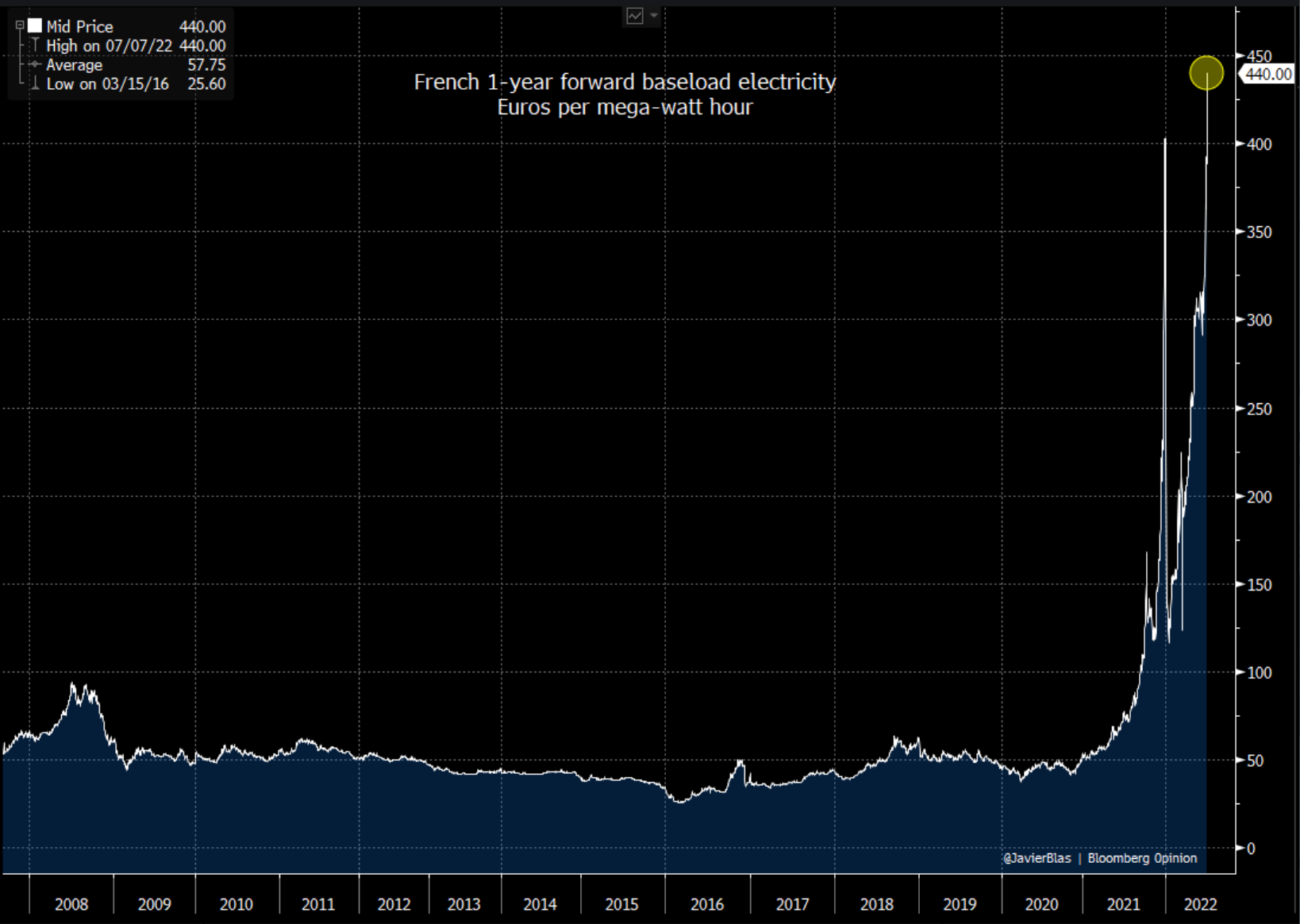
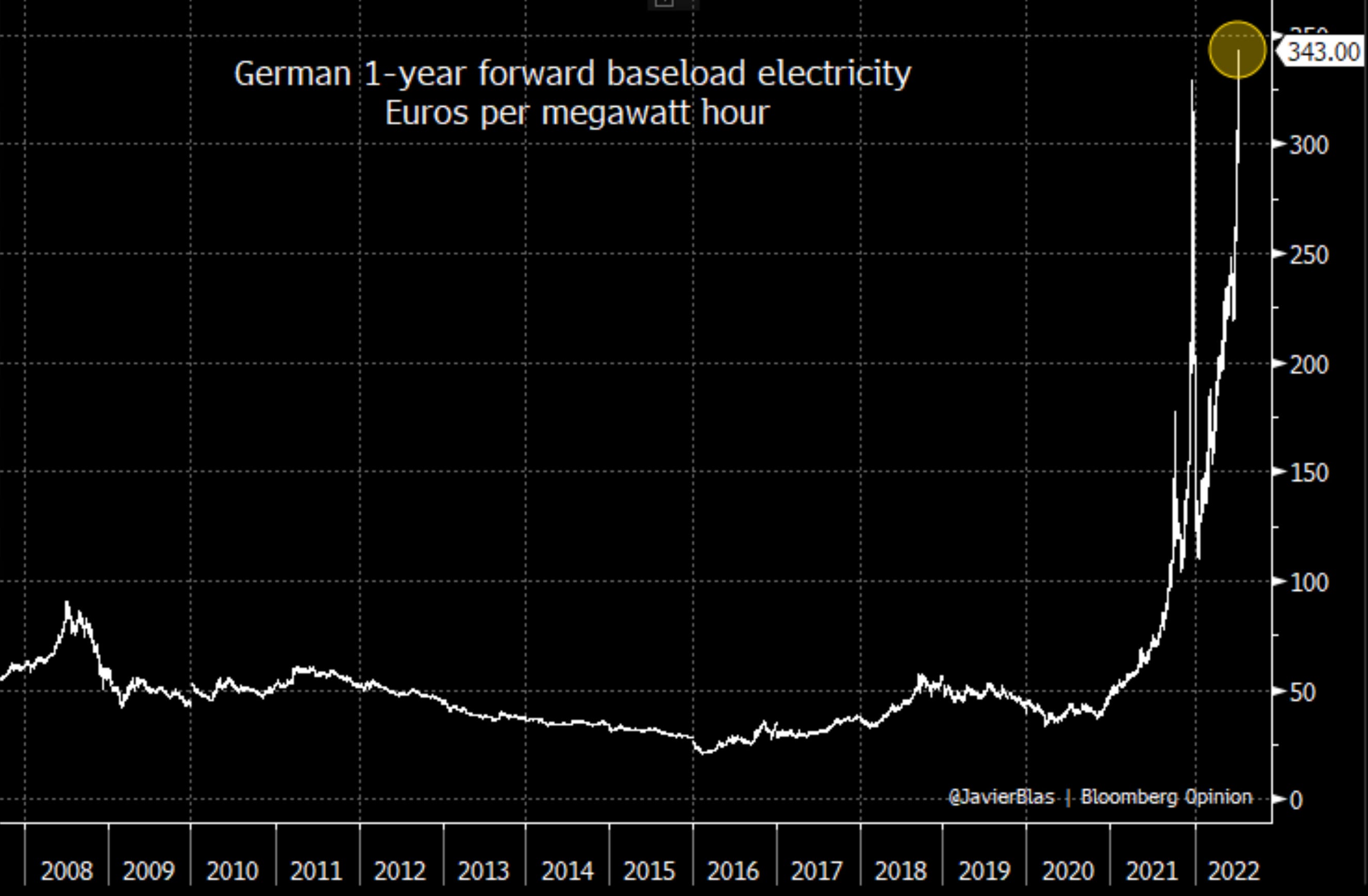
European electricity and gas markets will put massive, I think intolerable, pressure on European politics/policy
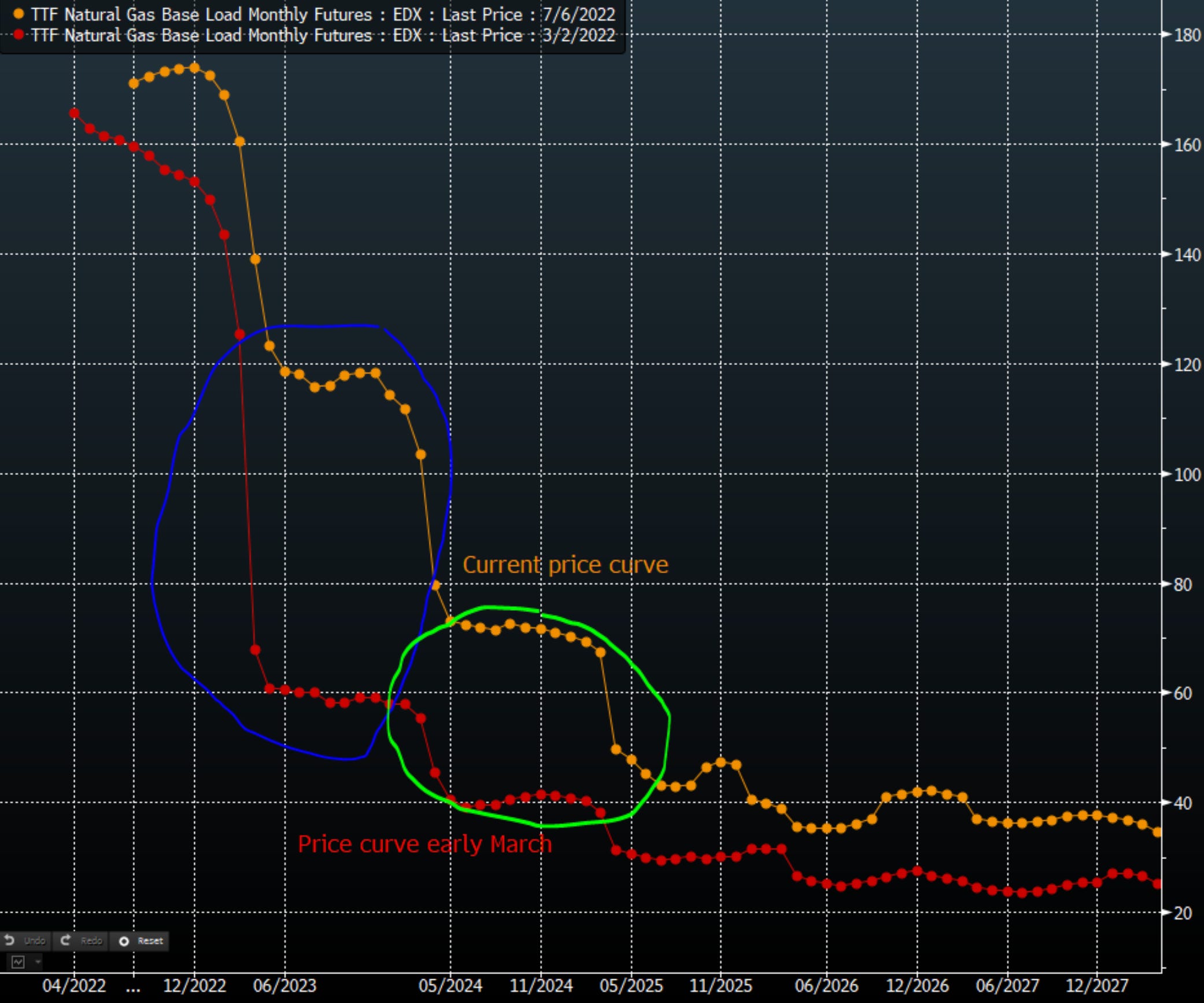
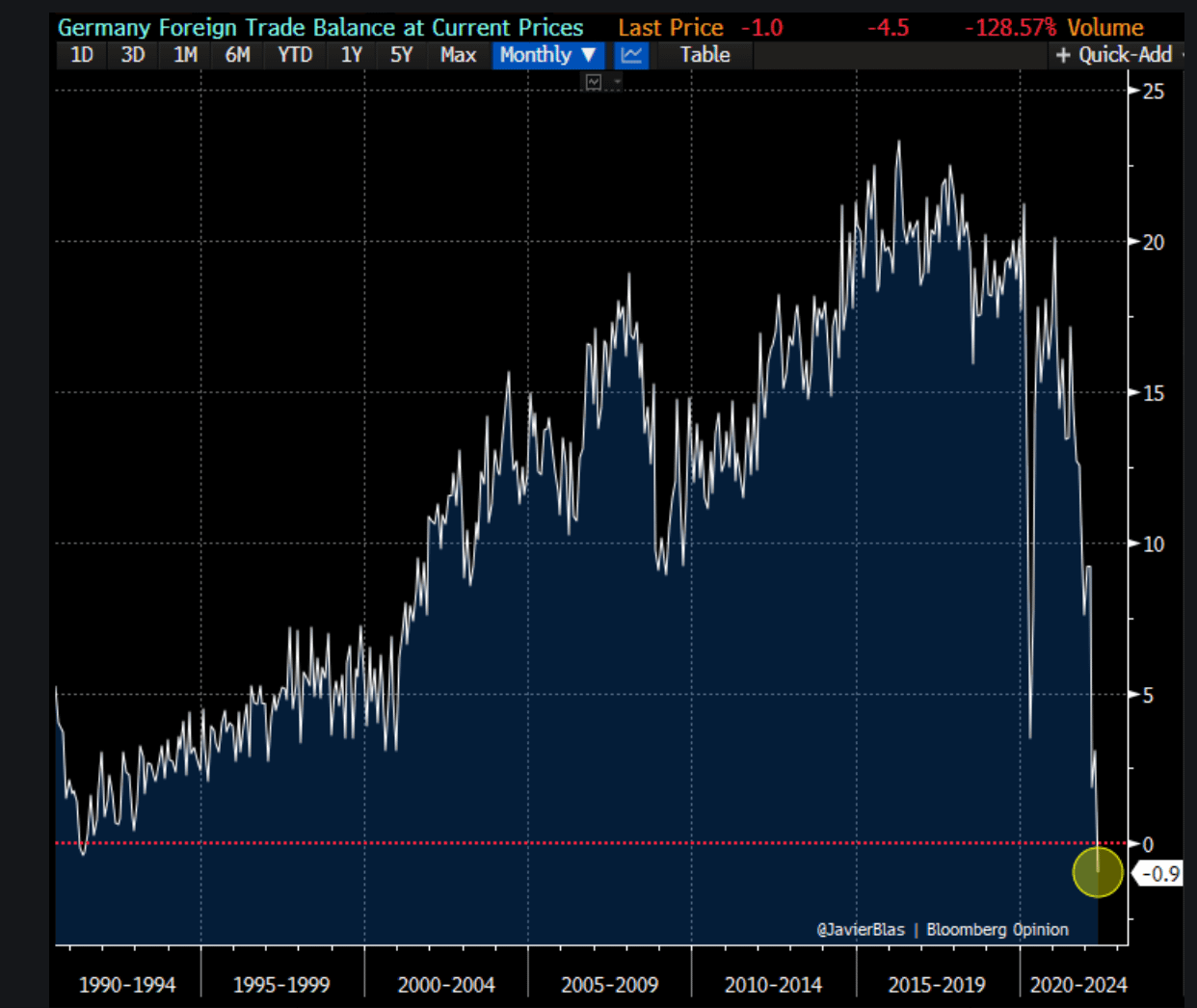
Spot electricity and gas markets are blowing up. But, less noticed, so are 2023 and 2024 gas prices.
Germany’s gas situation is dire. They are issuing official warnings about rationing. Lots of manufacturing will get turned off.
The head of the Swiss gas industry association:
People are not aware of how dangerous the situation is.
People who hedged forward will face massive margin calls. Industry experts are predicting governments will have to do bailouts.
I do not think Europe will sustain its current position on UKR/Russia through this winter. And Putin can squeeze much harder.
European voters will not support large hits to their living standards to fund turnign UKR into rubble and fighting between people screaming in Russian at each other.
The media and much of academia has cheered for the war so it’s very hard for them to cover this story…
French 1-year forward electricity price blowing up
German 1-year forward electricity price blowing up
2023 and 2024 EUR gas prices also way up, not just spot prices
BBC giving duff info about a no confidence vote
The BBC political editor has been saying this morning that if Boris loses a no confidence vote there will be an election.
Wrong.
This is not automatic.
As I explained a few days ago the Lascelles Principles apply.
In short:
The Queen & Cabinet Secretary will confer. (Surely already have.)
A new Tory leader will be asked to form new govt.
The new leader then can win a vote of confidence.
So no election.
It doesn’t have to work out like this, it depends on exact votes, people, circumstances, but this is the overwhelming likelihood of how the constitution would play out in these circumstances.
A PM cannot just ‘call an election’ and losing a vote does not necessarily mean an election.
A 'national broadcaster' has a duty to get basics right.
Standards collapsing everywhere…
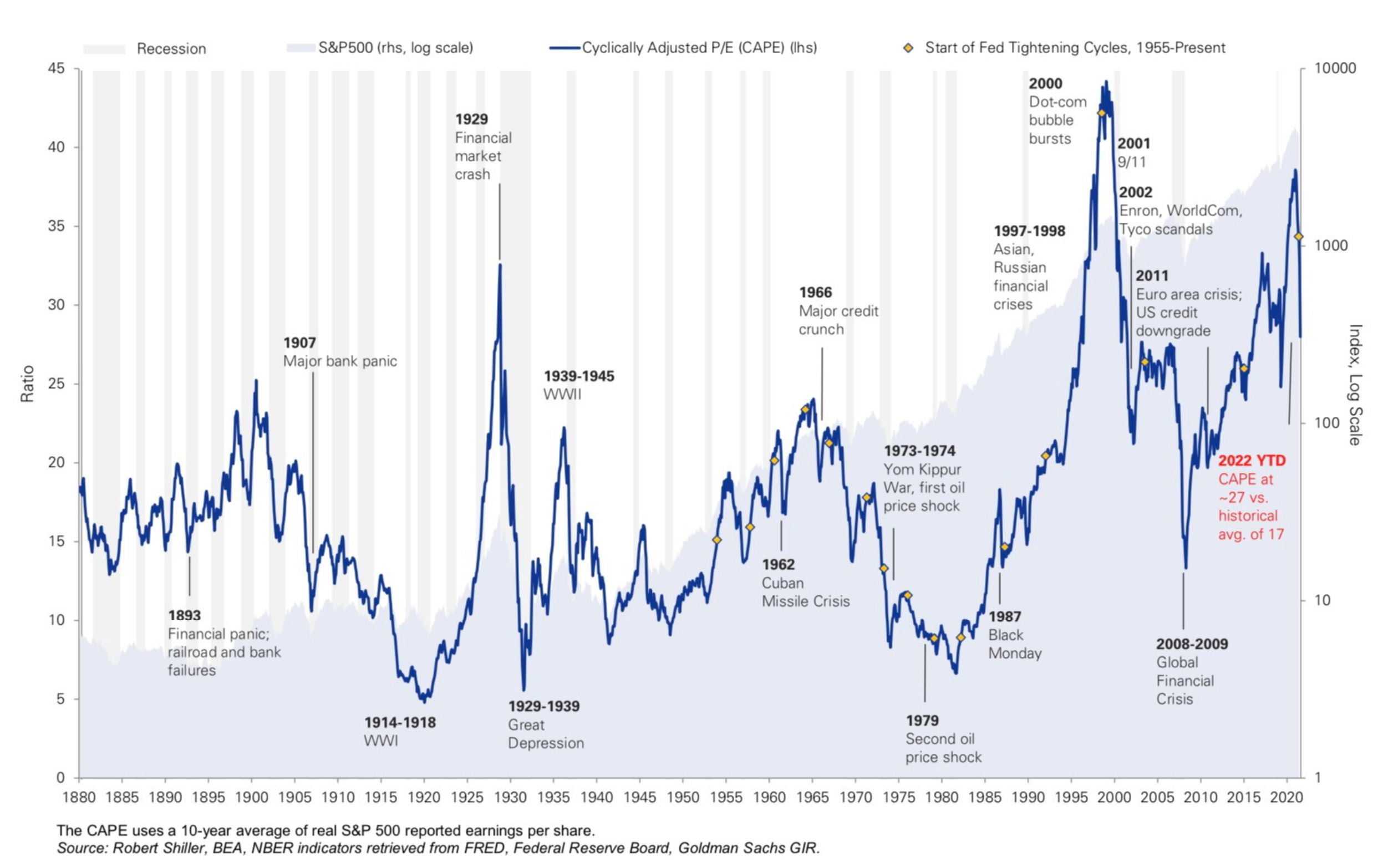
S&P500
German trade balance when cheap gas shut off
The answer to the question regarding overnight returns is that the SPY etf price is a total return series including dividends - when you look at this vs SPX e-mini futures (which is only a price series) the effect disappears. It's just a mirage created by the shares held in the SPY etf recieving dividends after the market close and this being reflected at the next market open.
https://twitter.com/profplum99/status/1487453567858319369?t=abpC3c_jg0G4Levkf2X4Pg&s=19
Riveting stuff, Dom. Really enjoyed the snippets. I was slightly upset you left out any discourse about “Minions: The Rise if Gru” and it’s impact on the socio-economic state of the West. Other than that, good read