

Old snippets free, new snippets below the paywall, and a TSP Project update for subscribers.
US election
Let’s look briefly at the incredible delusions of the Insider class.
I’ve described repeatedly here since 2021 how swing voters who barely watch political news in focus groups discussed Biden’s age while the mainstream media and hyper-news obsessed NPCs were extremely delusional on the subject. And how Kamala is seen in focus groups — she was not the ‘great candidate’ that the Insider class deluded themselves into believing.
The Pod Save America crew — the savviest of the Obama DEMs — are still deluding themselves about this in their podcast today. If you think this, your focus group people are deluded or lying to you!
I will be very surprised if David Plouffe returns to tell them all that Kamala was a great candidate with a great campaign. I think Plouffe will diplomatically say — we should have a) pushed Biden out straight after the midterms and b) had an open primary starting early 2023 which almost certainly would have generated c) someone much better than Kamala and a tough campaign machine and this would have given us a much better chance against Trump.
I.e they should have taken my advice!
I said April 2023: if you wait until 2024 then panic over Biden being gaga and find yourself with Kamala, you could lose even worse!
Ben Horowitz has a great book on startups and management. Ben says to founders, ‘The main thing is to keep the main thing the main thing.’
It is seared into my brain about politics.
There is a vast industry to discuss politics. But this industry operates to pull you away from keeping the main thing the main thing.
The DEM establishment with a net worth in the trillions couldn’t focus on the main thing in early 2023: Biden is gaga, Trump is not a doomed moron, if we box ourselves in in 2024 we could easily lose, so let’s face reality now.
Earlier this year I explained my view to one of the richest, toughest, best connected Democrat insiders in America with access to all sorts of private information, in and out of the White House, friends with all the most famous people in the world. He replied: you’re wrong, abortion is the big issue, we’ll tear down Trump every day and win.
On almost any other issue, I would assume this guy is 10X-100X more likely to be right than me.
But in politics it’s really hard to ignore consensus and social pressure and see the main thing.
SOME SELF-HELP ADVICE FOR THE NPCs coming here from Twitter…
You need to plug your brains into a different ecosystem and practice NOT saying ‘retard nazis’.
Step 1. Watch Theo Von interview Dana White. Best bit is Dana on ripping out Peloton.
Step 2. Watch Theo Von talk to Joe Rogan — two top comedians, if your conclusion is ‘unfunny retard nazis’ you must try harder!
Step 3. Watch Theo Von interview Trump.
Step 4. Consider there is an entire ecosystem of communication outside your ‘mainstream’. Tens of millions prefer it. Trump was all over this ecosystem. But your candidate Kamala couldn’t be risked in it because she would obviously blow up! People are now saying ‘she should have done Rogan’ but the right take is — we got ourselves a candidate who we couldn’t have put on Rogan without serious risk of totally self-nuking our campaign because the modes of speech among normal voters is now defined as FASCIST by the Insider class. Democrats and their thought police have made it culturally impossible to engage with more than half the voters.
Another part of the reason is the ‘mainstream’ media no longer pretends to try to give truthful information. Instead it clearly LIES CONSTANTLY. And this alternative ecosystem can and does explain the lies — the days of Walter Cronkite are over, hence why so many mainstream media and ‘mainstream’ DEM politicians now support censorship. As I pointed out a few weeks ago, the DEM candidate for President in 2004 now openly describes the First Amendment as a historic problem needing solution — inconceivable a decade ago.
There’s so many examples but just consider one.
One of the most important memes to believe for the Insider NPC class is that ‘Trump praised Nazis at Charlottesville’. This meme has been repeated endlessly. I hear it endlessly among academics and hacks. But if you watch the full clip of his speech at Charlottesville, it’s clear that his actual meaning is the exact opposite of what the mainstream says and he was NOT ‘praising Nazis’.
Now I suspect that most of you hearing this won’t believe me.
Watch it…
Ok, you watched?
If your reaction is ‘err well he’s still a fascist’ you are probably not going to cope well with the next few years.
What you should think is: My God, I believed the meme, so did almost everybody I know, what else do I believe that is fake?
I’ve said to many people that ‘if you watch the whole clip you see the mainstream media is fake’. They never believe me until they watch it.
If you’re one of the Pod Save guys reading this, then a step for your recovery is — explain to your audience that the mainstream media lied about this and Trump never said it, play them the whole tape, apologise for getting it wrong yourselves, and tell them ‘if we want to recover we must stop kidding ourselves with fake news from the mainstream media!’
Good luck!
Biden is Biden. He’s rubbish relative to the level of Bill Clinton or Obama… And he’s old, mentally frail (putting it kindly), clearly even less up to the job than in the 1980s, and getting older/frailer. Biden will be an even worse candidate in 2024 than he was in 2020…
Me, 2021
He isn’t going to change much for the better. People at his age only change a lot in a negative direction. And in 2024 it’s unlikely some covid-like situation will let him hide from the rigours of the campaign trail... DEM voters and swing voters already want him to stand down in favour of someone from a younger generation...
While he’s [Biden] benefiting now from confounding media expectations, such pundit-cycles never last. It’s easy to imagine that in the course of 2023 Biden comes to be seen as non-viable. He may die, be too ill, or be too obviously infirm to be viable even if the Party tries to rally behind him. Actuarial statistics are against him. And he may be challenged and quickly appear unable to cope and therefore doomed to lose against Trump, prompting panic…
His [Trump’s] strengths are still underrated by the media, as is the potential for Biden’s age to turn into a disaster. If tempted to think ‘Trump’s finished’, imagine how you’ll feel if Biden has a visible deterioration in 2023, says he will still stand, and the polls show him neck and neck, while Kamala is positioning for a run if Biden collapses.
The media underrates the desire of normal voters, including core DEM voters, for Biden to stand down and a new generation to step up.
Me, November 2022, post mid-terms
Biden is a weak candidate. He answers questions about Ukraine saying ‘Fallujah’. His own voters are not enthusiastic about him running again. Given his age and mental impairment he could easily suddenly deteriorate… But if the DEMs replace him, perhaps in panic after a sudden deterioration, someone could win the primaries who is easier for Trump to beat…
Many players around the world regard Biden as senile, the Democrats as insane, and the DC system — together with European capitals — spinning out of control towards more war. The Insider-Twitter network has been effective in policing views inside western elites but its very success is generating counter-forces outside the West…
[P]oorer people who don’t watch much news are generally much more open-minded about politics than graduates living in big cities who consume a lot of news, who are much more ‘trapped in narrow information bubbles’ than the average GOP rural voter who pays little attention to politics. And pundits and academics are the most closed-minded of all while thinking of themselves as the opposite. They herd to a few acceptable opinions but think they’re the few able to step outside herding and observe objectively. Another golden rule of politics is that it’s the intelligentsia who are easiest to fool with simple moral propaganda tales…
One core problem with the 2016 Facebook story was that almost nobody in politics, media or academia understood communication, digital marketing, how Facebook actually worked and how ‘AI/data science’ could be connected to these subjects…
But a deeper problem was and is: most of the old political media and Left-academia aren’t actually interested in the truth, they just repeat whatever crazy nonsense they see on Twitter and if their social network believes it so do they! A small but telling recent example: look at how they swallowed the ‘Andrew Tate arrested because of his twitter spat with Greta’ story, classic fake news reported as fact across old media and swallowed whole by the Insider twitter network that generates Official Truth because it was simple and striking propaganda with a moral twist that the audience wanted to believe. Everywhere you looked, Harvard and Oxbridge graduates, so keen to write op-eds and tweets about how non-graduates are suckered by Putin-Trump ‘misinformation’, tweeted their delight at the story. This is normal.
Having watched Washington and New York since 2016 the most reasonable prediction is that most Insiders will continue to tell themselves fairy tales and peddle misinformation to each other while thinking it’s the MAGA plebs who are the victims of misinformation. There will be incredible dislocations between Insider debates over 2024 election and what’s really happening, what normal voters actually hear and prioritise. If you pour the petrol of the war and ‘AI/KGB/PRC/MBS’ stories onto the fire, it could easily be even crazier than 2020.
Me, April 2023
Biden is seen by critical voters — not just swing voters but most DEMs — as ‘too old for the job’. The old media has tried to portray the State of the Union speech as kiboshing this meme. Everybody honestly reporting focus groups knows this is deluded. (Some of the comments are like this — ‘he was shouting in the speech, I guess because he’s so old, you know old people lose track of whether they’re shouting’.) A faction of the most Left is attacking the NYT for discussing this problem and printing polls that show the problem. This is a classic example of how political networks can reinforce delusional behaviour by encouraging displays of ‘loyalty’ based on spreading nonsense. (This is much-discussed by academics so ironic that academics are the most prone to this sort of thing.)
Similarly DEM Insiders keep saying on the media that ‘those who work with Biden know he’s super-sharp’ etc. This is also deluded. Voters can see an old man shuffling around the stage, often tumbling over, clearly confused, often getting critical names wrong — calling Ukraine ‘Iraq’ etc. He’s now got those special extra-wide shoes designed to make old people less likely to tumble. Voters will not be persuaded to disbelieve their own eyes by tales of ‘how sharp Biden is in private’… Term limits is even more popular than in the 1990s because the age of DC has grown and Biden is so visibly old…
Me, Feb 2024
It wasn’t hard to be ahead of the game on this if you just listened to voters but as I keep stressing, a fascinating aspect of modern politics is that Insiders talk endlessly of ‘strategy’ and ‘message discipline’ and ‘focus groups’ but they just won’t listen to the voters, they only really listen to each other!
Below the paywall is:
Systemic problems with the polling industry and Trump.
Power in No10 and 70 Whitehall — how the Cabinet Office has sabotaged the PM’s office.
Quick thoughts on budget.
More on AI. A ‘country of geniuses in a datacenter’ as soon as 2026? How an AI model has created a $300M memecoin and what this says about the next few years.
More on EU failure.
Having avoided the speaking circuit I’m now doing paid talks to raise money for a) Maths Circles (a nonprofit network giving primary children elite maths education) and b) the ‘TSP project’. Fees depend on who/what you are and how rich you are. I do some free (e.g schools), some discounted, some expensive… DM me via the Substack app if interested: put TALK, venue, date, audience, proposed fee etc — and I’ll get back pronto. Don’t waste your corporate loot on MPs!
I’ve cut/pasted pre-14/10 Snippets from the Pitt/Metternich blog and pasted them below.
Topics include:
The Westminster Waste Land: the Theresa May/Osborne inverse-signal on the Tories.
Southwood et al essay on productivity and the collapse of interest in it I’ve noticed among Tory MPs over 25 years.
Sadiq and crime.
Sue Gray and the intel agencies.
ECHR, Jenrick and fake news from academics (e.g Prof Tim Bale) and old media (e.g Adam Boulton, Iain Martin). As you’d expect from the old media, they comprehensively fooled themselves over the basics in a case study of why watching the old media makes your understanding worse.
EU failure. Because the old media is dominated by people to the left of Blair and strongly Remain, the UK MSM cannot cover the EU’s problems as this would break the simple narrative they've been desperate to believe in. We’re in the odd position of more and more EU elite characters, such as Macron, sounding more like Vote Leave 2016 while their comments are largely undiscussed in SW1. EU governments are bailing on Schengen. Their defense industries are a joke. They’re sabotaging their own tech industry while propagandising to European intellectuals — originally THE supporters of technology! — that technology is some sort of California fad, AND while blabbing nonsense about ‘strategic autonomy’ that requires actually being able to build technology. Actual extremists are a serious and growing problem in the EU — unlike in Britain where our joke media tried to portray irrelevant football hooligan types as if they’re a serious fascist menace, to justify shifting UK elite opinion closer to the NYT on the need for censorship. In America, the EU is becoming a rich source of memes for ‘useless stagnant bureaucracy’ but the old ‘mainstream’ UK political media is stuck in perpetual 1998 on this subject.
A case study of SW1 moral rot. Lawyers used Whitehall and MPs to push through primary legislation overturning a Supreme Court judgment in the PACCAR case in order to allow lawyers to keep their snouts in the trough. As you would expect, radio silence from the network of charlatan lawyers who spent the Brexit years screaming ‘fascism’ and ‘rule of law’. Radio silence from the media. SW1’s revealed preference: it’s OK to overturn Supreme Court judgments, it’s NOT ‘an attack on the rule of law’, provided it’s to secure the stream of Range Rovers to lefty lawyers.
AI models evolving into agents.
Thiel, Taiwan and deterrence.
Houellebecq: immigration and the scorn of elites.
Madness generated by the Equality Act, supported across SW1.
Why Starmer resembles the Trolley-2021: doesn’t understand why he won, hasn’t an actual plan, doesn’t understand power in Whitehall.
Zelikow on the big picture of US/China/Russia/Europe — parallels with the 1930s and Hitler, Japan, Stalin challenging the US/UK.
Senator Lindsay Graham says we should support UKR because ‘they’re sitting on a trillion dollars of minerals’!
Delusions of NPC intelligentsia, immigration, false consciousness — Prof Simon Wren Lewis as a case study.
Patrick McKenzie, covid, AI security.
Li Lu and Charlie Munger.
Elon
For three years the graduate NPCs of SW1 who have built nothing in their careers have babbled their takes on ‘what Elon doesn’t understand about managing tech companies’. This month Elon caught a skyscraper falling from space with chopsticks.
It’s a perfect summary of the West’s politics. Outside SW1, it is beyond laughable that NPC hacks could think they understand managing tech companies better than the guy who built SpaceX.
But this became the high status SW1 position to hold and tweet! They were not mocked and humiliated. They were retweeted and strengthened their position in the NPC hierarchy. For the past two years the same people kept predicting ‘I’m leaving Twitter’ and they couldn’t even get this right. When the Starship news broke, therefore, the NPCs just ignored it — like they now largely ignore Ukraine. In the same week, the same characters took to twitter to agree about how No10 should, obviously, NOT invite Elon to discuss growth and innovation.
Watch this video of smug EU/Arianne characters mocking Elon a decade ago — it’s important to remember that the ‘serious’ people of government were profoundly wrong as usual.
The system is working as intended — its core function now is to generate and preserve the pathological denial-of-service attack on Insider NPCs own perceptions of reality. If you don’t tweet-signal that you share this perception, you’re ‘extremist/fascist’. The Attorney General’s speech this month may prove to be the most important speech of the entire Starmer government. Obviously therefore it was almost entirely ignored or misinterpreted inside the system — except in the deep state where they understand very well what it means, for us and for their careers.
SNIPPETS: September to 14/10
6/10: The Westminster Waste Land speaks: the Theresa May/Osborne inverse-signal on the Tories
May ‘analysed’ the Tories’ loss. If you abstract from the dead clichés, her propositions are:
A/ The loss was NOT because they abandoned control of immigration and put taxes up.
B/ Nor was it that they ‘talked right and acted left’.
C/ She says they lost because ‘we trashed our brand’ by which she means abandoning ‘integrity and competence’.
D/ And because they spent ‘too much time’ focused on defections to Reform and ’tacking to the right’.
E/ ‘Elections are won on the centre ground.’
F/ The key elements of the Tory Party are ‘security, freedom, opportunity’.
G/ The Tories ‘have never been an ideological party. It is a party of principles and pragmatism.’ [😂🤣😂]
George Osborne chirped up that: ‘This is a very good piece - I agree with @theresa_may’.
It’s pointless analysing such rubbish much but…
As usual the party and many pundits are generating false dichotomies that obscure reality and fool Insiders.
Saying ‘we’ll take back control of immigration and reduce it’ (2019 election) then abandoning this from 2021 and instead having legal immigration, illegal immigration and fake asylum/boats totally out of control, then adding the abysmal Rwanda farce, certainly was part of it.
Saying ‘we guarantee not to put up income tax’ (2019 election) then putting income tax up certainly was part of it. As was the general failure of MPs to be interested in stalled productivity — as I’ve written about many times, this was a deep sign of the deep Tory rot.
Saying ‘we’re the party of law and order’ while letting out of jail early serial rapists and domestic abusers and killers while spending taxpayers’ money on weddings for serial child killers ‘because they have human rights’ certainly was part of it.
But it isn’t all.
Saying ‘we’re the natural party of government’ and self-evidently not taking government seriously certainly was part of it. The Boris shambles, the Truss shambles and the Sunak shambles — the constant daily uselessness and clear lack of priorities and capacity to act — added to these things.
And the way in which from 2021-4 all three PMs just let the NHS collapse and kill thousands, such that all over the country people had personal experience of NHS nightmares, certainly was part of it. A huge part. And a part Tory MPs have not faced and characteristically tried to ignore last week. This is their comfort zone. As many of them have said to me over the years, ‘Dominic, we’re Tories, we try to avoid discussing the NHS’. Vote Leave’s 2019 campaign that made reassurance on health/NHS central is an aberration in Tory world over decades.
It is an obvious fact that they ‘talked right and acted mostly left’. It’s idiotic to deny this — though most high status pundits are denying it! But is also obvious that they overrated the potential of tax cuts and ignored the NHS while the whole country wanted action in a way that illustrates very deep pathological ideas among Tory MPs — pathological because it was so massively and obviously massively self-destructive.
The ‘centre ground’ meme is, as I’ve explained for 20 years empirically false. Vote Leave won in 2016 and 2019 explicitly on the basis that this meme is false and swing voters are not in a ‘centre ground’. SW1 didn’t listen and won’t listen. They parrot these fake memes because they focus on Insider discourse instead of listening intensely to voters.
If you believe this meme, then it makes sense to say ‘the Tories lost because they shifted right’.
But when you realise this meme is false, you can also realise the truth — the Tories machine-gunned the entire electoral coalition we built 2016/19 by failing on immigration AND the NHS, by talking ‘right’ but letting Whitehall continue with Left policies on almost everything, by focusing on the media and SW1 instead of on voters. They were simultaneously both too on the ‘right’ and too on the ‘left’, which makes no sense if you believe the ‘centre ground’ meme, and far from ‘shifting to the right’ there was no coherent political strategy at all behind Trolley-2021/2, Truss, or Sunak.
Connected to the ‘centre ground’ meme is another meme, even more ludicrous, pushed by Kemi B’s campaign: that ‘we lost because we paid too much attention to focus groups’. You can only make such absurd claims if your entire orientation is to SW1, you spend no time talking to focus groups, and you refuse to face the consequences of 2021-4 for millions of families vis the NHS and cost of living. That the person saying this is also the favourite of much of the Tory Establishment says a lot about how the Establishment continues to live in its own increasingly deranged parallel world and absolutely refuses to listen to voters. As many said about Tory conference, the NHS was not an issue and they were boozing as if they’d won.
May’s piece, amplified by Establishment voices, is the sort of garbage that SW1 generates — empty dead clichés, fitting for the Westminster Waste Land, useful only as inverse-signal.
One of the oddest but most important changes I’ve noticed in dealing with Tory MPs from when I first got involved in politics in 1999 (over Blair's campaign to replace the pound) is the change in attitudes over the economy/productivity.
In 1999 they often said things I disagreed with but they were *interested* in productivity.
In 2020 even after the covid nightmare and a massive obvious need for radical action also demanded by voters, it was amazing how *UNINTERESTED* Tory MPs had become in all the questions about: planning, housing, procurement, R&D, startups, investment (foreign/domestic, public/private), skills, the massive amounts of damaging regulation *they* had imposed since 2010 never mind previous 20 years, the abysmal tax system they’d made more abysmal ever year since 2010 etc etc.
This was a major part of how I spent my time, contra the media story then. But there was almost no interest from Tory MPs!
MP after MP would look at me funny in 2020 and suggest the focus of No10 on these things was somehow an odd obsession, a bad priority.
It seemed in No10 that MPs were 10x more interested in footballer/celebrity stories than in productivity.
When over summer 2020 we did various things to deregulate, there was 10x more opposition & whining than support. So much so that I told officials and spads to make changes to secondary planning regulations *without ANY formal media announcements* so the *Tory* MPs wouldn’t notice. I assumed that if it wasn’t in the media it effectively did not exist for MPs. This proved sadly true.
This obviously continued 2021-24. And they fought an election without any serious story on the economy — they didn’t even fake/pretend to have one. And ~95% of the MPs didn’t seem to notice! (Similarly they seemed collectively unaware of all the things we did 2010-14 on schools. Even though they were mocked for having no story of success, they didn’t even stutter out a rubbish story about ‘school reform’.)
Partly this is the obvious massive drop in talent of Tory MPs (a subset of the larger massive drop in talent across public life including Perm Secs, Cab Secs, generals etc).
Partly it's cos the lower grade characters are NPCs staring at their phones, they don’t read much, it’s hopeless giving them complex things to read etc.
Partly it’s cos the ‘right wing’ MPs have built an information system for themselves via WhatsApp based on garbage websites. They bitch about the biased MSM but they collectively have no interest in creating an elite high status alternative.
Partly it seems there’s a similar drop in interest in the old media where Brexit has also made discussion of productivity issues even more psychologically fraught.
When I asked some bright young people interested in productivity recently about this, they suggested that the nature of MPs has also changed so they are much more ‘local councillor types’ who are less interested in such things. Seems true.
But there's something else, I’m not sure what...
I hope the few smart and determined young MPs read this essay and consciously try to reverse this trend.
An interesting test of whether the rotten Tory Party has *any* residual energy is the degree to which this paper is discussed and ideas promoted by MPs.
I don’t think they will and if someone tries I think they’ll probably fail - and even be attacked by their colleagues - but I hope a few remember: it is not necessary to hope to persevere…! And you can always defect to something new!
18/9: Sadiq and crime
NB. Labour is so programmed by loony pundits and ‘experts’ on crime that Sadiq is saying he will PROMOTE THE CRIMINALS BEING LET OUT OF JAIL EARLY TO THE TOP OF THE HOUSING QUEUE!! He says this will ‘save money’ because they will ‘reoffend less’.
If you think ‘yeah sounds reasonable’ then support Labour or Tories. If you think ‘these loons are deluded voter-haters’, you’ll love the new movement. More info coming soon. I’ll soon post here a ‘how you can help’ blog and do a AMA about the new project. We’re holding off because we don’t want to say ‘how can you help’ until we can engage with those interested. A lot will happen over the next month.

Sue Gray and the intel agencies
As you can see the old political media cannot report on the Cabinet Office and the true deep state. One effect is the absence of explanations about things like the lack of a PPS to the PM. Another is there is very little coverage I can see of another important fact — many powerful officials in the intelligence agencies strongly oppose Sue Gray staying and are briefing to undermine her. This is partly because of her views on Ireland where she is not, to put it mildly, aligned with the punchier ends of the deep state (and cf. her son, now an MP). And she has cut the agencies out of meetings with the PM.
This has also, I’m told, affected the battle over the new Cabinet Secretary. Cabinet Office officials thought for months that SG had stitched up the process for her friend Olly Robbins — in Whitehall the normal hypocrisy is for everyone to talk loudly about ‘meritocracy’ while stitching up a fake process to give the desired result. But there is a push among a network of officials to dissuade Starmer from this and instead appoint a figure they trust and who will not represent an axis of power with SG. If a spad controls the PPS and the Cabinet Secretary, they are more powerful than anybody but the PM — and given what a NPC Starmer is, this effect would be enhanced.
Now obviously if these sort of things had been going on when I was there, the screams of ‘fascism’ would have been deafening. But always remember, the centre of gravity among SW1 political hacks — wherever they work, including in places like the Telegraph — is to the left of Blair and is deeply friendly to the Cabinet Office system. They puffed up SG as a genius. So it is even harder than usual for them to cover what’s really happening. The median lobby hack/pundit sees Labour fixing appointments as ‘grownup government’ but Tories doing it as ‘fascism’.
ECHR/HRA, fake news, and how the old media and MPs struggle to discuss serious things seriously
Back in 2021-2 I explained on this blog some basic issues with the ECHR/HRA and the armed forces and agencies. E.g it creates weird situations with drone strikes where government lawyers decree that it’s lawful to kill X but it would be unlawful to try to arrest X. But a bigger problem is effects on surveillance in Britain.
Jenrick touched on the first in a video this week — the issue of government legal advice leading to people being killed rather than arrested. Unfortunately he phrased it badly in his video then his campaign botched handling it after it became news.
The old political media has spread total misunderstanding about the issues. Almost universally the old media has ignored the actual issues and turned the story into ‘Jenrick accuses soldiers of murder’ — when the whole point is that government legal advice is defining killings as ‘lawful’, NOT murder. SKY referred to it as ‘EU law’ when it isn’t. Iain Martin and others confused people that the issue relates to Afghanistan 20 years ago (and the inquiry now underway) when the point is it was an issue in the 2019-24 Parliament and is an issue today — it’s nothing to do with the current inquiry. Lefty hacks and lawyers spread ‘murder’ and ‘extra-judicial killing’.
So the net result of SW1’s focus partly turned on tricky important issues is that they’ve confused themselves and voters even more and the overall understanding on these issues has got even worse. The median Tory MP and median political hack will understand the whole thing worse today than 48 hours ago. The system is working as intended!
I explained on Twitter, in response to Rusbridger spreading confusion, the actual issues.

This below sums up how the Idiocracy works. A ‘Professor of Political Science’ spreads the fake news that the issue is an accusation of ‘murder’ and a senior reliably-useless SKY hack retweets it.
As always it’s hard to know how much is malice — i.e they want to discredit the story so they reframe it like this — and how much is incompetence/carelessness, i.e these days senior people in academia and media just don’t care about facts, they just spread whatever fits with their emotions (while claiming it’s the proles who do this). And of course these two characters are constantly complaining about Trump inventing things and ‘disinformation’ — but what they actually care about is portraying the other side as mad/evil, they have no interest in objective accuracy as valuable in itself.

In The Times, Iain Martin, reliable spokesman for Whitehall conventional wisdom, repeats the confusion and adds to it:
In effect, he was accusing members of the special forces, who take exceptional risks in defence of our country, of extra-judicial killings, and he was doing it simply to make a cartoonish point about the ECHR in the middle of a Tory leadership race.
Martin then writes that the issue relates to operations in Afghanistan 20 years ago. Wrong. The issue is live in the last Parliament, it’s a live issue today!
SKY news managed to combine ‘murder’ with confusing ‘EU law’ and the ECHR/HRA, 8 yeas after the referendum.

There’s a lot of discussion in AI circles about a) the extending planning horizon of AI-agents and b) progress made on ‘hallucination’.
The crossover point isn’t far away when AI-agents have a) longer planning horizons than MPs and b) less hallucination on important subjects than mainstream political hacks and MPs.
When you look at the old media, think ‘most of this is now hallucination’.
Memoir on the referendum
Alan Halsall had more effect on history than 99-100% of MPs in the last 50 years. Without him, Vote Leave might not have won.
After the referendum, while the Conservatives were in office and nominally ‘in power’, the Electoral Commission and other state entities tried to convict him as a criminal. It showed how the Establishment will use the law for political warfare — even while they simultaneously attack others as trying to subvert institutions with fascist tactics. And it showed how utterly NPC Tories were in office — they had a No10 nominally committed to the idea that the referendum result was valid but it couldn’t control quangos run by Remainiacs from using state power in this way.
Halsall has written a Memoir. Obviously I’m not at all objective but if you’re interested in these things you should read it. Alan was a hero. The treatment of him was disgraceful. One of the reasons I hate the Tory Party so much is that Conservative ministers either sided with this effort or sat uselessly without the courage or gumption to act.
Unusually it gets some of the history right.
In particular, the inspiration for ARIA was NOT ‘DARPA’ with a ‘D’ added in 1975 but ARPA, the original, which funded Licklider, Bob Taylor et al.
Creating this was one of my terrorist demands when Boris came to my house in July 2019 asking for help in survival and somehow solving the constitutional crisis.
Patrick Vallance suggests that when I arrived the civil service was already working on this. LOL. HMT and other officials repeatedly tried to kill it. HMT even tried to kill it after the legislation had been passed. Some officials came on board and played a heroic role. But the idea that the system was already planning to do this before we arrived in 2019 is nonsense. It only survived because it was written into the 2019 manifesto which gave it just enough momentum to survive the bureaucracy.
More on EU failure: defence and industrial capacity
The WSJ ran a story on many ways the EU is failing to build for war despite saying it’s crucial.
Denmark said it would reopen an ammunition plant but hasn’t been able even to start tendering:
In a highly trumpeted move, Denmark—a nation of around six million that has donated all of its artillery to the Ukrainian war effort—late last year bought back a decommissioned ammunition plant to resurrect its production of artillery shells.
Nearly a year later, the factory in a remote village in northern Denmark remains empty. Political wrangling has delayed the process of finding a company to produce the ammunition, and the formal tendering process has yet to start…
Britain has yet to restock its inventories of the Storm Shadow missiles…
Inaction has created a vicious cycle: European defense companies, short of investment, struggle to deliver, prompting European governments to buy instead from American suppliers. That in turn means less money to European manufacturers, which risk falling even further behind in the race for new military and technological advances.
European Union countries directed 78% of their procurement spending to suppliers outside the bloc, including 63% to the U.S., according to the most recent EU statistics available, covering June 2022 to June 2023.
Frederiksen, the Danish prime minister, said Europe must cut red tape so defense production can accelerate.
“If we want to accomplish this, we need to blow up all our usual procedures,” she said.
In the EU like Britain it has become normal for it to be impossible/illegal to do anything fast.
Among Insiders this is rationalised as good and the idea of doing anything fast is treated as moronic or part of a corrupt plan.
I predict Brussels will not ‘blow up all our usual procedures’ though it’s interesting a senior politician is even saying this. Change will only come after even bigger crises in the domestic economy shifting EU politics further.
Back when campaigning against the euro I used to tell British hacks — you have to stop just reporting the rhetoric and look at the reality. Remember the Lisbon summit in 2000 and the claim the EU would become the tech capital of the world?! I said then — bullshit. Many in SW1 swallowed it and kept swallowing it for the next 24 years.
Case study: a Tory Bill you almost certainly haven’t heard of but speaks volumes
The Government’s priorities 2021-4 were a joke.
There’s a hundred examples but I’ll give you one you almost certainly won’t have heard about but which also tells you a lot about the rest of the rotten SW1 system.
Look at its reaction to the July 2023 ruling of the Supreme Court in the PACCAR case concerning litigation funding agreements.
Parliament had legislated that funding agreements which provide for the payment to the litigation funder of damages awarded by a court to a claimant are enforceable, but only if they comply with certain conditions designed to protect the litigant from the funder, including regulations limiting the amount the funder can recover from the damages awarded to the claimant by the court.
In PACCAR, it was argued that litigation funders were exempt from these rules and thereby immune from regulation. If this argument had been correct, it would have allowed them to have made substantially greater speculative returns from litigation. These arguments succeeded before the lower courts, but were rejected by the Supreme Court by a 4-1 majority.
The effect of the Supreme Court’s decision was that a very significant number of litigation funding agreements were rendered unenforceable, because they did not comply with the rules set out in legislation which the industry had generally ignored.
The Conservative Government had less than a year left in office at the time the Supreme Court’s judgment was handed down. Despite having enormous voter demands for action on various fronts and huge political incentives to act on those pressure, following heavy lobbying by the litigation funding industry and lawyers, the Government devoted significant Parliamentary time to trying to pass a one-clause Bill to reverse, with retrospective effect, the decision of the Supreme Court, and thereby free the litigation funding industry from the modest degree of regulation which the Supreme Court’s judgment confirmed it was subject to.
The Bill fell when Parliament was dissolved before the General Election and did not become law.
With extreme irony, despite the open attempt to reverse the Supreme Court’s decision with retroactive effect, did you see lawyers screaming on TV that that the Bill, which greatly benefited them as well as the litigation funding industry, was an attack on the ‘rule of law’?! You did not!
A perfect example of:
Utter Tory moral and practical rot in caving to self-interested lobbyists for such a shamelessly self-interested Bill. This is on brand for the modern Party.
Nonsensical Tory rot too since these vultures hate the Tories — it wasn’t even corruption to help friends, it was just a display that the Tory Party is a NPC operation that exists to act for lobbyists of powerful interests and they’re so brain dead they automatically do as they’re told.
The incredible cant of lawyers, screaming across the media about ‘Brexit and the rule of law’ then, to get their snouts in the trough even more, passing a Bill to reverse a Supreme Court decision. The ‘rule of law is sacrosanct, protect human rights’ lawyers were silent when it comes to lawyers looting.
Radio silence from our ‘mainstream media’, always on the side of Establishment lawyers.
It’s a non-issue among Conservative supposedly anti-Establishment dissidents — they just don’t care about government.
I assume that Labour will shove it through in coming months so their friends can grab millions more.
And the media will continue radio silence.
And the Tory Opposition will probably side with Labour.
It may seem a small thing but it sums up so much about Westminster, the parties, the media, the ‘human rights blah rule of law blah’ lawyer charlatans and how power works.
It sums up rancid SW1.
Insiders shifting against the First Amendment
I’ve mentioned this before. Here is a telling spiel from John Kerry making clear how Democrat Insiders now are creating a story that the First Amendment means disinformation therefore must be ‘changed’:
There’s a lot of discussion now about how you curb those entities [social media] in order to guarantee that you’re going to have some accountability on facts etcetera. But look if people go to only one source, and the source they go to is sick and has an agenda and they're putting out disinformation, our First Amendment stands as a major block to the ability to be able to just, you know, hammer it [i.e ‘disinformation’] out of existence. So what you need, what we need, is to win the ground, win the right to govern by hopefully having, you know winning enough votes that you're free to be able to implement change [i.e to the First Amendment].
I said this would spread. It’s spreading. If Kamala wins there will be action. Including I think Elon et al being forced to sell Twitter to people who will rebuild censorship in the name of ‘national security’ and ‘disinformation’. Perhaps you think this is a price worth paying to avoid Trump but don’t fool yourself about the direction the DEMs will go in if they win: hostility to free speech, hostility to entrepreneurs.
Great podcast from Steve Hsu
Steve talks genetics, startups, academia, physics sociology, US-PRC and much more.
All-In podcast: models becoming agents
Always interesting, this week it has a particularly interesting discussion on OpenAI and the future of LLMs. A central point I think almost totally missed in SW1: SW1 sees these models as ‘chatbots’ but the real point is the models are evolving into agents. Agents can become drop-in workers/assistants and replace human ‘knowledge workers’. This is already happening. If you know what you’re doing you can use these models now as useful research assistants.
It’s very early in the process. But a few more cranks of the model training runs and these agents will be everywhere and increasingly autonomous. This will bring huge productivity gains for a small number of already-competent humans and organisations and will allow such organisations to have greater reach and create more value without having to hire more people. Greater autonomy will also enhance their destructive capacity when applied to drones and war etc.
An updated graph showing how model training compute is doubling every ~6 months

Also look at this shift in predictions for when an AI will achieve 98th percentile in a MENSA admission test. Four years ago the median prediction was 22 years ago. The market was resolved on 12 September!

Connected, Chinese smartphone factories where ~100% of highly complex manufacturing is automated.
But of course in Westminster and much of social science academia, all this is ‘fake/bubble’…
Great podcasts on Li Lu
Li Lu is an extraordinary character. He had a truly appalling childhood, somewhere in the range of 1 in 10,000 worst on earth or even worse! He survived the most fatal recorded earthquake in history, Tangshan 1971, and the Tiananmen massacre after which he fled to America.
He then happened to hear a speech by Warren Buffett, became friends with Charlie Munger, was the only person on earth Munger gave money to to manage, and built a very successful investment fund.
At some point in this tale before he was rich and famous he happened to visit Spoleto during the festival. My wife was friends with the organisers of the festival and went every year. She met Li Lu and talked to him, not knowing how his life would turn out. She often says to our son, ‘Remember Li Lu’s childhood, stop whinging!’
These two podcasts tell some of the story.
Charlie Munger on why Li Lu is different, 90 secs.
Patrick Collison, if you’re reading, please call Li Lu and get his permission for Stripe Press to republish his book, it’s impossible to get without spending many hundreds of dollars!
Yield on Greek bonds now below French bonds

Via @INArteCarloDoss (an accomplished trader) who also comments:
At this stage, there is absolutely zero doubt that [US] unemployment is going to have a period of steady increase into 2025. My numbers indicate a EOY level above Fed’s median SEP (4.4%) and higher from there in 25.
The point that is lost on most is that private payrolls have already started contracting while job openings have dropped but are still above the layoffs trigger line. In anecdotal terms this translates into the current rigidity of a jobs market where applicants find it extremely hard to get rehired, and it takes much longer than it would have and/or what it should have.
This is absolutely critical because it shows that future rises in unemployment will come with a much higher difficulty of finding jobs. So the upcoming layoffs might be compounded with a worsened transition rate and an openings to unemployment ratio that might get trapped at depressed levels.
More on Sue Gray
See below for last week’s comment.
I said last week it was hard to believe No10’s claim about SG and spad pay.
Today it’s reported by BBC that SG is on 170k and was involved in the decision.
I said last week the Cabinet Office lies and tricks the press successfully more than anybody in Whitehall.
Today the Cabinet Office says:
“It is false to suggest that political appointees have made any decisions on their own pay bands or determining their own pay. Any decision on special adviser pay is made by officials not political appointees. As set out publicly, special advisers cannot authorise expenditure of public funds or have responsibility for budgets.”
A clear attempt to mislead the media.
Many media reports will recycle the claim I gave myself a 40k pay rise after covid.
False.
I gave myself a 44k pay CUT (from 140 to 96) so I'd be paid the same to sort out Brexit as I was paid for doing Vote Leave, the pay rise story was a lie but Starmer like the average NPC believed the lies.
After the 2019 election I then put my pay back to the normal figure 140 in Jan 2020. This was then misreported at the end of 2020 after I'd left as 'he gave himself a post-covid pay rise' etc.
Terry Tao on the new OpenAI model
A ‘mediocre but not completely incompetent graduate student’.
With another one or two training runs plus other tools like proof assistants it may be ‘significant use in research’.

If the model is given a preview of the methods section of a physics paper, it can reproduce 10 months of work coding in 5 prompts.
https://x.com/emollick/status/1835342797722767592
Tyler summary: https://marginalrevolution.com/marginalrevolution/2024/09/strawberry-alarm-clock.html
Steve Hsu summarises:
For this discussion I am considering one specific metric, namely the extent that an assistant can help with one or more subtasks of a complex mathematical research project directed by an expert mathematician. A competent graduate student can make contibutions to such a project that are more valuable than the net effort put in to get the student up to speed on such a project and then supervise their performance; but with even the latest tools the effort put in to get the model to produce useful output is still some multiple (but not an enormous multiple now, say 2x to 5x) of the effort needed to properly prompt and verify the output. However, I see no reason to prevent this ratio from falling below 1x in a few years, which I think could be a tipping point for broader adoption of these tools in my field. (And I would say that the ratio is already below 1 for some specific subtasks, such as semantic search, data formatting, or generating code for numerics to assist a mathematical research exploration.)
Thiel, Taiwan and deterrence
Thiel said at the All In summit:
A/ PRC grabbing Taiwan will be a disaster.
B/ Stopping it is NOT worth World War 3.
C/ America should remain ambiguous about whether and in what circumstances it might fight.
I agree on A and B.
I partly disagree on C. There are many scenarios where America should stay quiet. But 1914 shows the danger of ‘strategic ambiguity’: it signalled strategic confusion leading to strategic disaster.
The British PM, Cabinet and departments were uncertain about whether we should and would fight for Belgium, and what the supposed ‘guarantee’ (in contention with Bismarck in 1871) really meant and we projected this uncertainty. (If you look carefully you see that the big issues were in no sense properly examined before the crisis.) It encouraged Berlin to conclude that we would not fight. If you’re talking about nuclear weapons, you really don’t want to deepen confusion that leads to the sort of miscalculation that has been common in history.
With nukes, if you will fight you should say so because you might deter the war. You don’t want the 1914 scenario: you don’t deter your opponent then after they attack someone else you decide to fight to the surprise of your opponent who may have been deterred if you’d made it clear.
While ambiguity can be useful, we simply do not have the calibre of people I trust to make it work. It’s much more likely that Biden/Kamala types will repeat our 1914 error than pull off a clever bluff.
Interesting and funny!
Also a perfect example of what I say repeatedly about the unrecognised simplicities of high performance.
The extremely intense interest in what he does screams on every page.
It is undiscussable in polite society that almost nothing that is of real importance in government attracts this sort of intense interest so it’s not surprising most government is rubbish and Lollapalooza effects (cf. Charlie Munger) are very rare.
The most obvious exception is special forces where there are people like Mr Beast. So Whitehall increasingly imposes rules to stop special forces interacting with the rest of Whitehall and even the MoD.
Interesting FT interview with Houellebecq: immigration and the scorn of elites
What has driven the rise of the French far right in the past 20 years?
“Immigration,” he answers without hesitation. “And also, the total scorn of the elites.” He’s speaking in a low voice, in short sentences interspersed with long pauses, every now and then popping mysterious pills from a plastic bag. He mentions the 2005 referendum on the European constitution. The result was “No”, later overridden by the French parliament. “It was almost 20 years ago and people still remember it,” he says. “They really made fools of us.” “It’s dangerous to mock people,” he adds, and pauses. “I mean, you can mock them, but there are limits.”…
The elites, he says, think of people as ploucs. “In America the equivalent is hillbilly.” Does he actually like hillbillies? I ask. He takes a while to consider. “Yes,” he says finally, but he pleads to not having any friends among the category. “I’m faithful to my class.”…
“Nobility had nothing to explain their right to stay in power, apart from their birth. Contemporary elites claim intellectual and moral superiority.”
“In France, immigrants from northern Africa, who are usually Muslim, don’t integrate well,” he continues. Doesn’t integration take time? “In France, it’s the reverse,” he says. “It’s the second or third generation that is making trouble. We are witnessing a disassimilation. It’s a catastrophe.”…
The other controversy was caused by an interview he gave in which he said: “The wish of the native French population, as they say, is not that Muslims assimilate, but that they stop stealing from them and attacking them — or else, another solution, that they go,” predicted “acts of resistance” against Muslims in France and said that some French people expected “a civil war in the near future”.
Even the RN’s president Jordan Bardella considered these “generalisations” “excessive”. The rector of the Grand Mosque of Paris announced he had started legal action against the novelist but after meeting him, was satisfied with an apology. Is he still predicting civil war? Houellebecq takes time to think. “No. There will be lots of violence but not between Muslims and non-Muslims,” he says. “Until recently all the immigrants coming to France were from the same two regions, north and west Africa. Now they come from all sorts of places, Pakistan, Chechnya, Somalia and other countries.” Some are Christian. “They bring their conflicts here . . . There are ethnic wars in France to control drug trafficking,” he says, echoing a common trope in French media. “Some end in submachine gun fire.” He pauses. “Well, it could be worse. In France, it’s still relatively difficult to get a submachine gun.”…
I mention a 2019 essay in which he called Donald Trump a good president and wonder if he will be cheering him on in this US election too. “Yes,” he says. “Trump won’t start wars,” he adds, topping up our glasses. What if he stops supporting Ukraine? “That’s good,” Houellebecq says. But Ukrainians want to liberate their territory, I say. “What do I care? At the start of the war, I was surprised because I thought Ukraine was Russian,” he says. “It’s better for nature to take its course,” he adds in the spirit of might is right. “People who have humanitarian ideas are a catastrophe. It doesn’t work and motivations are doubtful.”
I’m not sure he’s changed his mind on civil war, perhaps it’s too much of a hot potato…?
New paper on natural selection
There’s coordinated natural selection on alleles affecting associated with:
lighter skin color
lower risk for schizophrenia and bipolar disease
slower health decline
increased measures related to cognitive performance (scores on intelligence tests, household income, and years of schooling).
Paper: a look back for 50 years of Study on Mathematically Precocious Youth.
The system working as intended: the madness of the Equality Act
The excellent Marginal Revolution covers the recent absurd court case against Next.
I won’t repeat its arguments but you should read it. It explains how the courts are now imposing their ideas on ‘fair prices’ as if Adam Smith never wrote. There’s many levels of stupidity and damage. Without understanding what they are doing, Labour and Tories have given judges — often ignorant of basic education about markets — the power to fine companies for simply paying people market wages. Apart from the direct harm, such stupidities also create vast uncertainty for investors, entrepreneurs, and managers.
Another few examples…
A/ Councils are now not allowed to prioritise English children for services because a lefty campaign brought a judicial review under the EA and had it declared unlawful — the Council cannot prioritise English children over illegal asylum seekers.
B/ There has been a multi-year disaster with pension rules driving senior NHS surgeons, doctors etc into retirement. In No10 I dug into why. it became clear discussions in the Cabinet room were dishonest. I dug deeper. Finally officials came clean. The reason for the problem was legal advice that said — you can’t change the rules just for NHS staff because we will lose judicial reviews under the EA and be forced to extend changes across the entire public sector costing over £10B (I can’t remember the exact number but I think it was around 10-20B range).
In 2020 during covid we used a temporary dodge. But the government then did what is now normal. The Tories worked with Whitehall to hide the truth about the effects of the EA from MPs and media. If you look at all the debate over the issue I’m not aware of a single MSM story explaining this classic ‘legal advice’ problem.
This is replicated daily with EA and HRA.
Both parties strongly support the EA and will continue to.
*The system is working as intended.*
Many deep things vindicating Vote Leave predictions in 2015-16
a/ During the referendum I said Brussels would be a disaster on tech regulation. Clegg and his FT, Economist etc chums laughed. Here is Clegg himself admitting how Brussels is blocking models deployed in the EU.

Brussels regulation is causing havoc in other areas including genomics and genetic engineering. As we said during the referendum, the Charter of Fundamental Rights — NB. this is EU law and entirely separate to the ECHR — gives the ECJ vast scope to regulate and impose political ideas. And because this is now in the Treaties it’s extremely hard to change.
b/ I said that free movement plus inability to deal with Islamic extremists/terrorists would lead to political crisis.
Germany said a few days ago it is opting out of Schengen.
The deputy federal chairman of the Federal Police Union said: 'The crisis in Germany's security is a direct consequence of Schengen's ineffective policies. Schengen's inability to manage migration effectively has put Germany's safety at stake. Germany must realize the current failure of Schengen and either make a concerted effort to return to the current legal situation or terminate Schengen.’
4/5 of Germans want a ‘fundamentally different’ immigration and asylum policy.
The CDU leader has said Germany should turn away all asylum seekers from Syria and Afghanistan. If you said this in SW1 the NPCs would scream ‘Far Right!’
And the Dutch said this week they will enact emergency measures and want an opt out from EU asylum rules.
This is barely covered by the old media because it’s an obvious narrative violation: EU good, Brexit bad. And there’s another narrative violation: the EU approach on free movement is forever, British whining was a British aberration, no change will be tolerated, predictions of political crisis are wishful thinking.
But the scale of voter revolt is upending this assumption of Brussels and SW1.
The Dutch Minister of Asylum and Migration Marjolein Faber said: ‘The voter has given a clear mandate. We need to change course and the influx must be reduced immediately. We are taking measures to make the Netherlands as unattractive as possible for asylum seekers. And there is no place here for anyone who abuses our hospitality. I am going for a safer Netherlands.’
The EU will continue to fall behind America and China on technology because of its regulation. The political crisis over immigration/asylum will grow and empower real extremists because the EU’s fundamental approach is wrong and it’s extremely hard to fix. They are stuck with the Treaties and the ECJ which will greatly inhibit attempts at a saner system.
As David Deutsch said in 2016, the critical issue in the referendum was the potential for future error-correction. The EU is programmed to make this super-hard. Our MPs can, do and will cock up all sorts but thanks to Brexit we have restored our potential for error-correction. This week is also a reminded that a judgement over something as deep and complex as Brexit will take decades because it concerns huge historical forces such as demographics, immigration, productivity that play out over decades.
Ford executives visit China, are stunned to realise China has overtaken them. Steve Hsu has been saying for years: China is advancing across the tech stack faster than the West realises. Our ‘experts’ are often not. Actual experts are not listened to because the message is uncomfortable. Actual racism (Chinese can’t innovate, just copy etc) inhibits facing reality.
I assume the EU will increasingly block PRC imports using the propaganda of ‘climate change’ to stop competition and ignore the obvious hypocrisy regarding the implications for its revealed preferences versus climate change rhetoric.
Starmer already resembles Johnson-2021: doesn’t understand why he won, machine-gunning his electoral coalition, no actual plan, no grip of Whitehall
No10 is briefing that ‘We were elected first and foremost to sort out the public finances.’ If Starmer believes this he will fail even faster and harder than I thought and predicted.
They were elected because a) the Tories destroyed themselves and b) voters could see failure everywhere particularly with ‘stop the boats’ actually meaning ‘record immigration’, record NHS waiting lists, and stagnant real wages combining with a cost of living nightmare. They were not elected to continue Treasury vandalism masquerading as ‘sorting out public finances’ that dominated 2010-24 with the exception only of the Vote Leave interregnum.
Connected to this is that, leaving aside entirely the question of whether the winter fuel payment is a good policy, it is amazingly bad politics for Labour to have made this a defining battle in SW1. The money is trivial. Even if you accept the Treasury bullshit, there’s a hundred ways to save this money in ways that are good politics rather than something unpopular across the political spectrum and which signals bad priorities. If they can’t grasp this it strongly suggests they will blunder into much worse things because their OODA loop doesn’t work.
Further Starmer has allowed an open power struggle to play out in the media between Sue Gray and McSweeney. Either it’s real in which case Starmer is, like Johnson, doomed to cause chaos for himself because he has no idea of basic principles of management. Or it’s fake in which case the operation is so weak it can’t close it down. (Also NB a lot of leaks presented by the media as from political forces are actually from officials leaking to cause chaos for their own ends, hacks mask the source of leaks to maximise trouble and protect sources.) I think it’s real. And Starmer has institutionalised the conflict because he doesn’t know what he’s doing. And both of them are trying to drive the other out.
This should remind people that Starmer has always been bad at politics. SW1 operates on the basis of — if you’re ahead in the polls you know what you’re doing and if behind you’re useless. SW1’s mood is always a lagging indicator. And it doesn’t work when both parties are clownish as is now normal.
(I think McSweeney does understand a lot of things but I don’t think Starmer does and there is only so much an able spad can do when the principal is a duffer.)
The trolley never understood why we won in 2019.
So after VL left No10, No10 in 2021 started systematically stopping or reversing almost all the big things we started on productivity, spending control, regulation, procurement, R&D, the deep state, Whitehall reform, the NHS and other public services, infrastructure — nearly everything. No10 started machine-gunning the 2019 electoral coalition that the Vote Leave strategy built. Truss and Sunak finished the job.
No Tory PM understood how power in Whitehall really works and none of them even aspired to be ‘a government that controls the government’ — with the exception of the Trolley in 2019 until the election, when he thought he had to control the government in order to stop being chucked out in days or weeks, and for about 4-6 weeks April-May 2020 after the system nearly killed him and he took it personally.
Each Tory PM accepted the intellectually bankrupt and self-defeating Treasury view of how government should work that guarantees systemic vandalism of critical capabilities, procurement, infrastructure, productivity, national security etc.
So the Starmer project already resembles the Trolley in 2021.
He doesn’t understand why they won.
He’s started machine-gunning their electoral coalition.
He doesn’t understand how power works in Whitehall and doesn’t have a grip of it — Whitehall is running them.
And he’s let the Treasury conventional wisdom run their political and governing strategy. He’s even let Reeves chair the ‘mission Board’ on growth!
And another huge problem is coming their way.
In 2020 officials came to No10 with nightmare numbers on prison places and correctly said the system would run out over winter 2023.
We put prisons into Project Speed to figure out how we could start acting in 2020 to make up for the uselessness of Cameron and May by building places faster and cheaper. In the Department for Education, we brought in an excellent official, Mike Green, who cut about a third out of DfE building costs. We brought him into No10 to get help on prisons.
This was one of many things the Trolley stopped in 2021. The Tories instead knowingly headed for this situation refusing to build more capacity — a perfect example of their political idiocy and total lack of interest in good government.
Labour is now continuing the Tory practice of letting out repeat sex criminals, people who’ve murdered people etc after just a few months.
These people will reoffend at high rates.
The voters will think it’s madness and hate SW1 even more.
What would you do if you had to solve this?
You would pass primary legislation empowering government to create thousands of prison places within months using emergency super fast building and repurposing of existing buildings “NOTWITHSTANDING” multiple laws that make it impossible including the HRA (in order to override primary legislation and negate many judicial review nightmares).
This is the only way to stop letting these people out and to provide thousands of places fast.
But Labour can’t do this.
So Labour will be trapped between its ideology, the law, the HRA, and the way both parties have embraced a situation in which Whitehall cannot build anything in less than a decade and both parties have accepted a conventional wisdom that letting out the most violent people early is not only sensible but ‘civilised’ and to be defended.
As often, the ‘sensible’ position adopted cross party in SW1 is seen by voters as stupid and extreme while what voters want is seen in SW1 as extreme.
The old parties are programmed to fail…
SW1 madness on UKR can always deepen
It’s almost impossible to exaggerate how mad much of SW1 has become over UKR.
The UK must issue a straightforward warning to Putin. If you continue to murder men, women and children with glide bombs launched from Russia, then we will lead the rest of the world to authorise our long-range missiles to take out your launchers, regardless of where they happen to be — even inside Russia…
We should provide permission for our Storm Shadows to be used, and invite the French, the Americans and even our more reticent German partners to follow us…
I know that freedom, democracy and elections are complete anathema to Putin. But we are stronger because we willingly accept that elections may not always go our way. He would rather impose his autocracy on Ukraine, but if you value freedom, this is not just a battle for Ukraine, it matters the free world over. Or to put it another way, this is a battle for the right to be a political loser.
I warned in this blog in September 2021 about a possible Putin move on UKR. But if you’d told me then that ministers would be calling for missile strikes in Russia, I’d have said, ‘Not even I think MPs are that moronic.’
And if you’d said that they would frame the war as about ‘a battle for the right to be a political loser’ I’d have said OK you’ve really gone far too far in your contempt for MPs.’
SW1 can always surprise on the downside.
Thank God even gaga Biden wouldn’t go along with SW1’s deranged warmongering.
Zelikow on the big picture of US/China/Russia/Europe
This piece from months ago is interesting. It looks at the current ‘axis’ of PRC/Russia/Iran/NK in the context of the revisionist powers of the 1930s and how the Soviets pushed post-1945.
I don’t agree with it all but it is a useful summary of key features of deep state debate.
I add a quick summary at the end.
New Axis
Wang Yi, China’s top diplomat, said to Putin, Moscow, February 2023: “Crisis and chaos appear repeatedly before us, but within crisis there is opportunity.”
There is defense-industrial cooperation across Russia, China, Iran, and North Korea. This didn’t really happen much with Nazi-JAP axis.
Old axis
‘In the old Axis, there was plenty of distrust. The Italians generally disliked the Germans. They had recently fought them in the Great War. Italy had its own aspirations, both in Africa and in the Adriatic/Mediterranean world. Mussolini remained neutral when European war began in 1939. Japan was neutral too. When Germany invaded Poland, that plan had been hatched exclusively in Berlin. It didn’t have a long gestation.’
‘Just before Germany invaded Poland, Hitler told his Italian friends he would do this. He thought Britain and France would stay out, deterred by Germany’s partnership with the Soviet Union. Italy had just concluded a “Pact of Steel” with Hitler in May 1939. But Mussolini vacillated about joining in Hitler’s war and in the last week of August, appalled that Hitler was really going through with his plans, he told Hitler he was not ready to join a war.’
‘The British of 1939 treated the negotiation of such an alliance with the Soviet Union as play-acting. The British hoped their play-acting with the Soviets might actually be an inducement for Hitler … to make another deal (Munich-style) that might avert war at Poland’s expense.’
But Hitler sent Ribbentrop to Moscow instead of London.
‘When Germany invaded Poland, its closest partner was the Soviet Union. Moscow had a more active partnership with Hitler, economically and militarily, than Rome or Tokyo did. The Soviet Union supplied vital raw materials. Germany, in return, provided a wish list of advanced military designs and manufactured goods.’
‘Stalin was not naïve about Hitler. But … he was coming to regard the Nazi leader as a strategic partner in a wider effort for the ‘have-nots’ to take down the great European powers.’
‘Stalin felt he also had to oppose the Japanese imperialists. The Soviet Union fought two border wars with Japan in 1938 and 1939 and was a key arms supplier for Nationalist China. Until 1938, Nationalist China’s other key arms supplier was Nazi Germany. This made sense to both the Soviets and the Germans. After all, Nationalist China then regarded itself as a kindred revolutionary and anti-imperialist state, opposing predations from Japanese and British imperial interests.’
‘Italy and Japan, remained carefully neutral until June 1940, when France fell… Italy then took a piece of France and turned its attentions to Greece. Italy did this without Germany’s interest or approval. Germany then had to conquer all the Balkan countries who were not already its allies, and intervene in north Africa, as Italy got in trouble and German oil in Romania seemed threatened by British moves toward the Balkans.’
‘Japan joined what had become an “Axis,” but it did not join the war. Stalin used his partnership with Hitler to neutralize the Japanese threat to the Soviet Union. In exchange for a treaty of neutrality with Japan, Stalin cut off his assistance to China.’
‘Thus, in the autumn of 1940, it appeared that the Axis might coalesce to include all four of these major powers. ‘
‘The whole story, from 1937 through June 1941, was then one where there was a revisionist core. Yet that core then was looser and less harmonized than the one that exists now. Its leaders displayed a capacity for strategic opportunism, wishful thinking, rapid turnabouts, and decisive action.’
‘Franklin D. Roosevelt did try hard to find an accommodation with Japan. His efforts in the first half of 1941 were entirely fruitless. In July, emboldened by German successes, Japan moved into southern Indochina. The United States cut off vital oil supplies. The U.S. oil sanctions on Japan shocked leaders in Tokyo. They recalculated.’
[Attempt at reconciliation.]
‘At all times Japan was prepared to negotiate about Indochina. It was even prepared to forego the great plans for the southward advance into resource-rich British and Dutch colonies. But Japan was not prepared to yield its domination of China.’
‘When Konoe’s government failed in its diplomacy with America, the Japanese recalculated again. An entirely new cabinet took power in October 1941. It had a new prime minister and yet another foreign minister. Tokyo redoubled its efforts, diplomatically and militarily. The new government decided that it would either conclude a deal by the end of November — even a temporary one — or it would go to war.
‘In this crunch time, the United States still would not write China off. This U.S. commitment to China was not well-understood at the time or by historians now. For Roosevelt, the commitment mainly arose from his complex calculations about the war in Europe — the need to keep the Soviet Union from collapse and therefore the need to keep Japanese troops tied down in China. It is worth recalling today, as Russia and China confront the United States, that the proximate reason for America’s entry into World War II was its determination to save those two countries from extinction.
‘The United States had prioritized Germany as the likely main enemy. Its strategy for Japan was deterrence. By October 1941, it became more and more apparent that the U.S. deterrent strategy might fail. So Roosevelt seriously considered a temporary deal to relax sanctions on Japan, at China’s expense.
‘The U.S. Army and U.S. Navy supported such a deal, if only to buy time. They feared they might be embroiled in the wrong war against the wrong enemy on the wrong side of the world. The possible deal … leaked. Amid the domestic furor and British and Chinese complaints during that fateful last week of November, Roosevelt decided: No deal.
‘Once the United States adopted its enormous Lend-Lease program in March 1941, Hitler assumed, as Putin now does, that he was effectively in a kind of war with the United States. Yet Hitler wished to put off any direct warfare with the United States. By late October 1941, Hitler still seemed willing to put up with American provocations and leave the ultimate war against America to “the next generation.” In early November, his foreign minister was pointing the Japanese toward the British and Dutch, urging them to avoid any attack on America.
‘Hitler’s calculations about both a Japanese and German war with America finally turned around … decisively, during the second half of November 1941. Why then? Washington rescinded the Neutrality Acts on Nov. 13. That move would, for the first time, bring U.S. convoys into the western approaches near Britain and likely lead to clashes in 1942 unless Germany abandoned its Battle for the Atlantic.
‘With its final diplomatic cards having just been laid on the table in Washington, having set an internal deadline for a war decision, Japan began final preparations for possible war with America. On Nov. 20, Japan asked Germany to join in. Hitler therefore also had that request pending.
‘Berlin did assess that the Red Army was essentially broken. Germany’s 1942 campaigns would just have to mop up. That remained the prevailing assessment in Hitler’s headquarters until Dec. 18.
[So: US rescinded Neutrality Acts; Hitler thought Red Army broken; Japan asked for help in imminent strike; Hitler underrated his own industrial production problems. Hitler said YES. Pearl Harbour, Germany declared war.]
‘It was only about a week after that, in the second half of December, that Hitler started receiving the full news of the weight of the Soviet counteroffensive, even though those attacks had actually begun on Dec. 5. This rough news from the East was joined by other unpleasant disillusionments, about the U-boat program and developments in war industry. Confiding to his intimates on Jan. 15, 1942, Hitler worried aloud that he might have erred. He wondered if the odds might now favor an eventual American victory. But Hitler had not declared war on the United States because of nihilistic fanaticism. He had carefully calculated. He had calculated wrong.
POST45
[Soviet-PRC partnership coalesced as the Chinese communists defeated the nationalists and won their civil war in 1948–49.]
In January 1950, Stalin decided to approve the invasion of South Korea. He summoned North Korean leader Kim Il Sung to Moscow so Stalin could personally and secretly explain his reasoning and plans in detail.’
Stalin: ‘China is no longer busy with internal fighting and can devote its attention and energy to the assistance of Korea…. The Chinese [civil war] victory [in 1949] is also important psychologically. It has proven the strength of Asian revolutionaries, and shown the weakness of Asian reactionaries and their mentors in the West… Now that China has signed a treaty of alliance with the USSR, Americans will be even more hesitant to challenge the Communists in Asia. According to information coming from the United States, it is really so. The prevailing mood is not to interfere. Such a mood is reinforced by the fact that the USSR now has the atomic bomb and that our positions are solidified in Pyongyang. However, we have to weigh once again all the ‘pros’ and ‘cons’ of the liberation. First of all, will Americans interfere or not? Second, the liberation can be started only if the Chinese leadership endorses it.’
‘First, the Soviet-Chinese planning occurred at a time when both countries were still very badly damaged, in every possible way, by their recent wars. There were members of the leadership group in both countries who were anxious to first heal such wounds. These men were also apprehensive about new wars that might involve the United States. They were overruled.
‘Second, the pace of Soviet-Chinese planning was remarkably rapid and decisive. The Berlin blockade came in 1948. The Chinese won the civil war in 1949 and the Soviets tested an atomic bomb. Settling the failed Berlin blockade, Stalin concluded his defense alliance with Mao.
‘And finally, they planned three major operations in east Asia in 1950: a North Korean invasion of the South with China pledged to back the play if needed; a Chinese invasion of Taiwan later in the year; and a Viet Minh revolution against the French in Indochina, using Chinese sanctuaries, advisers, and weapons.
‘In 1950, the United States ended up fighting in Korea, blocking the Taiwan move with naval forces, and reluctantly deciding to support the French in Indochina. Washington reversed its earlier decisions, in 1949, that it would not do any of these things. This American resolve may have surprised Stalin. He had a chance to evaluate this and recalculate. He and Mao also began thinking hard about what they thought would be the coming revival of Japanese or German power. Stalin’s reaction was to double down.
[Stalin was not wrong in calculations on US but US reversed decisions, then Stalin doubled down.]
Stalin-Mao: ‘1) the USA, as the Korean events showed, is not ready at present for a big war; 2) Japan, whose militaristic potential has not yet been restored, is not capable of rendering military assistance to the Americans; 3) the USA will be compelled to yield in the Korean question to China behind which stands its ally, the USSR …; 4) for the same reasons, the USA will not only have to abandon Taiwan, but also to reject the idea of a separate peace with the Japanese reactionaries … Of course, I took into account also that the USA, despite its unreadiness for a big war, could still be drawn into a big war out of prestige which, in turn, could drag China into the war, and along with this draw into the war the USSR, which is bound with China by the Mutual Assistance Pact. Should we fear this? In my opinion, we should not, because together we will be stronger than the USA and England, while the other European capitalist states (with the exception of Germany which is unable to provide any assistance to the United States now) do not present serious military forces. If a war is inevitable, then let it be waged now, and not in a few years when Japanese militarism will be restored as an ally of the USA.’
‘Overcoming sharp disagreements among China’s leaders, Mao went forward with the plan to join the war. The Chinese offensive was barely contained. The U.S. seriously considered nuclear escalation in Asia and mobilized for World War III.
Yugo
Yugoslavia crisis in 1951. In 1951 Sherman Kent of the CIA, in “Probability of an Invasion of Yugoslavia in 1951’, wrote there was a ‘serious possibility’ of a Soviet attack on Yugoslavia. When Nitze asked him what this meant, Kent replied, “I told him that my personal estimate was on the dark side, namely that the odds were around 65 to 35 [percent] in favor of an attack.” Nitze “was somewhat jolted by this; he and his colleagues had read ‘serious possibility’ to mean odds very considerably lower.” Kent then polled his CIA colleagues and their odds in favor of an attack had ranged between 20 and 80 percent.
The attack did not happen.
But in January 1951, there had been a top-secret conference in Moscow. Washington knew nothing of it. Stalin said they had to prepare urgently to invade Yugoslavia and prepare for the possibility of general war. After watching Korea, Stalin concluded ‘the United States is unprepared to start a third world war and is not even capable of fighting a small war.’
‘A tense equilibrium seemed to slowly develop during 1951 and 1952. Why? Perhaps it was the product of further Chinese defeats in Korea. Maybe the scale of U.S. and NATO aid for Yugoslavia helped. Then there was the scale and rapidity of the Western mobilization for general war, the extensive deployment of U.S. nuclear weapons, and the Western determination evident in the appointments of Dwight Eisenhower and Bernard Montgomery to lead the newly mobilized NATO forces.
[Stalin did prepare for Yugo invasion, CIA detected real plans, but predictions of attack turned out wrong because Stalin changed his mind.]
NOW?
‘China and Russia are fundamentally revisionist powers. Their leaders regard themselves as men of destiny, with values and historical perspectives quite different from the consumerist or social metrics that suffuse much of the world. During the last two years they, Iran, and North Korea have intensified their common work to shore up weaknesses in each other’s defense-industrial bases, with Russia the most active entrepreneur. All feel boxed in by extensions of American power they regard as fragile, though formidable in parts. All have long been preparing for a great reckoning. They wonder: Is now the time? If not soon, when?’
[Many historical cases in which dictators did not do what seemed sensible to well-informed outsiders.].
‘Factional debates are difficult for outsiders to see or gauge. Their outcomes often crystallize opportunistically and unpredictably around somebody’s proposal or some external development that forces choices.’
A. Perhaps US enemies will think: things are going OK, we’ll push UKR to failure, the West will crackup over its response, Israel will tear itself apart, we’ll keep strengthening, don’t push confrontation with West, time is on our side.
B. There’s a PRC faction who sees: a slow buildup of encircling alliances, a rearming Japan (also getting closer to South Korea), a mobilizing Taiwan, American plans for high-tech countermoves and containment and strategic decoupling through technology and trade controls. Maybe they’ll think US and EUR are frightened of the economic costs of a conflict over Taiwan. Perhaps they’ll calculate that PRC can weather an economic meltdown better than the decadent disintegrating West. Perhaps they’ll push to strike in Taiwan soon.
Russia sees itself in an existential battle and is militarising.
Both Xi and Putin see themselves as world-historical figures compared to Mao and Peter the Great.
They’re already building their own alternative trading and payments systems.
‘In 2023, Chinese leaders made a strategic choice to replace defiant “wolf warriors” with peace offerings, extending olive branches, inviting mutual cooperation and peaceful coexistence. In this strategy, the burden of choice thus shifts to the United States and others to decide whether to accept these offers.’
[San Francisco summit. Beijing’s official read out was both agreed to peaceful coexistence, no new Cold War etc. But — is that really how they think? Is it more like Camp David 1959 - seemed there could be a possible rapprochement but it soon blew up, no Berlin solution, U2 crisis etc. Then Khrushchev pushed. ‘You are trying to humiliate us. You speak about your prestige but do take our prestige into account.” When Kennedy held firm, Khrushchev warned him, “Let the war happen now rather than later, when there will be even more horrible types of weapons.”]
PRC propaganda. ‘In China, most visible are the full cinemas watching blunt messages in massively popular and costly movies that were deliberate government projects, such as The Battle at Lake Changjin (the highest-grossing Chinese film of all time), its recent sequel (also one of the highest-grossing movies of all time), and Full River Red (last year’s top film).’
Similarly there’s huge propaganda in Russia and Iran.
PRC sees US containment: ‘They see America already energetically organizing, with some effect, its global coalition to impose containment and strategic decoupling through technology and trade controls.’
US is rearming. But PRC can see weakness of US industrial base.
JAP is rearming.
‘China is preparing for war. I am not saying it seeks a war. But, publicly and privately, the Chinese Communist Party is mobilizing its country for one… China has been working hard on preparing and refining its plans for national defense mobilization [which] has repeatedly engaged Xi’s personal attention… Chinese manufacturing capacity now exceeds both the United States and Europe put together.’
In Korea, the Soviet Union deterred US attacks on China. In Vietnam, China deterred US invasion of NV (PRC threatened full PRC attack). In the South China Seas, PRC encroached without war.
Perhaps PRC will announce it will not allow US weapons into Taiwan, per Cuba 1962.
Taiwan scenarios:
A/ Pearl Harbour. Swift PRC invasion on Taiwan and US bases. Probably a general war.
B/ Korea 1950. PRC attack on Taiwan. What does US do?
C/ Indirect. ‘China implements air and sea border controls to make Taiwan a self-governing administrative region of China. There is no need for a direct attack on Taiwan or any blockade of usual commerce. Without initiating violent action, the Chinese can assert sovereign control over the air and sea borders to Taiwan, establishing customs and immigration controls. This is not the same thing as a blockade. A blockade would instead become one of the possible consequences if the other side violently challenged China’s assertion of indirect control… A key point: In my indirect control scenario, the burden of challenging offshore Chinese border controls, and therefore of causing any cut off of Taiwanese exports like semiconductors, would actually fall on the United States and its allies, not on China. This may deter the United States… On July 31, 1914, the New York and London stock markets closed. They did not reopen for the next five months. Even a relatively limited war with China would almost automatically, practically overnight, lead to freezes or seizures of trillions of dollars’ worth of Chinese and American assets of all kinds, with all sorts of counterparties caught in the whirlpools. It could rapidly trigger the greatest disruption in the global economy since the Great Depression, and the effects could easily exceed that.
On Berlin, US relied on nuke threats. We can’t do that on Taiwan.
‘Yet, for good political as well as strategic reasons, the United States also can’t and won’t preemptively and visibly abandon Taiwan.’ [But he doesn’t spell out the reasons!]
[He also suggests continuing to support UKR but accepts ‘maximum danger’ is - what do we do if UKR is successful and Russia escalates?]
‘Iran can provoke with proxies, continue the renewal of its nuclear program that it accelerated in 2023, and dare exhausted, isolated Israel to attack. Iran can also dare the United States to join such a war in the Middle East.’
‘Saudi Arabia and the United Arab Emirates … conduct a diplomatic revolution in the Middle East. Their realignments include a detente with Iran, brokered with China. It includes understandings with China, Russia, and India that further guarantee their security.’
‘Greatly exacerbated by the Russo-Ukrainian war, Europe’s current dependence on Middle Eastern, North African, and east Mediterranean gas and oil has become profound. European states will feel great pressure to avoid doing anything that might endanger these supplies.’
Israel is isolated, weakening and possibly headed for civil unrest.
There’s little support for big new US defence spending.
US has overstretched its institutions by applying sanctions and other economic warfare.
During WWII, Eberstadt played a crucial role in developing US industrial capacity and munitions. He lobbied for the National Security Council after the war in order to improve coordination of all resources.
A few thoughts from me, part summary part my views
In the 1930s there was a revisionist network that was determined to overthrow the dominance of US, UK and other imperial powers. Per Thucydides, they resented the dominance of the dominant and were determined to undermine it and prepared to risk an expanding war to do it.
There is another revisionist network: PRC, Russia, Iran, North Korea.
There is more cooperation over defence capabilities and industrial capacity between this network than there was in the 1930s.
It’s extremely hard to figure out true intentions and calculations of risk inside countries like PRC and Russia. And they are dynamic and change because of how others act. Japan and Hitler calculated the downsides of war with America and concluded the risks were worth it. They were not deterred. Stalin was right to assess that American leaders intended not to fight over Korea but Truman and others then changed their minds to such an extent that America seriously considered nuking PRC. The CIA was right to think Stalin intended to invade Yugoslavia but then he changed his mind (perhaps because of US actions in response to intelligence that was thereby nullified).
To what extent do recapturing Ukraine and Taiwan loom as legacy-defining historic accomplishments for Xi and Putin? We do not know. We should be very careful about any assumptions like ‘they won’t do X because it would be so risky given nuclear weapons’. Such calculations have been repeatedly wrong as I’ve stressed repeatedly in analysis of nuclear thinking back in 2022.
Chinese leaders understand Leo Strauss’s critiques of the modern west, think we are disintegrating spiritually and institutionally, and are weakening economically with huge debts growing and doomed to grow more. Cf. blog on Wang Huning and Strauss.
PRC and Russia are pushing strong propaganda internally.
They’re building their own alternative trading and payments systems. Western sanctions and secondary sanctions over Ukraine are pushing more and more countries to explore alternatives to the post-1945 systems. I’ve said repeatedly I think this will be seen by historians as one of the many own goals of the UKR madness.
They’re building defence industries rapidly. And they can build rapidly unlike the West which can do very little fast now. China is far ahead of Europe now in many technologies including AI, where the EU has kneecapped itself and is proud of it. Unlike vis Hitler or Stalin, the PRC’s manufacturing capacity exceeds both the United States and Europe put together.
Xi does not have to declare war or a launch an attack on Taiwan. He can increase the pressure in a thousand ways, bit bit bit, day by day. He can increase the psychological pressure on Taiwan too, getting voters and the military accustomed to the idea that there is no escape so negotiations is the best path. And as America sees a lack of will to see Taiwan destroyed as a pawn sacrifice in the great power game, many Americans will argue: why are we preparing for possible nuclear war over a Chinese island full of Chinese who don’t want to fight their cousins? (I’ve long argued Taiwan is not the place Bismarck would draw a red line for war.)
America can’t prioritise and has no strategy. Across the world it’s losing ground. And it’s losing the lead in economic strength and tech strength that were critical in defeating the Soviet Union.
What’s needed is a systems view, as I keep harping on about, but this is extremely hard to do as our institutions hate it and like familiar silos (and their budgets/power) and don’t have the people/skills for it.
It’s hard to see NATO cooperation improving given the UKR disaster. If anything coordination seems to be crumbling. Germany has said it’s ending financial help for UKR. Macron has dropped his absurd threats of a few months ago. NPCs inevitably got excited over UKR’s PR offensive into Russia but it signals the lack of an actual plan as Russia’s war of attrition rolls on. (Zelensky will ramp up even further provocations to try to sucker us into direct war. He’ll send effectively terrorist groups into Russia, try to bomb Moscow civilians or something that escalates, try to get strikes on NATO territory or fake them. The comedian-dictator can’t survive UKR facing reality and doing a deal so him and a certain mafia-KGB network will keep doubling down.)
It’s hard to see the EU facing its industrial production problems. This would require fundamental admissions of errors over decades. Then repealing thousands of regulations. And a philosophical reboot.
It’s hard to see US facing its industrial production / procurement problems under Kamala. It will be more regulation and more of all the things causing problems (e.g DEI CHIPS). If you look at the vast spending 2021-4 you can see how little the taxpayers got for it. E.g spending more on broadband than Starlink and getting almost zero for it. With Trump it’s higher variance: it all depends on whether he is prepared to hire top people and trust them to grip real power from the start. If he does, it could be the most important administration since FDR. If he runs it like last time, no chance.
There isn’t public support for more conflicts.
America looks sure to keep increasing its massive debts. This gives China and Russia confidence in the long-term.
The US is obviously unprepared for the enormous economic disruption of a war with PRC: supply chains, trade, financial system etc.
One of the most amazing things about the LLM revolution is how it’s changing software

US Senator says support UKR because ‘they’re sitting on a trillion dollars of minerals’
You can’t make this up.
Lindsay Graham, US Senator, does a video with comedian-dictator Zelensky in which he explains to Americans that NATO should arm UKR to strike Russia (and risk a nuclear war) because ‘they’re sitting on a trillion dollars of minerals that could be good for our economy’.

What’s the best way to follow the US ad campaigns? I want to be able to click and watch the ad and see: how much is being spent, rough audience numbers, where. Please leave suggestions…
Interview with one of the ‘weirdos and misfits’ I brought to No10
In Jan 2020 I wrote a blog about some of the problems with the civil service such as the disastrous rules requiring officials to change jobs every two years to get a pay rise, how we could build something better, and the need for real cognitive diversity — not the fake diversity of DEI/EDI — by recruiting ‘weirdos and misfits’, people with a very different background to the normal of SW1. In Jan 2020 it seemed crazy in SW1 to bring scientists into No10 (look at the responses to that blog) but 8 weeks later it turned out to be super-valuable to have people who actually understood what a virus was and had even engineered them.
Here is an interview with one of those weirdos and misfits who came into No10, one of Britain’s great young neuroscientists who came to No10 from Janelia lab in America where he worked with Nobel winner Eric Betzig. James played a crucial role in alerting No10 to Whitehall’s suppression of the idea of rapid testing and developing an actual rapid testing plan. Without him, Britain would have handled wave 2 much worse, thousands would have died who lived instead, the lockdowns would have been worse, the economic damage would have been worse. Also after I left he played a crucial role in keeping ARIA going and stopping HMT attempts to vandalise it.
He is a good example of the value of No10 having people who a) are highly technically competent and b) have moral courage — they are there to do, not to be, in Colonel Boyd’s formula.
The media debate about rapid tests was a classic example of the invisible narrative whiplash that now dominates political elites.
Story A is believed
NPCs spread it and attack those who don’t believe it
Story A turns out to be fake, inconvenient, redundant etc ( e.g it turns out UKR, not Russia, blew up the Nord Stream pipeline)
Story B replaces Story A
NPCs spread Story B, swiftly reprogram themselves to believe Story B was always the story (there was no A), and now attack people who believe A rather than B.
Rapid tests are dangerous, Cummings is pushing them against heroic Whitehall holding back corruption, fire Cummings… Rapid tests are crucial, scum Tories are delaying their adoption, heroic Whitehall ignored again…
Narrative whiplash is generally so invisible that I’ve said to Guardian journalists — get your phone out, google rapid tests on date XX then YY, see how your paper changed between October 2020 and January 2021 — and they look at their phones … and are puzzled then stunned.
This phenomenon is now ubiquitous. The ‘Biden is super sharp in private… Biden must go’ episode recently was a classic of narrative whiplash. As subscribers will know, I was explaining that swing voters paying very little attention to any news realised Biden was gaga in 2021 but even the week before the disastrous debate SW1 NPCs, echoing the DC NPCs, faithfully parroted the line that this was ‘Russian disinformation’.
James explains from the perspective of a scientist and outsider to SW1 how he found SW1 and the culture of the Cabinet Office.
Pretty much all of the amazing people who came in to Whitehall in 2020 have left or were pushed out. Many other great younger officials have also left. Whitehall is mostly much happier. The public are much worse served but they are obviously the lowest priority in SW1, protecting the system is the top priority.
Delusions of NPC intelligentsia, immigration, false consciousness
I’ve said many times that a Golden Rule of politics is that the intelligentsia are the easiest to fool with simple moral propaganda tales, not the ‘low information voters’ as the intelligentsia refers to them. Those with more education and verbal skills use them to build elaborate ideas about what they want to be true — particularly about the ways people like them should have more power (‘more rational this way’), decentralised systems like markets should have less power (‘they’re irrational, more selfish, too much information asymmetry’), and why ‘low information voters’ don’t understand ‘the real issues’ so need to have their information curated by, you guessed it, the intelligentsia. Thanks to Twitter you can build a Twitter list and observe this phenomenon in real time.
One of the best bits in all Thucydides is his account of the civil wars that wracked Greece:
Thus revolution gave birth to every form of wickedness in Greece. The simplicity which is so large an element in a noble nature was laughed to scorn and disappeared… In general, the dishonest more easily gain credit for cleverness than the simple do for goodness; men take pride in one, but are ashamed of the other… At such a time, the life of the city was all in disorder, and human nature, which is always ready to transgress the laws, having now trampled them under foot, delighted to show that her passions were ungovernable, that she was stronger than justice, and the enemy of everything above her…
When men are retaliating upon others, they are reckless of the future and do not hesitate to annul those common laws of humanity to which every individual trusts for his own hope of deliverance should he ever be overtaken by calamity; they forget that in their own hour of need they will look for them in vain…
The cause of all these evils was the love of power, originating in avarice and ambition, and the party-spirit which is engendered by them when men are fairly embarked in a contest… For party associations are not based upon any established law nor do they seek the public good; they are formed in defiance of the laws and from self-interest. (Book III, Jowett translation.)
‘The simplicity which is so large an element in a noble nature…’ IQ/education are not positively correlated with the political wisdom needed to avoid being suckers for horrific regimes. The suckers for Stalin’s propaganda were the ‘educated classes’, not the median voter. Those managing and directing that propaganda and the torture chambers of totalitarian states are from the ‘educated classes’, not the median voter. And more elite education today is increasingly positively correlated with growing opposition to the First Amendment and support for more censorship on the grounds that the voters need direction. You can see this in the reaction of SW1 NPCs to the riots here and in the reaction of transatlantic NPCs to Elon’s ownership of Twitter.
One of the best examples of the rancid influence of academics on SW1 politics is Professor Portes, a super-reliable useful idiot for the worst regimes and terrorists on earth, a great example of someone who is pure NPC but thinks of themselves as an independent intellect unlike the hoi polloi.
Another example is Professor Simon Wren Lewis (SWL). I’ve mentioned him before. Once or twice a year I flick through his blog for 20 minutes to get an update on what a certain section of the most delusional subset of academics thinks. This is the guy who wrote that supporting Brexit is like believing in QAnon and also writes a lot about how voters are misled by the media. He assumes without question that he sees through all facades to core reality. He believes comic nonsense about what voters think, how they form views, how the media works etc but he has absolutely no idea he is an ignorant clown, more ignorant than a 18 year old who spent 2 months working on a real election would be.
Here he is recently on immigration:
Much public discussion about immigration, including much of the print and broadcast media, negates rather than promotes understanding. The most obvious example is that polling companies still ask voters whether they think immigration is too high, and those in the media treat the results of those polls as indicative of what voters really think. As a result, much media discussion about immigration views it as a problem, and the solution involves reducing the number of immigrants coming to the UK.
The idea of ‘false consciousness’ played an important role for Marxists.
In a letter Engels explained:
Ideology is a process accomplished by the so-called thinker consciously, it is true, but with a false consciousness. The real motive forces impelling him remain unknown to him; otherwise it simply would not be an ideological process.
Gramsci wrote about how ‘progressives’ should ‘work to re-educate and transform the false consciousness that makes hegemonic rule possible’ by the bourgeois order.
For SWL as for many academics, it is axiomatic that ‘more immigration is good’ and that concerns of voters about the effects on public services, our importing of violent and sex criminals etc are a ‘false consciousness’ that is a product of voters being thick and believing the ‘lying right wing media’.
SWL also believes that the Tories tried to ‘eliminate’ the BBC. He doesn’t realise that far from trying to eliminate the BBC, most Tory MPs would sell their families to be on the Today program 810 slot. Possibly nothing I did in No10 annoyed MPs more than banning Ministers from appearing on the Today program and telling them to focus on their real job in January 2020. *I* wanted to marginalise BBC News. Tory MPs violently opposed me, as did Boris Johnson.
SWL also states:
How can we in the UK wonder how a man who tried to overturn an election result can appear to be winning a race to be POTUS again, when a man who illegally shut down parliament could be elected Prime Minister just months later?!
SWL represents a set of hardcore Remainiacs who cannot absorb the fact that proroguing Parliament in September 2019 was seen by the most conservative lawyers as tritely and unarguably LEGAL. Even the most Remainiac government lawyers, such as the appalling J Jones, couldn’t argue otherwise. The Court of Appeal said so in short simple terms. It was the Supreme Court that acted to overturn precedents, not No10. This has been entirely memory-holed. Another irony: these hardcore Remainiacs constantly parrot lines about Trump ‘overturning an election result’ while they themselves explicitly said that the referendum should be overturned. This hypocrisy is invisible to them.
SWL also states that Tory MP rhetoric encouraged race riots:
Attacks by right-wing thugs on hotels housing asylum seekers can be directly linked to the decision by the last Conservative Government to call those refugees that come to the UK by small boats from France “illegal”, and their failure to process asylum claims quickly. Attacks on mosques reflect the Conservative party tolerating, even at the most senior level within the party, Islamophobic language…
Elite rhetoric can easily normalise far-right views and behaviour.
A textbook example of how these NPCs think: the ‘real problem’ is calling the boats ‘illegal’ and ‘Islamophobia’. And they think that if they a) marginalise ‘elites’ by describing as ‘fascist’ anybody who opposes mass immigration, and b) impose more censorship, then they will control the ‘low information voters’ who take their lead from elites. For SWL, the views of Conservative party members ‘reflect a right-wing press that demonises immigrants and Muslims’. So he wants the Tories to ‘portray Farage as unacceptably extreme’, to highlight his ‘links to Russia and his lack of support for Ukraine’.
SWL’s recent blogs are an example of how the tropes of NPC intelligentsia come together in an internally coherent — but actually gibberish — worldview:
Hardcore Remain, we should have overturned the referendum result and we must rejoin.
Those who object to the last 20 years of immigration policy (single exception of 2019-20 when I was in No10) are ‘unacceptably extreme’, many are ‘fascist’.
The Russia hoax was true, Cadwalladr exposed a conspiracy that explains Brexit/Trump.
Support for escalating the UKR war and those who oppose it are ‘a fascist enemy within’ (ironically a classic fascist device).
Voters are easily manipulated by ‘the right wing press’ so we need more censorship. Increasingly they sound like they really HATE the voters. And their reaction to the riots showed these emotions — people who have campaigned for years against jailing people were screaming on Twitter ‘throw them in jail for years!’ I’m sure the fact that pictures of the rioters chosen by newspapers looked like pictures used to illustrate ‘working class Brexit voters’ played a part. The hate is seen and felt by the NPC classes as payback: you racists voted for Brexit, now we can throw you in jail for your racism. Suddenly the ‘rehabilitation is the way, jail doesn’t work’ crowd were transformed into ‘punitive sentences are the way, we can’t be tough enough’!
Tory MPs are following a ‘strategy’ of ‘populism’ that includes promoting and ‘raising the salience’ of ‘Islamophobia’, which — unlike mass immigration, illegal immigration, bogus asylum claims — is ‘the real problem’.
Hatred for successful entrepreneurs, which has become more and more intense, and leads to weird effects like having to argue that ‘AI is a fad/bubble’ etc — because accepting the importance of AI would mean accepting that ‘tech bros like Elon’ are building something important, which cannot be admitted. Any entrepreneurs who do not support the ruling regime must now be demonised as ‘fascist’.
Regulation is good. The idea that there is enormous friction responsible for declining productivity and government performance — and infrastructure taking decades — is false. The only regulation that is bad is that caused by Brexit!
Went along with most of the BLM and trans madness (the median NPC has backed off somewhat from the most crazy elements).
They describe a process of ‘online radicalisation’ they think applies to other groups, including ‘tech bros’, which actually applies best to them as I’ve described here for 3 years.
Their attitude to arms sales today is — support for arming literal Nazi units in Ukraine while screaming for the end of support for Israel.
This combination of views is an extreme view, relative to the median swing voter, held by a subset of the graduate class that pays most attention to ‘news’ and most trusts the MSM. But it is a very widespread worldview inside the network of MPs, officials, MSM hacks, pundits, think tankers, charity workers etc — the NPC network that largely determines opinion inside the SW1 political Simulacrum — and those who believe it strongly believe that those who do NOT share it are themselves extremists or fools (‘low information voters’ or fascist elites). Tories have no inertial guidance and are so intellectually lost they are carried along on the currents of such ideas.
Another delusion these academics tell themselves and the MSM is that the Tories 2010-24 generally and Sunak in particular were ‘right wing on economics’. Leaving aside what Sunak et al ‘really believed’ (to the extent these words mean much when applied to most MPs), it is important that to the set of academics who pundit on politics, a government that put taxes up and regulation up enormously, joined with Whitehall in vandalising the ecosystem for entrepreneurs, and every week let out of prison early murderers and sex criminals who repeat offended then defended this as ‘civilised’ — this is treated as ‘very right wing’ in the NPC ecosystem, too right wing for them to tolerate, and they want the Tories boxed in even further in terms of what it’s acceptable for them to say as a licensed opposition.
NB. These people swallowed all nonsense from the MSM about Biden being ‘supersharp in private’ for two years while the ‘low information voters’ knew in 2021 that Biden was gaga. This fact makes no impression on the likes of SWL who are totally impervious to the ways in which they are constantly deluded by MSM nonsense.
As I’ve said before, we are experiencing a historic event in which consensus reality among educated elites has cracked up. NPCs like SWL/Portes and Live Players such as Elon agreed about a lot in the news a decade ago. Now the NPCs see Elon as ‘mad/delusional’ — so much so they even tweet without irony about how Elon doesn’t understand rockets, is technically an idiot etc. Although the NPC class thinks this crackup will get patched up if they ‘marginalise fascism’, they are deluded about this too…
Sue Gray and spad pay
I’ll write about Sue Gray more soon. There are a lot of claims from ‘allies of Sue Gray’ and ‘No10 sources’ that she has nothing to do with spad pay so accusations of her control are false.
This is very odd. In No10 I sat in a sort of unofficial committee with officials from the Cabinet Office (PET department) to agree spad pay. They had their criteria, I had mine. We went through each one and agreed an amount. If spads thought it was unfair they could and did complain to me. While I did not have total control, I had considerable influence and it would have been entirely dishonest for No10 to tell hacks ‘Cummings has nothing to do with spad pay’.
So if No10 is speaking the truth they have allowed the spads to lose control of their own pay.
Given how generally the civil service is running the show and political forces have been marginalised, this is possible. But it would be very odd for Sue Gray, who herself controlled spad pay in this committee when she was at PET, to have allowed this to happen. Why would she give up this useful power? And are they going to tell disgruntled spads ‘tough luck, officials are in charge, we gave up this power because we think it is constitutionally appropriate’?
A lot of power is in PET. Hacks should pay far more attention to it than they do. And remember that nobody, with the partial exception of the MoD, lies more in Whitehall than the Cabinet Office press office. And this might be another example…
Qs to ask:
Does a PET committee still set spad pay?
Do any spads including SG sit on this committee or attend its meetings?
Is No10’s position that Sue Gray ‘does not set’ spad pay or ‘has no involvement at all’ in spad pay?
If spads want to complain, is the PM the only person allowed to talk to officials about spad pay and HR?
Preparations
If you look back over decades you see repeated financial crashes:
1987
2000
2007-8
2020
There seems to be a pattern of:
Authorities had poor/terrible systems to understand what was happening.
A few smart people with particular psychological characteristics — particularly *want to find the truth* rather than have an easy life — figured out what was happening but senior people mostly ignored them and official systems were programmed to suppress useful signals and spread delusions.
The old media acted as if programmed to be behind the curve and was useless in seeing what was coming (though was sometimes useful after the event in generating investigations into what had happened).
Warren Buffett was positioned to use huge cash reserves to buy bargains cheap.
I assume something similar is likely before the 2028/9 election. And Buffett already seems positioned, has sold vast amounts of shares and is sitting on vast cash piles. On the All-in podcast a few months ago they remarked how Buffett had stopped talking about Apple and this might be a sign. So it proved. He’d sold.
I think that probably we’ll see a combination of:
The old regimes won’t change their ways and therefore won’t be able to do government better and cheaper. I’ve explained many times why and won’t repeat here.
The old regimes don’t believe they can keep power and stop the growing spending.
So the old regimes will try substantial inflation as regimes have throughout history to deal with the massive debts they are incurring and which will get worse and worse.
In parallel other parts of the modern state will crumble. E.g the disasters of Labour 1997-2010 and Tories 2010-24 will continue with energy and the grid.
So in a nutshell: I think it’s sensible to prepare for financial crisis and energy crisis in the next five years. Especially when you add continuing political chaos, the chances of another pandemic, Europe’s economic and political decline etc, to the picture.
An upside of technology development is it’s easier and cheaper than ever to power your home without the grid. I think companies helping people prepare for crumbling of state infrastructure will do well. The downsides of some preparations seem to me very small relative to potential upsides…
Online ads don’t annoy people
An interesting paper. They used a set of Facebook users who see NO ads.
Research on the causal effects of online advertising on consumer welfare is limited due to challenges in running large-scale field experiments and tracking effects over extended periods. We analyze a long-running field experiment of online advertising in which a random 0.5% subset of all users are assigned to a group that does not ever see ever ads. We recruit a representative sample of Facebook users in the ads and no-ads groups and estimate their welfare gains from using Facebook using a series of incentive-compatible choice experiments. We find no significant differences in welfare gains from Facebook. Our estimates are relatively precisely estimated reflecting our large sample size (53,166 participants). Specifically, the minimum detectable difference in median valuations at standard thresholds is $3.18/month compared to a baseline valuation of $31.95/month for giving up access to Facebook. That is, we can reject the hypothesis that the median disutility from advertising exceeds 10% of the median baseline valuation. Our findings suggest that either the disutility of ads for consumers is relatively small, or that there are offsetting benefits, such as helping consumers find products and services of interest.
Obviously this is strongly counter mainstream narrative but makes sense to me, I’ve never understood why so many online people whine about ads so much, I barely notice them and don’t care. (Via Tyler Cowen)
I did a new podcast with Chris Williamson
The reach of these podcasts is interesting, bigger than numbers suggest (I assume because they’re shared via Whatsapp etc in ways that aren’t measured), and far bigger than things I do with mainstream media. People come up to me on the street and talk about them which is much rarer with mainstream things. And the people are different to those who trust the BBC etc for news.
Patrick McKenzie, covid, AI security
This podcast with Patrick McKenzie is the single best thing I've seen/heard in 4 years explaining how/why governments failed so badly in covid. I predict it will be more valuable than the entire ~£1 billion UK covid inquiry stretching over ?10? years.
Also for those interested in AI security. It’s hard to think of someone better than @patio11 to have a senior role in or run the White House NSC AI Security Taskforce 2025-8, likely to make critical decisions for war and peace.
- a world class ninja on money, software and security
- saw first hand how the US government is pathological during covid so will have a great feel for the madness of deep state bureaucratic wrangles
- can navigate government-tech interface
- a ninja at the odd skill of understanding how cunning bad actors exploit systems
- a ninja team builder
- clear moral courage
- could get support from people across a wide range of views on regulation of AI, an extremely complex issue that will be entangled in WMD/geopolitics issues as well as domestic politics
Who is a better fit in this Venn diagram who a President could persuade to do the job?
Where are drones made?

The old media doesn’t understand how they’re seen
Watch this clip of Colbert talking to a CNN hack.
This audience — a very ‘mainstream’ audience, not at all MAGA — bursts out laughing at Colbert’s suggestion that CNN is ‘objective’.
The more their audiences shrink, the less the old media understand those still watching.
McLuhan’s 1969 Playboy interview
This McLuhan interview is interesting vis thinking about the emerging new media/information ecosystem and the process of Insider Invisible Narrative Whiplash.
SNIPPETS since 14 October…
UPDATE 3/11
All-In podcast (2/11) on US economy
$1T p/a interest payments p/a on 35T debt.
~25M people working for government.
The yield on 10 yr Treasuries rising.
So the interest payments are compounding.
So interest payments will consume more of government spending.
Historically the point where interest payments is greater than security spending marks extreme danger for the empire.
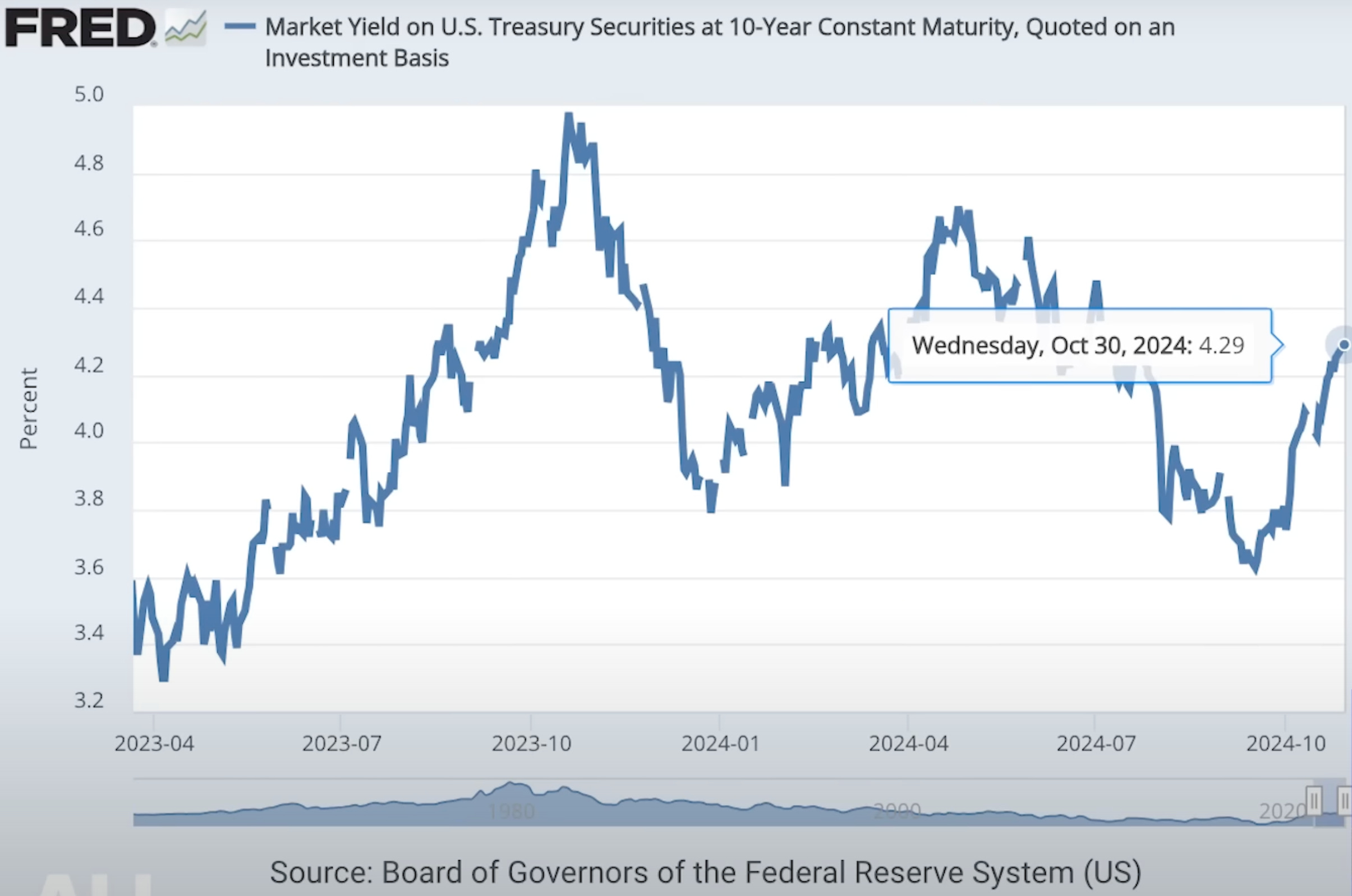
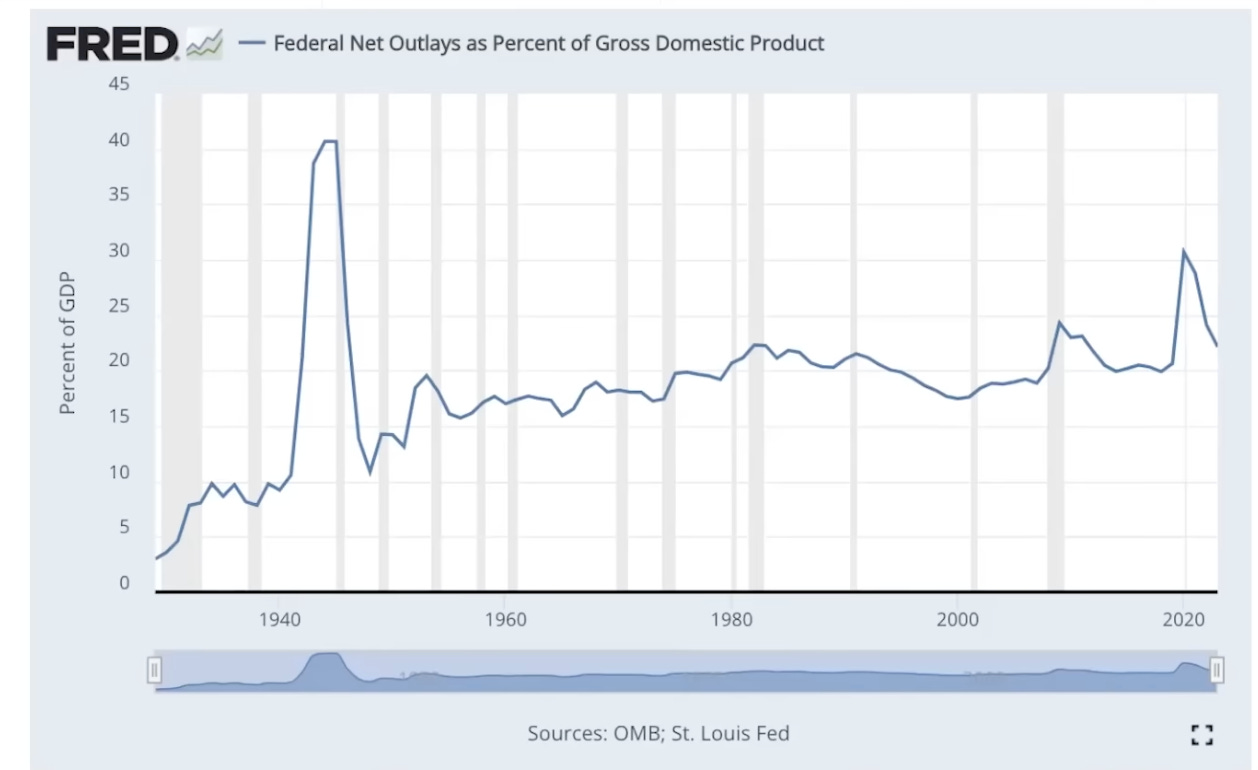
Whoever wins spending will grow — unless something like the Elon/DOGE plan happens. (Obviously Elon could save vast amounts of money. But the legal and civil service resistance will obviously be very strong. And much of the GOP will oppose serious change.)
Unrealised losses in the financial system are huge. Warren Buffett warned Bank of America last year about facing this problem. BoA did not act aggressively enough. Buffett sold. Many banks have huge losses on commercial real estate that are being hidden. As I’ve said before, over coming years these losses will have to be faced. If you walk around NYC you will see many of these buildings with outstanding loans unoccupied (e.g finance people went to Miami during covid and didn’t come back). When these loans are refinanced, interest rates on new debt will be higher and banks will face losses. Many investments will be bust. And there’ll be derivatives built on top of this problem. This is an obvious candidate for the trigger of a new financial meltdown.
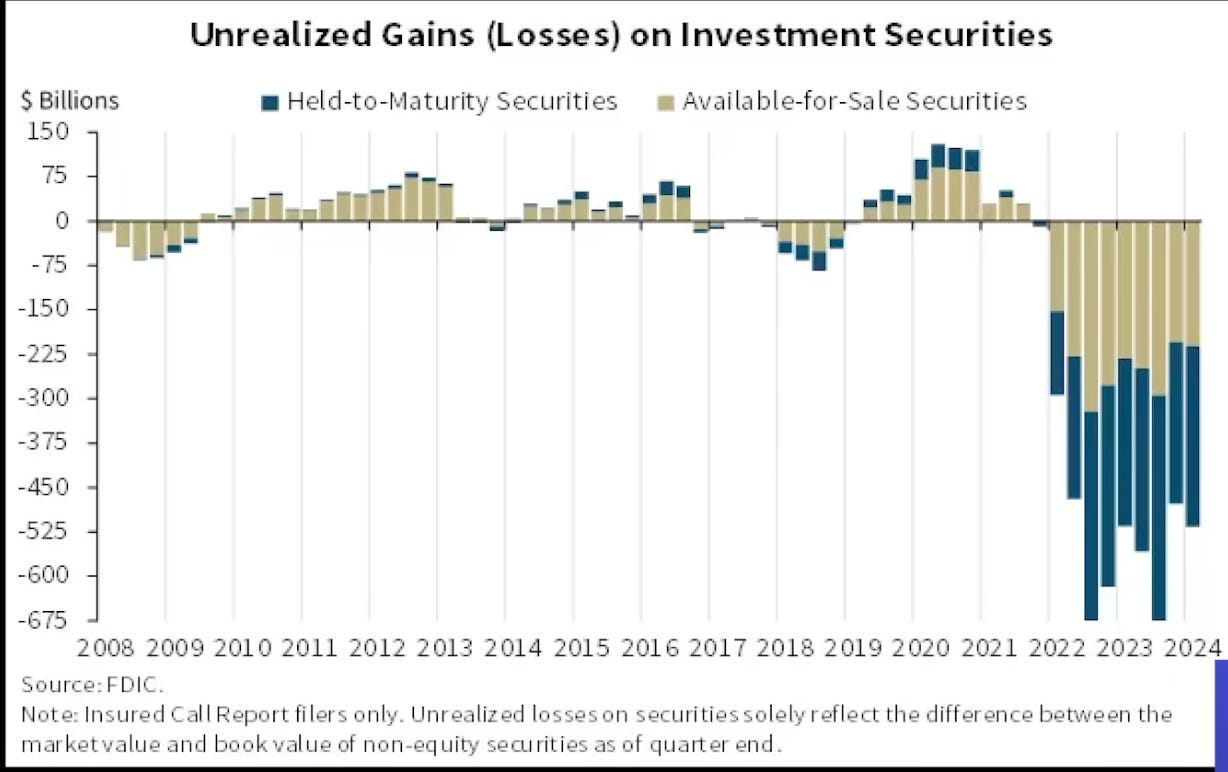
The riots and ‘disinformation’ about the killer of the girls
Follow my twitter for this.
Basic story:
Cops found ricin and Al Qaeda manuals very quickly in his house, informed No10.
No10 knew about this throughout August while pushing the story of ‘nothing to do with Islam, don’t believe Far Right disinformation, Elon is fascist’ etc.
Now the story is: oh we can’t discuss this because there’s a trial, which will take years.
And yesterday the Commons agreed that MPs can’t ask the PM about all this in Parliament ‘because of the court case’.
The script is the same Narrative Whiplash I’ve written about dozens of times.
Although this is particularly blatant it won’t lead to any big change in SW1 where ‘mainstream’ world is happy with government lying about such things and has programmed itself to go along with it. Hence my SW1-NPC meme theme…
UPDATE 3/11:
The Times reports that the terror charges for the Southport nutter were delayed because Whitehall feared that a) the cop would be found guilty in the Kabala case, then b) firearms officers would hand in guns and go on strike, then c) Southport charges would go public causing more riots as people realised Islam was involved and they’d been lied to, and d) there’d be no armed cops able to deal with them.
So we’re at the point where senior officials are having to game out specific scenarios for widespread state failure and violence and interfere in the timing of the justice system to avoid news cascades blowing up on them.
Like the extreme failures of the Treasury and Bank of England in the Truss/Kami-Kwasi meltdown, I predict MPs will ignore this. One of many striking contrasts between SW1 now and ~1800 as described in my blog on the Napoleonic wars is how then Parliament was active in investigating failure and pushing for improvement. Now MPs work, explicitly and implicitly, with officials to keep failure secret and continuing.
Budget
Continuity Osborne/Sunak as you’d expect.
Both parties and Whitehall are happy with the existing Whitehall model:
high tax
high debt
insane regulation
insane procurement
stagnant productivity
anti-entrepreneur
anti-R&D
more money and power for all the things failing with no pretence of reform
vandalisation of critical national capabilities
ignoring all massive developments changing the world, supply chains for chips, data centres, robotics, AI models etc.
There’ll be four more years of it.
‘Mainstream’ media praise it as ‘sensible’.
Both parties and the media spend huge amounts of time arguing about how to ‘restore trust’ in themselves.
They can’t and won’t.
A big part of the core reason is: voters have wanted big changes for a long time but the old system is totally determined to maintain its power and budgets without change.
The American situation is very similar. Pundits were astonished at those who voted for Obama then Trump. But when the Obama campaign researched why, the answer was simple: I voted Trump for the same reason as I voted Obama, I wanted CHANGE and I thought maybe he’d force Washington to do it.
The parties create echo chambers of political analysis to avoid facing this and create complex arguments for midtwits about how ‘the voters don’t understand the complexity’. Wrong. The voters understand. It’s the NPCs who are blind.
Polls and Trump
I did some detailed work on this in Q1 2023 and wrote about it here.
Back then the conventional wisdom in DC and SW1 had reverted to 2016 mode: Trump’s a joke, he’s finished, Biden is doing well.
I published a model we’d done showing Trump beating Biden in the electoral college and explaining Biden’s age was one of the three big issues along with the cost of living (#1) and the border chaos/criminals (#2).
As you’d expect, SW1’s NPCs laughed at the narrative violation. Sam Freedman has reinvented himself as an expert in politics, communication, political strategy and polling and is taken seriously by fellow NPCs on all this — highly amusing for those of us who knew Sam when he was a humble, and much lower status, expert on school funding and admitted he knew nothing about any of this:
His fellow NPCs tweeted furiously at Peston that he shouldn’t be reporting such obvious nonsense.
Now this entire network is tweeting ‘too close to call’ at each other in panic.
I haven’t worked on US electoral data since then. But here’s a few thoughts on the polls as we enter the final days…
A/ Almost all public political polling (and a lot of private polling) comes out into the public as ‘company X’s poll’ but almost all these different companies actually do the polls via a few online ‘panel’ companies (i.e a company that’s built its own panel of people it goes back to repeatedly and pays a pittance to).
B/ The quality of the panel data has WORSENED since 2020 according to specialists who deal with them constantly. The panel business got commoditised and competition has focused on price not quality/accuracy.
C/ In 16 and 20 the polls were very bad on the Trump vote. The polls were better in 18 and 22 but Trump was NOT on ballot. In 2020 the polls missed by MORE than 2016 BUT the predicted result was RIGHT — Biden won though even closer than 2016 — so there was much less attention on the polling failures.
D/ They were bad because, for example, they systematically under-sampled Trump voters among non-college whites. One of the reasons our models were better than the pollsters in the Brexit referendum was that we weighted for education which was not standard then. After the Brexit/Trump shocks of 2016, polling companies shifted to weight by education but still got non-college whites badly wrong in 2020. (In the past, the issue of ‘low trust’ voters not answering polls was less important because they were not very skewed DEM/GOP. This changed from 2016. I.e engagement and partisanship became much more correlated. Cf. David Shor for details.)
E/ The polling industry makes its money NOT from politics. It is not well incentivised to get politics right. And many things have contributed to growing problems (e.g collapse of land lines and response rates).
F/ There are interesting ideas about what to do. E.g in the referendum we ran a football competition with a £50M prize to gather data from people who normally don’t talk to pollsters. This gave us crucial data from people who are very hard to reach — i.e those people that campaigns now most want to reach. There are ideas about weighting according to issues like ‘trust in vaccines’. But I don’t see evidence of normal polling companies doing clever things. It seems reasonable to assume, in the absence of counter-evidence which I can’t see (please post if you think I’m wrong) that the problems of 16/20 have not been solved by an industry a) not well-incentivised to solve this hard, complex and expensive problem which has also b) allowed the quality of panel data to fall.
G/ Campaigns have enough money, brains and access to diverse data that they can do interesting things others can’t (cheaply) and/or aren’t incentivised to do. (Many assume hedge funds spend a lot of time on this but they don’t — they almost all ignore it until quite near the end and don’t invest early in what you’d do if your life depended on being right.) In 2020 the Biden campaign avoided some errors the public polls did not. BUT their private data also pushed them to important bad decisions, e.g thinking Ohio was in play. So the private campaign data was better than public data but still wrong in important ways. Have they solved this? David Plouffe, arguably the best living US campaign director, does not sound confident about it. He’s telling everyone that the EC is 50-50 and the campaign won’t be able to confidently call the crucial 7 states.
H/ These issues are very badly covered by the old political media and supposed ‘experts’. In the UK, our high status pundits are atrocious on these issues. They were rubbish 20 years ago when polling was simpler. They are even more rubbish as polling/models have become a much trickier intellectual/technological problem. And the absence of non-college voters in samples has encouraged them to systematically overrate the popularity of their own Left views and underrate the opposition (in UK and US). As David Shor has tried (and failed) to convey to DEMs, ‘fundamentally swing voters generally don’t share our values’.
Some thoughts.
1/ All the conditions are in place for another significant polling miss.
2/ If the polls are off on Trump vote by the level in 16 or 20 then Trump is (now) winning the electoral college. Even if they’re off by less, he could be winning the EC. And perhaps they’re off by more.
3/ Trump’s vote has also changed, e.g he has more ethnic minorities supporting him in the polls than in 2020. So it is also possible that the polls miss in ways that by chance cancel out, e.g they are wrong on non-college whites again but are also wrong on minorities and by pure luck their overall number isn’t too far out.
4/ Ignore national polls of ~1,000 people. Only look at averages in the critical states and EC models such as Nate Silver’s. (Another signal of how much our pundits have lost their minds is how some of them jabber about how Silver is also now part of the ‘far right ecosystem’. Actual ‘professors of political science’ like Prof Will Jennings repeat such nonsense while also jabbering about the ‘problem of online radicalisation’!)
5/ Polling error is correlated so in such a tight race it also would not be very unlikely if either DT or KH wins all 7 key states. Nate Silver estimates this at ~40%. If this happens, it does NOT mean ‘oh it was NOT close after all’ — it could be very close AND generate this result.
Trump’s chances of winning have been generated by the pathologies of the old system. This system has generated him, like a golem. Now in their terror at the golem they made, they are casting spells, excommunicating people, stabbing voodoo dolls, offering sacrifices. Hitler. Rapist. Epstein. KGB asset… [Epstein is particularly ironic given how many of the old regime are implicated in that.] All their memes of the past 8 years are desperately being re-created and spread by the old media.
It’s also important to remember how irrational campaigns often are. In 2016 the Clinton campaign made the huge error of agreeing with Trump that immigration was a central issue and they handled it similarly to the Remain campaign — we love immigrants, if you don’t you’re racist. They should have tried to redefine the central question of the election. And in 2016 and 2020 there was a clear correlation between the ads most loved by DEM donors and activists objectively helped Trump. Similarly Trump’s best issue is the cost of living crisis and his economic record but if you watch his speeches he hasn’t stressed this (though I think his campaign has tried to in its ads). Campaigning rationally is hard because it causes a lot of internal problems and social costs. After the referendum, the Remain campaign admitted how effective the £350M for the NHS line was but during the referendum all the Tory MPs and donors HATED it and wanted to babble about ‘free trade deals’ despite the data showing how effective 350M was and how voters weren’t interested in trade deals. It’s very plausible that the DEMs have, again, focused on messages like ‘Hitler’ that are loved by donors and young Harvard activists but backfire with voters.
An impartial person looking at all this, and models like Nate Silver’s, without any inside information could reasonably conclude that Trump is a little more than 50% likely to ‘win’. But I stress another factor. American politics is more corrupt and mafia-like than British politics. You can see this in my recent blog on the CIA and its hiring of mafia assassins etc. If you read Theodore White’s Making of the President, the first ever ‘inside the campaign’ book, there’s a great scene on election night where he writes about how the Kennedys awaited results produced by Joe Kennedy’s friend, Mayor Daley. It would not surprise me at all if it turns out that Trump ‘won’ in the normal sense but the Democrats cheat then refuse to leave the White House. Many of the smartest richest people in America are quietly preparing for mayhem.
I don’t have a good sense of what might happen on possible cheating and haven’t been tracking it. There are already stories from election officials busting mass scams in swing states. But does that mean a) officials are on top of the problem or b) the problem is big so officials are bound to catch some of it? And has Trump built a team of serious lawyers and researchers this time?
I will live blog on here on election night and post interesting things I see on the internet or get DMd.
The NPC media herds on ‘Hitler’: unplug yourself from taking this legacy system seriously

The spads, ministers and PM do not understand power in Whitehall and are being subverted by the pathological Cabinet Office
Overheard from No10/Cabinet Office officials: ‘McSweeney and McFadden aren’t idiots but it’s as if they’ve never watched Yes, Minister. They’re extremely naive about power, they don’t understand how the Cabinet Office is manipulating them, they’re suckered by the smiles and nods, and they won’t overrule officials.’
Word has spread quickly and power has slipped away from them.
An example…
In 2020, amid the chaos of the state’s core institutions in and around No10 collapsing, we created a data science and AI team in the PM’s office, known as ‘10ds’. There was an immediate goal of ‘stop the state killing people’ and a longer term goal of ‘provide a critical capability to help all future PMs, and use the team to force wider changes in data across government, therefore make a big improvement in government management and performance’. We brought in top analytical and technical talent, people who could make far more money outside Whitehall.
It made a huge improvement and saved many lives during covid. Officials and spads in the PM’s office, and the PM, had direct access to top technical/analytical talent and vastly improved data and analysis. All over the world people are talking about how to do this — we were far ahead.
But it was deeply disturbing for a lot of senior officials. It upended traditional hierarchies because young smart people, often women, were empowered to say in the Cabinet room ‘sorry that it not correct’ to senior ministers like Hancock and officials like Permanent Secretaries. And it alarmed the Treasury and Cabinet Office which quickly realised that power would quickly shift because the PM’s office would for the first time have better information than them and information is power. It is almost totally unknown in SW1 (outside No10/70WH) just how dismal HMT is on analysis and data. HMT controls information in the old system but new tools and skills subvert that power.
Senior HMT and Cabinet Office officials do not want people in the PM’s office looking at Cabinet Office documents and saying — the data is a joke, there is no actual evidence for X. Or — the Treasury is out of date/wrong on Y. I watched how popular this is many times — e.g in January 2020 when a physics PhD pointed out in the Cabinet room that the ‘evidence’ presented by the Cabinet Office and HMT to the PM’s office on HS2 was obviously mathematically impossible and bogus (the ‘data’ claimed that the entire UK population would be either working on HS2/3/4 or travelling on them).
The Cabinet Office and HMT do not want great people with better information and better tools than them giving the PM honest independent evidence and advice. It is ‘very disruptive’.
So, obviously, the pathological system is destroying 10ds. The Cabinet Secretary and Cat Little have used the change of No10 regime to move it out of the PM’s office, break it up, and merge it into various broken Cabinet Office structures. And they’ve have made clear to talented outsiders that they are not welcome or valued in Whitehall. Message received! The skills will go, tools will atrophy, and the PM’s office will not have independent top quality advice on the information they’re given.
Remember this when the next inevitable big disaster strikes and everyone in SW1 babbles ‘amazing, how could this happen?!’. These repeated disasters could be mainly avoided by improving the people and institutions at the top of power. ‘10ds plus a Red Team in No10’ is a critical part of this. But it’s been deliberately sabotaged. *The system is working as intended.*
There is great naivety in SW1 generally about such things because few know how power really works and almost nobody is interested in and understands either great management or modern data tools. Few Tory ministers were interested and those who were got little traction. The new ministers are similar. And MPs cannot face that the bureaucratic-career incentives of Whitehall push pathologically destructive behaviour.
This is part of a crucial wider story that will play out over the next four years. Labour ministers and spads arrived in office with the same mindset as Cameron and co in 2010 — ‘the civil service is sound, the only problem has been the wrong political team in charge’. Labour will gradually realise this was delusional and that Whitehall is rotten. But by the time many realise they will have wasted most of this Parliament, partly because success in modern government requires making the right big decisions early. And Starmer will never resolve to change the civil service because he is psychologically incapable of facing that it is broken. He will just keep tinkering as his position crumbles. Never forget — he stood by the MET management after the kidnap of Sarah Everard, a decision that sums up his deepest feelings about ‘the system’.
In many ways Britain is now a ‘Nobody-ocracy’ crossed with a ‘Veto-ocracy’. The old political media talk as if ministers are ‘running the country’. Nobody is ‘running the country’. The ministers aren’t ‘running the system’. The system is running the ministers.
On most important things only the PM can actually force change but Starmer — like Sunak, Boris, May, Cameron — exercises almost no power and is generally just another voice adding to noise. He is surrounded by people who can scupper things but can neither insist something happens nor build. So ‘the system’ is a network of hundreds of senior officials incentivised by careers and culture to focus intensely on preserving power and budgets while everything around them fails.
There is one and only one optimistic signal. The new PPS is Nin Pandjit. I worked with her on covid. She is a very able young women who in covid told the truth around the Cabinet table and helped build new NHS data systems when it was very unpopular all over Whitehall. Hopefully she is able to avert some of the inevitable horrors.
Oliver Johnson on the Vaccine Taskforce

He includes useful comments from Bingham and Farrar.
‘Mainstream’ SW1 has refused to discuss these issues. They want to believe a fake story.
It’s not just about their pathological self-deception on Brexit.
It’s also their pathological refusal to engage in how Whitehall really works, the complex interaction of the civil service, primary legislation, judicial review, government ‘legal advice’ and civil service HR. This is a complex interacting system.
Neither MPs nor mainstream media are interested in it.
The only discussions of how the system truly works are among officials and these discussions are not reported. This obviously relates to the section above.
Dario on the radical upsides of AI
Dario is co-founder and CEO of Anthropic, one of the big 3 AI companies. He is one of the handful of people on earth with the best insight into what is happening at the frontier of research.
Here he sketches ‘what a world with powerful AI might look like if everything goes right.’ And he says ‘most people are underestimating just how radical the upside of AI could be, just as I think most people are underestimating how bad the risks could be.’
Dario defines a powerful AI system as, inter alia:
a) ‘smarter than a Nobel Prize winner across most relevant fields’
b) with ‘all the “interfaces” available to a human working virtually’
c) ‘can be given tasks that take hours, days, or weeks to complete, and then goes off and does those tasks autonomously, in the way a smart employee would’
d) ‘can control existing physical tools, robots, or laboratory equipment through a computer’
e) can replicate millions of instances of itself and ‘can absorb information and generate actions at roughly 10x-100x human speed’.
He summarises it as a ‘country of geniuses in a datacenter’.
He says this may come as soon as 2026. He sketches what the next 5-10 years of the world may look like — curing most/all diseases, economic transformation etc.
Self-recommending. I won’t summarise — read it all, it may well deeply affect your life in the next 5-10 years!
I’ll just mention his points on international relations.
… the triumph of liberal democracy and political stability is not guaranteed, perhaps not even likely, and will require great sacrifice and commitment on all of our parts, as it often has in the past…
[D]emocracies need to be able to set the terms by which powerful AI is brought into the world, both to avoid being overpowered by authoritarians and to prevent human rights abuses within authoritarian countries.
My current guess at the best way to do this is via an “entente strategy”26, in which a coalition of democracies seeks to gain a clear advantage (even just a temporary one) on powerful AI by securing its supply chain, scaling quickly, and blocking or delaying adversaries’ access to key resources like chips and semiconductor equipment. This coalition would on one hand use AI to achieve robust military superiority (the stick) while at the same time offering to distribute the benefits of powerful AI (the carrot) to a wider and wider group of countries in exchange for supporting the coalition’s strategy to promote democracy (this would be a bit analogous to “Atoms for Peace”). The coalition would aim to gain the support of more and more of the world, isolating our worst adversaries and eventually putting them in a position where they are better off taking the same bargain as the rest of the world: give up competing with democracies in order to receive all the benefits and not fight a superior foe…
Again, this will be very difficult to achieve, and will in particular require close cooperation between private AI companies and democratic governments, as well as extraordinarily wise decisions about the balance between carrot and stick…
I do have some optimism that given a global environment in which democracies control the most powerful AI, then AI may actually structurally favor democracy everywhere. In particular, in this environment democratic governments can use their superior AI to win the information war: they can counter influence and propaganda operations by autocracies and may even be able to create a globally free information environment by providing channels of information and AI services in a way that autocracies lack the technical ability to block or monitor. It probably isn’t necessary to deliver propaganda, only to counter malicious attacks and unblock the free flow of information. Although not immediate, a level playing field like this stands a good chance of gradually tilting global governance towards democracy…
AI tools could also be used to monitor for violations of fundamental rights in a judicial or police context, making constitutions more self-enforcing…
AI could be used to both aggregate opinions and drive consensus among citizens, resolving conflict, finding common ground, and seeking compromise. Some early ideas in this direction have been undertaken by the computational democracy project, including collaborations with Anthropic…
Dario hopes that the values of the Enlightenment, human rights, individual freedom etc turn out to be somehow favoured by the universe in the way the values of The Culture in Iain Banks’s novels are favoured by the universe.
Those following the debate will see the similarities to Leopold’s essay, Situational Awareness, I referred to here earlier this year.
10 years ago when I wrote about the potential of AI to affect international politics, AI was a relatively tiny field and of no interest at all in mainstream politics. Today those people from a decade ago control companies that a) pose problems for human civilisation going back to fundamental debates in classical Greece, b) are colliding with the core power structures of the modern state such as the CIA, NSA, NRO, FBI etc, and c) challenge the foundations of the international system and war and peace.
I won’t go into my thoughts on Dario’s essay here. I’m glad he published it. I hope that these companies say publicly more about these issues of power and hire people who have thought deeply about previous ruptures in human civilisation, such as the wave of regime change from 1848-1871. And ponder what those in Xi’s security apparatus might think as they pick up red folders with intelligence documents from their desks, like an assessment of Dario’s essay, and flick through them sipping a cocktail looking at the ocean pondering war, peace and revolution in coming years. What does Wang Huning, the most powerful person you’ve probably never heard of, make of Dario’s essay?
Marc Andreessen explains a fascinating story
Someone trained an AI model on memes and communication theory. Marc sent the model 50k in bitcoin. The model created a memecoin, marketed it using its skills, and boosted the memecoin to $300M.
Marc explains this remarkable story.
Highly recommended — it’s often in such weird toylike things that William Gibson futures are revealed.
Casey Handmer: Starship means we can build the exoplanet telescope
Starship can allow greatly reduced space development costs, provided that telescope and instrument designers internalize its capabilities and reallocate resources towards rapid iteration on a production-line style program. This can break the dismal spiraling cycle of programmatic bloat, slipping schedules, and eye-watering costs. JWST represents the pinnacle of what this sort of highly contingent, highly complex, extremely expensive development process can achieve. To progress further, it is time to take another approach…
Assembling colossal mirrors in space sidesteps the gravity and atmosphere problems, so it is time to accept that the scope of our ambition exceeds the scale achievable on the surface of any planet, and use Starship to build transformational observatories in deep space: the Monster Scope has a mirror diameter of 1 kilometer, an unthinkably enormous span of glass enabling us to examine the features of nearby exoplanets with the same detail we can naturally see on the Moon…
The Monster Scope is designed to resolve features on the surface of exoplanets. Thousands of known exoplanets could be directly imaged, their continents, mountain ranges, and river systems studied from many light years away. Seasonal variations in plants and animals, if any, will be visible. Spectroscopic analysis of hundreds of discrete surface features per planet will tell us more about their geology than we knew about even Mars just forty years ago…
Humans have stared into the night sky for ten thousand generations and wondered “are we alone?” “Are there other worlds out there we can live on?” “Can we understand general relativity well enough to enable interstellar travel?” The Starship-enabled Monster Scope may answer these questions within our lifetimes.
Yes, obviously we should build this.
Narrative Whiplash: offshore detention centres are now decent and sensible, not fascism’
The EU has reverse ferreted and is planning offshore deportation camps for asylum seekers.
In 2018, the European Commission ruled that creating “externally located return centres” outside the EU would breach international refugee conventions.
Two years ago the EU home affairs commissioner described Britain’s plans to process asylum claims in Rwanda as “not a humane and dignified migration policy”.
Italy has started sending asylum seekers to Albania for processing.
Meloni told the Italian senate:
It is a new, courageous, unprecedented path, but one that perfectly reflects the European spirit and that has everything it takes to be followed also with other non-EU nations.
This was attacked. Now other countries want to do the same. German and French supported last week an Austro-Dutch proposal demanding a “paradigm shift in the return process” including “sanctions” for migrants who do not co-operate with deportation orders.
Brussels is looking for a deal — countries in the Balkans host the ‘return hubs’ and get their applications for EU membership fast-tracked!
Poland suspended all asylum claims.
Germany said it’s ditching Schengen.
The Netherlands and Hungary have demanded opt-outs from refugee rules.
More failure, more bullshit, more hypocrisy, and another data point for the failure of the EU’s free movement experiment.
Even the most Remainiac cheerleaders for UKR war are throwing in the towel
P O’brien is up with Tim Snyder at the top of the Deluded on UKR Top Trumps. He predicted China would abandon Russia. Every move from UKR was ‘brilliant’, Russia has always been on the brink of collapse. On and on the delusions have gone since the start. Along with constant demands that NATO start attacking Russia directly.
Finally he’s been overwhelmed by pessimism and thrown in the towel.
Europe has failed. It has failed on the level of states, it has failed in the level of supranational institutions such as the EU and arguably NATO. It has been confronted by a challenge that can easily end the post-1990 European vision (and arguably the post-1945 Western European vision) and it has not only not risen to the challenge—its has divided, it has prevaricated, it has to some degree stuck its head so deeply in the sand that the only way it can emerge is if something (US politics) comes by and kicks it so firmly in the ass that it has no option but to try something.
Once people like this throw in the towel you know it’s very bad.
Sadly they won’t learn.
They will argue that if only our Idiocracy had been prepared to run greater risks of nuclear war somehow it could have worked out better.
No.
The Idiocracy is what it is. It is doomed to fail. It is always the same story. You subscribers know I’ve said from the start there were only two outcomes I thought likely — the dismal failure we’re watching or a Cuba style nuclear crisis.
NATO never could define a coherent policy with ends, ways and means.
History shows repeatedly that the worst disasters in war come from a failure at the political level, not the military.
As with Hitler’s political errors (e.g declaring war on America, cf. above), our Idiocracy never could think things through in a coherent and realistic way.
The old media will avoid discussing it. There obviously will be no reckoning for all the ‘experts’ who got it wrong again. They’ll all just move on to the next Current Thing.
Hopefully more people learn not to trust the Idiocracy and the old media. And next time, fewer get memed by the emotions of the media.
Energy train wreck
This piece has new details of our train wreck and plans for pseudo-rationing.
SW1 remains solidly behind the disastrous combination of policies that has led to rising costs and a more fragile supply chain. In SW1, these issues are treated more like Scientology — i.e a cult — than as a rational issue.
If the new Tory leader tries to break ranks they will be denounced as ‘another sign of populism/fascism’.
More Left delusions
Sam Leith suggests that we should not feel national ‘pride’ but instead ‘gratitude:
If we were to see things that way, ego would be removed from the equation. We wouldn’t see historians soberly reevaluating the country’s past, or the National Trust using margarine instead of butter to make scones, as attacks on the core of our identity to which we should respond with rage.
Sam is much smarter than the average MP. But he shares common moral-political programming. The idea that ‘ego’ can ‘be removed from the equation’ and ‘identity’ will cease to be engaged if we can, by some effort of will, shift from ‘pride’ to ‘gratitude’ is … a cartoonish picture of the world. Ego and identity are fundamental to human nature. Our evolved nature makes us care intensely about ourselves, our families, and some sort of in-group the nature of which changes over time.
The longterm Left project to deprogram people from ‘national pride’ is, they think, the preface to some sort of one-world global kumbaya. Wherever people who think like this have taken power the executions and concentration camps have followed sharpish.
I don’t think that it was the metropolitan media elites who kicked off those riots: it looked an awful lot to me like a bunch of drunk blokes waving Union Flags. And it’s the sort of stuff spouted by Mr Jenrick that will tend to encourage them.
Like most in SW1, Sam thinks the ‘real problem’ is any politician breaking ranks with elite consensus. See above on Wren Lewis for some of why I think this is delusional.
Causation is very tricky.
If there is a food riot caused by a food shortage caused by venal corrupt officials, how do we apportion blame and decide on causes?
The courts hold the rioters responsible for violence. But if you’re trying to figure out causes, you also have to say — they rioted because the venal officials caused starvation.
Similarly, the hooligans are responsible for violence. But the causation is more complex — those who have deliberately destroyed border control are deep in the causal structure of these riots and future riots.
I’m sure many clever people like Sam understood the world better aged 25 than after 25 years of programming by their media environment.
Sex differences & academic achievement
This summarises a recent paper.
PODCASTS
All-in latest is interesting on financial markets and inflation expectations. People I’ve talked to in hedge fund land talk about the potential for serious inflation and higher interest rates in coming years.
Dwarkesh on semi-conductor industry.
TSP Update
I told subscribers that Starmer would fail fast and hard. SW1 babbled to itself about Starmer being a ‘serious grownup’, how genius Sue Gray — Heywood’s HR Stasi, totally unfit for the job she was given — would bring serious government back and so on. Remember George Osborne said that Truss was underestimated.
The SW1 system is now more self-reinforcing in its failures and delusions than ever. This will increase whatever happens in America.
But outside SW1 remarkable things are happening. Confidence in the old system has collapsed among Remainers, among business elites, among under 25s (who are very different to Millennials). Everywhere outside SW1, people grasp that Cameron/May/Trolley/Truss/Sunak/Starmer represent the apotheosis of the old system and its rot. Everywhere people are desperate for new ideas and new people — and realise the old system won’t give it to them.
Perhaps the most interesting trend is the 15-25s. SW1’s OODA loops are so broken they can’t grasp the median voter but this problem is much much worse with 15-25s because this age group is almost totally outside traditional media. This group is not trending the way SW1 assumes (i.e more LGBTQH+) but SW1 has no clue about this.
In 2024 voters voted for change again but this time, uniquely in decades, voters voted for ‘change’ but voted having skipped the usual ‘hope’ phase and voted already in the ‘disillusioned’ phase.
And SW1 isn’t disappointing! SW1 is absolutely determined to reject voters’ desires. We won in 2016 promising CHANGE then SW1 drove themselves and the country into a cul-de-sac rather than deliver it. We won in 2019 promising CHANGE then Boris-2021-mode chose more of the same. Sunak promised CHANGE then delivered more of the same. And Starmer is speed running the process. It’s more of the same on all fronts — taxes, debts, regulations, hate for entrepreneurs, letting out criminal savages early to slaughter people, sabotage of border control and national security, give away British territory ‘because lawyers told us to’, promise to discuss handing trillions of British taxpayers cash to countries we freed from slavery, extreme Left lawyers totally in charge, more money for every failing institution with not even a pretence of ‘reform’...
Situation normal. As they face rising hate from voters, SW1 will, like the DEMs in America, increasingly define all opposition as extremist/fascist.
It’s the right time to build and get new people involved in politics to force change.
I’ve been talking to a network of (mostly younger) people about ‘TSP projects’ we can run. We’ve been building. Some subscribers here — YOU! — have already become deeply involved and started building great things.
Over the next fortnight, the new Tory leader and the new US President will be clear (assuming the US election isn’t a chaotic mess dragging on for weeks, which it might be).
Some projects will start going public. We’ll say more about what different people are doing, and how subscribers can get involved as much as they want. It won’t look like a normal political enterprise. One of the projects is Mayor races over the next few years.
And we will start building NOW the best campaign for London Mayor in 2028, audition for candidates, and give the best campaign to the best candidate. Sadiq will have been in power for 12 years, he only beat a joke candidate by ~10 points, and crime will be an even bigger issue. We will crush him with a good Independent candidate— or his replacement if he flees.
If you are very keen to help, please consider a Mayor race that you care about 2025-8. Shortly we’ll open a network to talk to people about these, prioritise projects, and get cracking.
I think by next summer we have a good chance of having a mass movement bigger than both old parties combined. By then both old parties will be in the toilet. The media is propping Labour up but the LGBTQH+ (H for Hamas/Hezbollah) vs Blairites splits can only deepen.
It’s taken longer than I wanted for reasons that’ll become clear but a critical mass is developing. More soon…
The S&P 500 has dramatically outperformed MSCI Europe over the last decade (CAGR of 13.4 versus 5.7 pct), in large part due to the success of US Big Tech.
For Europe/UK to be competitive, it must embrace risk taking and entrepreneurship. Last Friday we toured Station F, the largest startup campus in the world, located in Paris. Everything to build a successful business is under one (very large) roof. Unicorns have emerged from its concrete walls. Station F shows what is possible, but unless the concept scales across the continent it will be very difficult for European equities to ever outperform US stocks.
Station F IS the world’s largest startup campus, located in Paris. Our host was Marwan Elfitesse, head of startup programs and business services. He gave us an hour of his time and a fresh perspective on one of the most important issues in global capital markets.
#1: To set the stage for why Station F is important to global equity investors, we need to take a step back and show that innovation is a key driver of stock returns.
The S&P 500 has dramatically outperformed MSCI Europe over the last 10 years (13.4 vs. 5.7 percent compounded annual total return), led by companies that were on average founded 64 years after the most valuable public companies in Europe.
That, in a nutshell, is the power of innovation. The “downside” is that disruptive technology combined with global scale tends to capture a lot of market cap.
Hence, the largest 6 names in the S&P 500 are now 30 percent of the index. MSCI Europe does not have the same concentration risk (just 13 pct to the top 6 stocks) because its largest weightings have compounded far slower than the S&P’s comparable names (12.6 versus 33.5 percent).
#2: The only long-term remedy for European stock markets is to create an ecosystem that develops entrepreneurship at scale, and that’s where Station F comes into the story.
The challenge goes far beyond just pairing founders with capital and hoping for the best. Europe has a well-earned reputation for risk aversion to the point of ostracizing those who try their best but still fail. The region needs places where startups have both moral support as well as access to intellectual and financial capital and other resources necessary for long-term success.
Before we get into Station F’s process, a few background points:
It was founded by French billionaire Xavier Niel, who bought an old unused train depot called la Halle Freysinet (hence the Station F moniker) in 2013 and converted it to its present use with €250 million of his own capital. His goals were to give startups a place to work, of course, but also to include other stakeholders like large companies and educational institutions as well as giving all segments of society access to Station F’s resources.
After 4 years of building renovations and hiring key staff, in 2017 Station F opened its doors. The physical space is divided into 3 parts: a public/private area in front available to select companies before they are accepted as well as third party resources, a private section in the middle with office and resource space, and a highly regarded public restaurant at the back. We saw all three areas.
In 2022, a chatbot-turned AI company named Hugging Face became Station F’s first unicorn. In the same year, Station F startups raised a record €1 billion.
In 2023, Station F startups also raised €1 billion, 15 percent of all the capital raised by French startups last year.
As for how it all works:
Startups apply to join a “Founders Program”, which are led by a wide variety of companies, institutions, schools, and Station F itself. The admission rate runs between 6 – 9 percent. Once accepted, there are 3 months of intensive programming catering to early-stage needs followed by up to 15 months of additional support to build the business.
Commercial program partners range from consumer products (LVMH, L’Oréal), to Tech (Microsoft, Meta), advertising (Havas), fintech (BNP Paribas, Binance), and alternative energy (Total). There are also educational institutions involved, such as EDHEC Paris (for alumni) and INSEAD. Ecosystem partners include pre-idea/pre-team (Entrepreneur First) and specific areas of interest like quantum computing (Le Lab Quantique). The split between corporate, university, and ecosystem programs is a third each. A complete list of program partners is available in the link at the end of this section.
Station F adds new program partners every year to stay at the forefront of evolving technologies and offer sponsorship variety to its startups.
Hundreds of prominent global venture capital firms have relationships with Station F, including legendary names like Andreessen Horowitz, Sequoia, and Accel.
To help startups navigate French government services and regulatory structures, Station F hosts officials onsite.
Some commercial partners have mentorship offices rather than sponsor programs. The list here includes Amazon Web Services, Apple, and Google Cloud. If a startup needs help getting on an app store or using cloud service, assistance is just a few steps away.
In addition to providing services, Station F also invests directly in select startups at the seed level.
There is also an offering called the “Fighters Program”, which seeks to attract and develop entrepreneurial talent from marginalized parts of society. Station F offers their services for free to this cohort, which includes an intensive course of business development, master classes, and ultimately a chance for inclusion in the mainstream program and potential investment.
Like many early-stage venture firms such as Y Combinator, Station F has demo days, where its best companies pitch to VCs. The next event is in November.
#3: Our take on what we saw and heard, in 3 points:
First: Station F is unique in its holistic approach to spurring entrepreneurship in France because it must be. In many ways, they are starting from scratch to build interest, excitement, social, and commercial support for startup founders and their nascent companies. Essentially, Station F wants to make risk taking “cool”. They are also very consciously trying to avoid the pitfalls of American VC culture, which sometimes values “breaking things” almost as much as “moving fast”. Skirting government regulations to build a business is often considered acceptable in US VC circles, but it would not be welcomed in France or continental Europe.
Second: The building is huge and houses a vast array of resources, a good reminder of the complexity inherent in building a successful disruptive tech company. There’s a lot of survivor bias in the origin stories of businesses like Apple, Google, and Facebook. Each had a clever and disruptive core offering, making it seem like success was inevitable. It wasn’t. No one builds a great company alone.
Third: We see Station F’s success as a proof of concept, not an end point sufficient to move the needle between the French/European startup ecosystem and that of the United States. Venture capitalists have a concept called “minimum viable product” (MVP). It is the bare bones of an offering that proves the soundness of an idea because it garners initial success. Station F is a fantastic MVP.
To have a real impact, however, there must be more Station Fs – many more – all across Europe. The continent is not short on intellectual capital. It lacks exactly what we saw on our tour last week: physical spaces where startups are celebrated and supported with all the resources necessary to have a fighting chance at success.
The Station F model can be replicated, but it requires a lot of financial and intellectual capital. The most straightforward answer would be for a publicly held version of Station F, funded initially by private investors and then through IPO and follow-on deal proceeds. The base cash flow would come from operations, with upside from venture capital investments.
Takeaway: Station F is a glimpse into what is possible in UK/Europe. When investors allocate long term capital to the S&P 500, they are not just buying today’s companies but the promise of new (and better) ones in the future. A US large cap index investor 10 years ago would likely have laughed if told that a bunch of tech nerds would end up delivering much of their returns over the last decade. European equities have lagged over this period in large part because the region had few comparable situations. The next 10 years may be a lost cause for the continent’s equity markets, but the next 20 – 50 years will come down to whether the region can embrace and build on Station F’s remarkable success.
By the way Samo Burja of the Bismarck Brief was on the...Manifold podcast was it recently? He described the UK as talent-producing under-developed country. He said, to summarise, that we are poor, unsafe, overtaxed, have terrible social problems and yet still produce Oxbridge dons who might be tempted to the US or elsewhere where they'd instantly quadruple their salary. This is not something the UK should take as a compliment.